How to Clean a Hand-Knotted Rug Properly: Step by Step
TL;DR: Proper cleaning of a handmade rug begins with regular, gentle care such as vacuuming without a brush attachment. You should dab stains immediately with lukewarm water and a cloth. For a deep clean, professional hand washing every few years is essential to protect the fibers and preserve the colors. Avoid harsh chemicals and household cleaners.
A handmade rug is more than just a floor covering; it is a piece of craftsmanship that tells stories and brings warmth into your home. Proper care is essential so that this heirloom retains its beauty across generations. As a family that has been working with these special pieces in the sixth generation since 1952, we have learned what a rug truly needs. In this guide, I, Amin, share our collected knowledge with you.
The Basics: Regular Care for a Long Rug Life
Basic care for your handmade rug consists of two simple steps: regular vacuuming and occasional rotating. Vacuum your rug once or twice a week using a flat nozzle to remove loose dirt. Rotating it every six months ensures even wear and prevents one side from fading or wearing out faster.
The longevity of a handmade rug lies in its robust structure and natural materials. Your job is to support these qualities with a consistent yet gentle routine.
1. Vacuuming properly: The vacuum cleaner is your most important helper, but only with the right attachment. Always use a flat upholstery or hard-floor nozzle. Rotating brushes are the natural enemy of hand-knotted wool. They tear at the fibers, pull out knots and can permanently ruin the structure. Always vacuum in the direction of the pile; you can feel it with your hand, as the pile feels smoother in one direction. Once or twice a week is completely sufficient to remove dust and surface dirt before it can settle deep into the fibers. Particular caution is needed with the fringes: never vacuum them directly. Instead, smooth them out by hand or use your appliance's lowest suction setting to clean them gently.
2. Regular rotating: Your rug lives with you and your everyday life. This means that some areas are walked on more than others and sunlight often hits only one side. To prevent uneven wear and fading colors, you should rotate your rug 180 degrees every six months. This ensures it is worn evenly and retains its harmonious overall appearance. For robust nomadic rugs, this is a simple way to maximize their lifespan.
If a rug sits in the exact same spot in front of a south-facing window for years, one corner will become noticeably lighter and its pile shorter than the rest. Simply rotating it costs nothing and is the most effective safeguard against uneven wear.
First Aid for Stains: What to Do with Red Wine, Coffee and Co.?
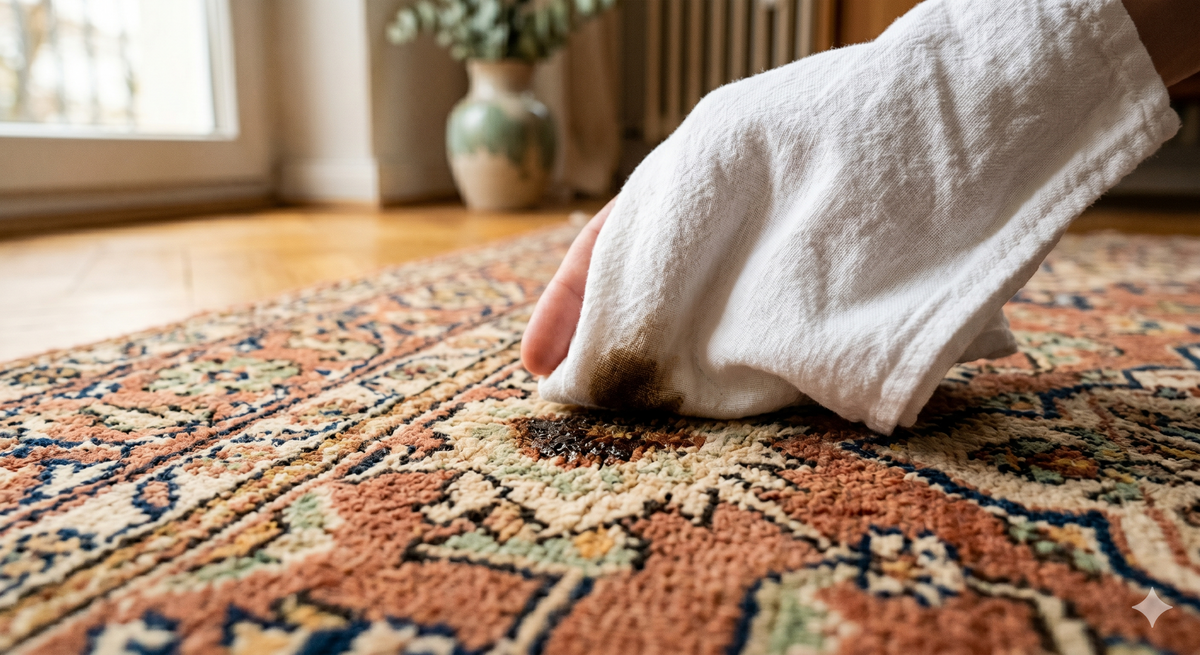
When dealing with a stain, quick action is crucial. Immediately blot liquids with a clean, absorbent cloth from the outside inward; never rub! For most stains, lukewarm water is sufficient. Gently lift solid debris with the back of a spoon. Avoid soap or chemical cleaners, as they can attack the wool's natural oils and colors.
A knocked-over glass of red wine or a spilled cup of coffee, it happens. Do not panic! Thanks to natural wool grease (lanolin), virgin wool in handmade rugs has an amazing self-cleaning power and is naturally stain-resistant. If you act quickly and properly, most mishaps will leave no trace.
The most important rule is: Blot, do not rub! Rubbing only works the dirt deeper into the fibers and makes the stain larger. Take a clean, dry and undyed cloth (paper towels or a white cotton cloth) and gently blot the liquid. Always work your way from the outside in so you do not spread the stain.
In 90% of cases, lukewarm water without additives is enough for follow-up treatment. Dampen a clean cloth and continue blotting the stain. Repeat the process with a dry cloth to absorb any remaining moisture. For solid substances such as food scraps, carefully lift them off with the back of a spoon or butter knife before you begin blotting.
| Stain type | Immediate action | What you should avoid |
|---|---|---|
| Red wine, coffee, tea | Blot immediately with a dry cloth. Then dab with a damp cloth (lukewarm water). | Salt (can bleach colors), hot water, aggressive rubbing. |
| Grease, oil, chocolate | Carefully scrape off solid residues. Dab with a cloth soaked in lukewarm water and a little gall soap. | Cleaners containing solvents or bleach, too much water. |
| Mud, dirt | First let it dry completely. Then gently brush off coarse dirt and vacuum the rest. | Rubbing wet mud, which only works it deeper into the fibers. |
| Wax | Place blotting paper on the stain and iron briefly over it with a lukewarm iron (lowest setting). The paper will absorb the wax. | Iron that is too hot (burns the wool), direct contact of the iron with the pile. |
Most stains can be treated this way. You can also find more information in our detailed care guide.
Deep Cleaning at Home: Is It Possible, and If So, How?
A full wet wash at home is not recommended for hand-knotted wool rugs, as the risk of color bleeding and fiber damage is too high. However, gentle surface cleaning is possible: with a special wool detergent and a damp sponge, you can carefully dab the pile. Afterwards, the rug must dry completely flat and in the open air.
Many people ask us whether they can wash their rug themselves. Our answer is usually a cautious 'yes and no'. A proper, soaking wash, such as we carry out professionally, is hardly possible to do safely at home. The risks are simply too high: colors, especially on pieces with what Abrash means in rugs, can run into each other. The cotton warp can warp, leading to waviness. And most critically: the rug rarely dries quickly and evenly enough, which can lead to musty odors and mold.
What you can do, however, is give the surface a gentle refresh. To do this, mix a pH-neutral, lipid-replenishing wool shampoo with lukewarm water. Dip a soft sponge into it, squeeze it out very well and gently wipe across the pile in the direction of the nap. The goal is simply to lightly clean the top layer, not to soak the rug. Then wipe down with a clean cloth moistened only with water.
Amin Ipektchi, Co-Founder: "Not all water is the same. At home, you lack the ability to dry the rug in a controlled and uniform way. This often leads to ripples or, even worse, a musty odor you can never get rid of. Professional rug cleaning workshops therefore work with specialized drying rooms and constant air circulation to prevent exactly that. That is a step you cannot replicate at home."
A traditional and safe method is cleaning with snow in winter. Lay the rug pile down in dry, clean powder snow for about half an hour. The snow binds dust and odors. Afterwards, you can beat the rug and simply sweep off the remaining snow. This is an excellent method for eliminating odors, but it does not replace a deep clean. For particularly resilient pieces such as our robust Kelim pieces, this can be a great annual refresh.
Professional Rug Washing: When Is It Necessary and What Happens?

Professional hand washing is recommended every three to five years to remove deep-seated dirt and care for the fibers. Unlike dry cleaning, the rug is washed here with plenty of water and moisturizing, organic soaps. This preserves the wool's natural lanolin and refreshes the colors without harming them.
Even with the best care, fine dust and dirt accumulate deep within the weave over the years, which a vacuum cleaner cannot reach. That is why we recommend a professional hand wash every 3 to 5 years, or even more frequently for high-traffic areas or light-colored rugs.
Be sure to choose a cleaning service that offers traditional hand washing with organic, lipid-replenishing soaps. Dry cleaning strips the wool of its vital lanolin, leaving it brittle and prone to dirt.
A professional hand wash, as performed by the partner workshops of our washing and repair service, works like this: 1. Dust removal: First, loose, deep-seated sand and dust are removed from the rug by gentle beating. 2. Washing: The rug is spread out on a flat surface and rinsed thoroughly with plenty of cold, clear water. It is then washed with a pH-neutral, organic soap and soft brushes in the direction of the nap. 3. Rinsing: Using a squeegee, the soap is pressed out of the pile along with the loosened dirt. This process is repeated until the water runs completely clear. 4. Drying: The rug is laid flat or hung up to dry in specialized, well-ventilated drying rooms with a constant temperature. Direct sunlight or heat from radiators is strictly forbidden.
Dieser process not only refreshes the colors and deep-cleans the fibers, but also preserves the wool's natural protective layer.
Absolute No-Gos: These Mistakes Will Ruin Your Rug
Certain cleaning methods can irreparably damage your handmade rug. These include the use of steam cleaners, washing machines or aggressive chemical cleaners like bleach. Drying in direct sunlight or on a radiator also leads to brittle fibers and faded colors. Always be gentle with your unique piece.
Sometimes with good intentions, you can do more harm than good. Here is a quick list of things you should definitely avoid with your handmade rug:
- Washing machine: Never, truly never put a handmade rug in the washing machine. The mechanical stress destroys the knot structure and deforms the warp.
- Steam cleaner: The combination of high temperature and moisture is poison for wool fibers. The lanolin is destroyed, colors can run, and the wool felts.
- Harsh cleaners: Household cleaners, bleach or aerosol carpet foam are far too aggressive. They attack color pigments and strip the wool of its natural oils.
- Hanging wet: A soaked wool rug is extremely heavy. If you hang it up, the warp will distort under its own weight and the rug will lose its shape.
- Direct heat for drying: Never place your rug on a radiator, in blazing sunshine or try to dry it with a hair dryer. The fibers will become brittle and colors will fade.
Always be gentle with your rug. It is a robust piece of craftsmanship, but it appreciates careful handling. If you follow these simple rules, you will enjoy it for a lifetime. Discover our unique handmade rugs and see their durability for yourself.
FAQ
How often should I have my handmade rug cleaned? For a professional deep clean, we recommend an interval of three to five years. However, this depends heavily on usage. A rug in the hallway or dining room might need washing every two years, whereas a rug in a rarely used guest room can easily go seven years without one. Light-colored rugs and households with children or pets also require shorter intervals.
Can I clean a wool rug with a steam cleaner? No, definitely not. Steam cleaners work with hot pressurized steam. This heat can permanently damage the sensitive protein molecules in the wool fiber, resulting in felting and color loss. In addition, moisture can cause the cotton warp to swell and deform the rug. Steer clear of steam cleaners!
What is the difference between standard and organic rug washing? In organic hand washing, only pH-neutral, biodegradable soaps are used. These are lipid-replenishing, meaning they preserve the fibers' natural lanolin (wool grease). This protects the rug from getting dirty again quickly. In contrast, conventional dry cleaning often uses solvents that strip the lanolin, leaving fibers dry and brittle.
How do I get bad odors out of my rug? Regular airing in fresh, dry air often works wonders. To do this, place the rug in a shaded spot for a few hours. In winter, traditional snow cleaning is very effective. As a home remedy, you can also sprinkle a thin layer of baking soda or specialized rug powder, let it sit for a few hours, and then vacuum it thoroughly using a flat nozzle.
My rug has fringes. What is the best way to clean them? Vacuums with rotating brushes are off-limits for fringes, as they can get tangled and tear out the threads. It is best to comb out the fringes by hand using a soft brush or gently vacuum them with an upholstery nozzle without brush bristles. Always work away from the rug to avoid putting strain on the knots.
Does salt really help with a red wine stain? We advise against this home remedy. While salt does draw out liquid, it can also attack the rug's color pigments and cause unsightly, bleached spots. Furthermore, the salt crystals can roughen the wool fibers. The safest and most effective method remains immediate blotting with an absorbent cloth and clean, lukewarm water.
Caring for a handmade rug may seem demanding at first glance, but with these tips, it quickly becomes an easy routine. If your rug needs professional care or you are looking for a new, durable one-of-a-kind piece, you have come to the right place. Feel free to browse our collection of handmade rugs.