What is Abrash in a Rug? Explaining Natural Colour Variations
TL;DR: Abrash refers to subtle color variations in the pile of hand-knotted rugs, occurring because hand-spun yarn turns out slightly different from batch to batch. It is not a flaw, but a mark of authenticity of traditional weaving art. You can recognize it by horizontal color gradients across the pile surface, especially in red, blue, and natural tones.
If part of a rug appears half a shade lighter than the rest, many people initially suspect damage. In fact, this is Abrash, an authentic hallmark of hand-spun wool and a clear indicator of genuine craftsmanship. This very shift in tone makes the rug more valuable than a perfectly uniform piece.
This article clears up the misconception. You will learn what Abrash technically is, why it occurs, how you can distinguish genuine Abrash from dyeing flaws, and how you can use it as a design element. A natural part of traditional weaving art, not a flaw in the material.
What Abrash means exactly
Abrash describes the natural color variations in hand-knotted rugs that result from yarn that is hand-spun and naturally dyed in small batches. Each dye batch absorbs the pigment slightly differently. During weaving, yarn skeins are switched, and the transition becomes visible in the pile.
The term originates from Arabic and means "dappled" or "spotted". In rug scholarship today, it is used almost exclusively for controlled, tradition-related color variation, not for genuine discolorations.
In a typical Gashgai Gabbeh, this looks like this: a weaver ties about 1,000 knots per hour. For a piece with 200,000 knots/m², she therefore needs a solid 200 hours just for the knotting work. During this time, she works through several dyeings of the same shade. When the old batch runs out, the new one arrives; the transition is visible.
Why Abrash occurs: three technical reasons
Three factors work together: hand-spun yarn is not uniformly thick, natural dyes have batch variations, and different wool qualities absorb pigments differently. Industrially dyed machine yarn avoids this, but loses all character and any visible trace of the weaver who knotted the piece. Exactly these traces account for its value.
1. Hand-spinning creates fiber variations. Wool spun with a drop spindle or on a spinning wheel has minute variations in thickness. Thicker sections absorb more dye, thinner ones less. Two meters of yarn thus yield two color nuances, both correct, both different.
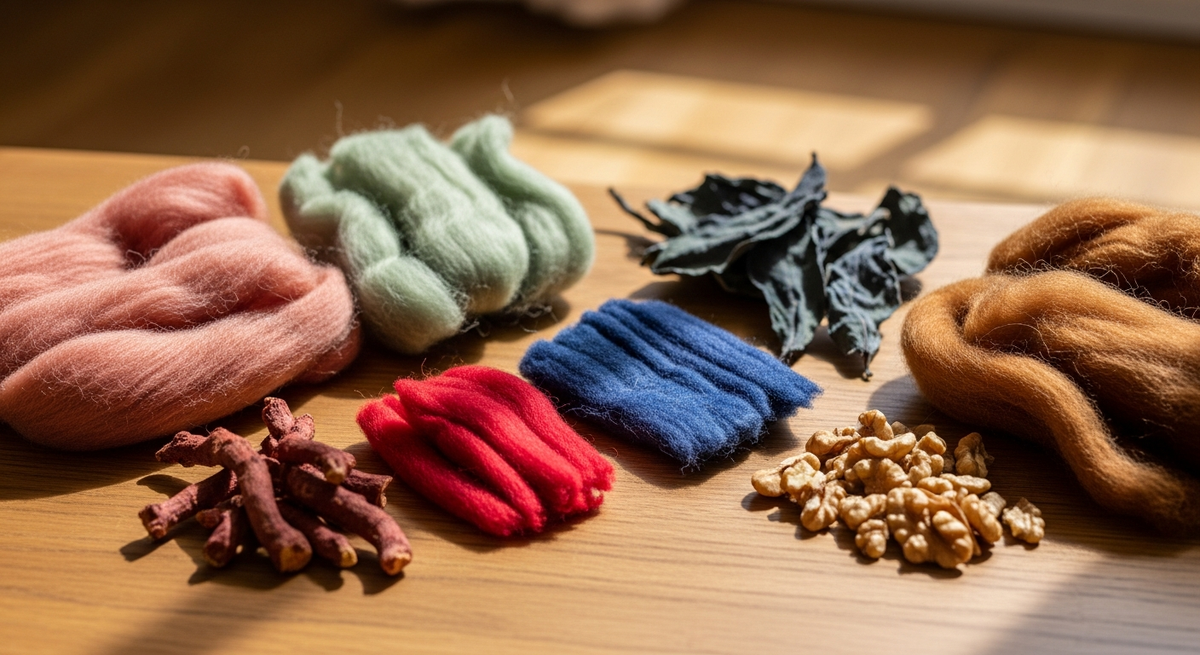
2. Natural dyeing is living chemistry. Madder red (from Rubia tinctorum), indigo, pomegranate peel, walnut, these vegetable dyes react to temperature, water hardness, and contact time. A dye bath in April turns out differently than one in October, even with an identical recipe.
3. Not all mountain wool is the same. Wool from sheep at 2,500 meters has a higher lanolin content than wool from 1,800 meters. The fat content influences how deeply the pigment penetrates. In hand-knotted pieces from the Zagros region, this is precisely part of the identity.
How to recognize genuine Abrash
Genuine Abrash shows a soft, horizontal color transition across the entire knotting width, an authentic quality hallmark of hand-spun wool. It runs parallel to the knotting direction because it arises when switching yarn batches. In contrast, discolorations or damages are spotty, irregular, and do not follow the weaving direction; the difference is immediately recognizable with a little practice.
Genuine Abrash has three characteristics by which you can reliably identify it:
| Feature | Genuine Abrash | Discoloration / defect |
|---|---|---|
| Progression | Horizontal across the entire pile width | Spotty, irregular |
| Edges | Soft transition across several rows | Hard line, sharp break |
| Background color | Both shades feel "right" | One area looks dirty or bleached |
A practical tip: run your hand across the direction of the pile. Genuine Abrash remains visible, while a superficial discoloration changes.
When Abrash is particularly valuable
In certain rug categories, Abrash is not only accepted, but a central stylistic feature: in Gabbeh and Loribaft, in vintage and overdyed pieces, in tribal Berbers, as well as in collector rugs. Here, distinct Abrash immediately signals hand-dyeing, hand-spinning, and thus traditional weaving art to the trained eye.
There are four style categories in which Abrash is not only accepted, but actively sought after:
- Gabbeh and Loribaft, the nomadic pieces of the Gashgai and Lori thrive on color idiosyncrasy. A modern Gabbeh without Abrash looks almost sterile.
- Vintage and overdyed rugs, here the patina is the selling point. The vintage selection in our range clearly shows this.
- Tribal Berbers, Beni Ourain and especially Boucherouite show color shifts that are part of their character.
- Collector pieces, at auctions, rugs with pronounced Abrash fetch higher prices because their authenticity is immediately legible.
If Abrash bothers you: three options
If you prefer as uniform an appearance as possible, especially in minimalist living styles, there are three legitimate ways without giving up the character of a hand-knotted rug: choosing the right pile direction when laying it out, finely knotted city rugs from Nain or Isfahan, and the AR visualizer for previewing in your own room.
Some buyers prefer as uniform an appearance as possible, especially in minimalist living styles. There are three legitimate ways:
1. Pay attention to pile direction. Abrash looks more dramatic from one direction than from the other, a typical characteristic of hand-knotted wool. When arranging furniture, you can position the rug so that the lighting softens the gradient without losing the natural depth.
2. Choose city rugs. Pieces from Nain or Isfahan have a much finer knotting at 400,000+ knots/m². Yarn changes are less visible here; the industry of high precision existed in Persian cities as early as 100 years ago.
3. See it in your room before buying. Our AR visualizer projects any rug to scale into your living room via smartphone before you decide. To do this, open a rug from our collection and tap "View in your room" on the product page.
How we handle Abrash at Rugtales
We document Abrash transparently: for every piece with clearly visible color variation, we take a detailed close-up of the transition area and display it on the product page. You see what to expect before buying and can make a conscious choice for the character of natural handcraft.
For pieces with pronounced Abrash, we explicitly document the gradient in the product photos, main photo plus a detailed close-up of the transition area. That way, you know exactly what you are getting when you buy, without any guesswork.
Our care instructions are especially strict for naturally dyed rugs: no aggressive cleaners, no direct UV exposure over years, otherwise the colors can level out, which in turn diminishes their character.
Frequently Asked Questions
Does Abrash disappear over time? No, Abrash is inherent in the pile itself and remains visible for its entire lifespan, easily 50 to 80 years with proper care. What can fade: the intensity, if UV light bleaches the colors evenly. Therefore, avoid direct sunlight over years.
Is Abrash possible in machine-made rugs? Technically, no. Machine yarn is dyed industrially; a single batch covers thousands of kilometers of yarn with an identical tint. Machine-"simulated" Abrash is immediately obvious: it repeats in a pattern repeat every 30 or 60 cm. Genuine Abrash has no repeating pattern.
Does Abrash make a rug more valuable? For hand-knotted pieces: yes, indirectly. A clearly visible Abrash signals hand-dyeing with natural pigments and hand-spinning, both indicators of the top quality tier. Auction prices reflect this, especially for collector pieces.
Should I expect Abrash in a vintage rug? Almost always. Vintage rugs are generally between 25 and 80 years old and produced almost exclusively with hand-spun, naturally dyed yarn. If you see a supposedly old rug without any Abrash, a second authenticity check is worthwhile.
How do I distinguish Abrash from a water stain? Abrash runs horizontally across the entire knotting width and follows the row of knots. Water stains are circular or show run marks, often with a tide mark. If you are unsure, send us a photo at hello@rugtales.com, and we will take a look free of charge.
Can Abrash become more pronounced during cleaning? With overly aggressive cleaning, the colors can "bleed" uncontrollably and create new variations, but that is damage, not character. Therefore, only have your rug cleaned by specialized companies that work with organic, pH-neutral methods; our cleaning and repair service connects you with such partners whom we have worked with for decades.
Now you know: Abrash is not a defect, but a seal of authenticity. If you are unsure whether a piece in your selection features Abrash, the Gabbeh selection and vintage rugs are the most common categories. When testing in your room, the AR visualizer helps you. And if you are still unsure: give us a call or write to us, we are here to help.