What is a Sofreh Rug?
TL;DR: A Sofreh is a small, handwoven Persian flatweave, traditionally made by nomadic tribes. It serves both as a practical cloth for meals on the floor and as a ceremonial cloth for important occasions such as weddings or the New Year celebration. Each piece tells its own story through its symbols.
 TL;DR: A Sofreh is a small, handwoven Persian flatweave, traditionally made by nomadic tribes. It serves both as a practical cloth for meals on the floor and as a ceremonial cloth for important occasions such as weddings or the New Year celebration. Each piece tells its own story through its symbols.
The Soul of Persia on the Floor: What Exactly Is a Sofreh?
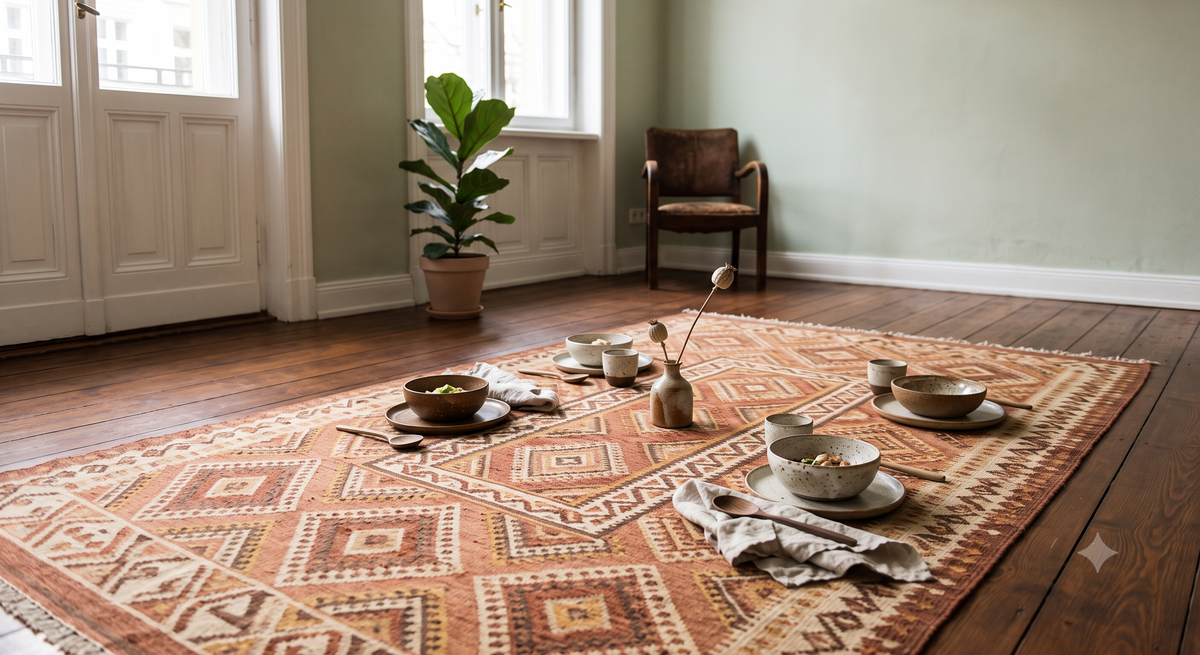
A Sofreh is a multifunctional, flatwoven textile from Persian tribal areas, mostly crafted in Kelim technique. Unlike a pure floor rug, its primary function was to serve as a clean base for bread and food. Its nomadic roots are reflected in robust materials and portable formats.
A Sofreh is more than just a small rug; it is a piece of living culture. Imagine a cloth crafted by the hands of a weaver from a nomadic tribe across the vast expanses of the Persian highlands. Its primary purpose was never to decorate an entire room, but to create a very specific, sacred space: the place where the family gathers to break bread. The Persian word 'Sofreh' literally means 'tablecloth' or 'spread', which describes its function perfectly. It is a cloth that transforms the floor into a table.
In contrast to high-pile Gabbeh rugs or fine city rugs, Sofreh are almost always flatwoven, similar to the technique of a Kelim. This weaving technique makes them lightweight, flexible, and resilient; ideal qualities for a life shaped by mobility. They were not conceived as stationary interior furnishings, but as practical companions that could easily be rolled up and transported to the next campsite. This functionality is the key to their design and their soul.
More Than Just Patterns: The Symbolism of Sofreh Designs
The patterns of a Sofreh are far more than decoration; they are a visual language of the weavers. Geometric shapes, stylized animals, and plant motifs carry deeply rooted meanings. They symbolize protection from the evil eye, fertility, prosperity, and connection to nature, passed down from generation to generation.
Every knot and every choice of color on a Sofreh tells a story. The weavers, mostly women of the Gashgai, Lori, or Bakhtiari tribes, wove their hopes, wishes, and faith into the textiles. This visual language was passed down from mothers to daughters and is a living archive of nomadic culture. The designs are often abstract and geometric, but behind every line lies a deeper meaning.
A common motif is the diamond, which is often interpreted as a protective symbol against the evil eye. Stylized birds can stand as messengers of good news, while the Tree of Life symbolizes the connection between heaven, earth, and the underworld, standing for eternal life and fertility. The colors, traditionally extracted from plants and minerals, also have their own language. A deep red from madder root stands for life and joy, while indigo blue represents the sky and eternity. Learn more about the significance of characteristic color variations, known as Abrash, which give these pieces their vibrancy.
| Symbol | Common Representation | Meaning |
|---|---|---|
| Diamond / Lozenge | Single or in chains | Protection against the evil eye, eye of vigilance |
| Tree of Life | Stylized tree with roots & branches | Connection between heaven & earth, fertility, eternal life |
| Bird | Geometric, abstract bird shape | Happiness, good news, the soul |
| S-Hook / Running Dog | Hook-shaped, repeating patterns | Protection, warding off danger and evil spirits |
| Comb | Geometric, comb-like symbol | Purity, cleanliness, preparation for marriage |
These symbols were not accidental decoration, but active prayers and blessings woven into daily life.
From Dining Table to Wedding: The Traditional Role of the Sofreh
Traditionally, the Sofreh is the centerpiece of social life. As 'Sofreh-ye Nan' (bread cloth), it serves as a clean base for daily meals. However, its most important role is as 'Sofreh-ye Aghd' at wedding ceremonies and as a spread for the New Year festival Nowruz, richly laden with symbolic items for the bridal couple.
Perhaps the most beautiful and significant role the Sofreh plays is in the Persian wedding ceremony, the 'Aghd'. Here, a special, often particularly elaborate or heirloom Sofreh, the 'Sofreh-ye Aghd', is spread out before the bridal couple. It is laid out with a variety of symbolic items, each representing a wish for the couple's shared future: a mirror for the light of the future, candles for warmth and energy, sweet pastries for a sweet life, nuts and eggs for fertility, and a sacred book as a blessing. The couple sits before this spread and exchanges their vows.
In daily nomadic life, the 'Sofreh-ye Nan' (bread cloth) was an indispensable companion. Fresh flatbread was kneaded, baked, and served on it. It created a clean, defined space on the tent floor and was a sign of hospitality. A Sofreh also plays a central role during the Persian New Year festival 'Nowruz', known as 'Haft-Sin', on which seven symbolic items starting with the letter 'S' are arranged.
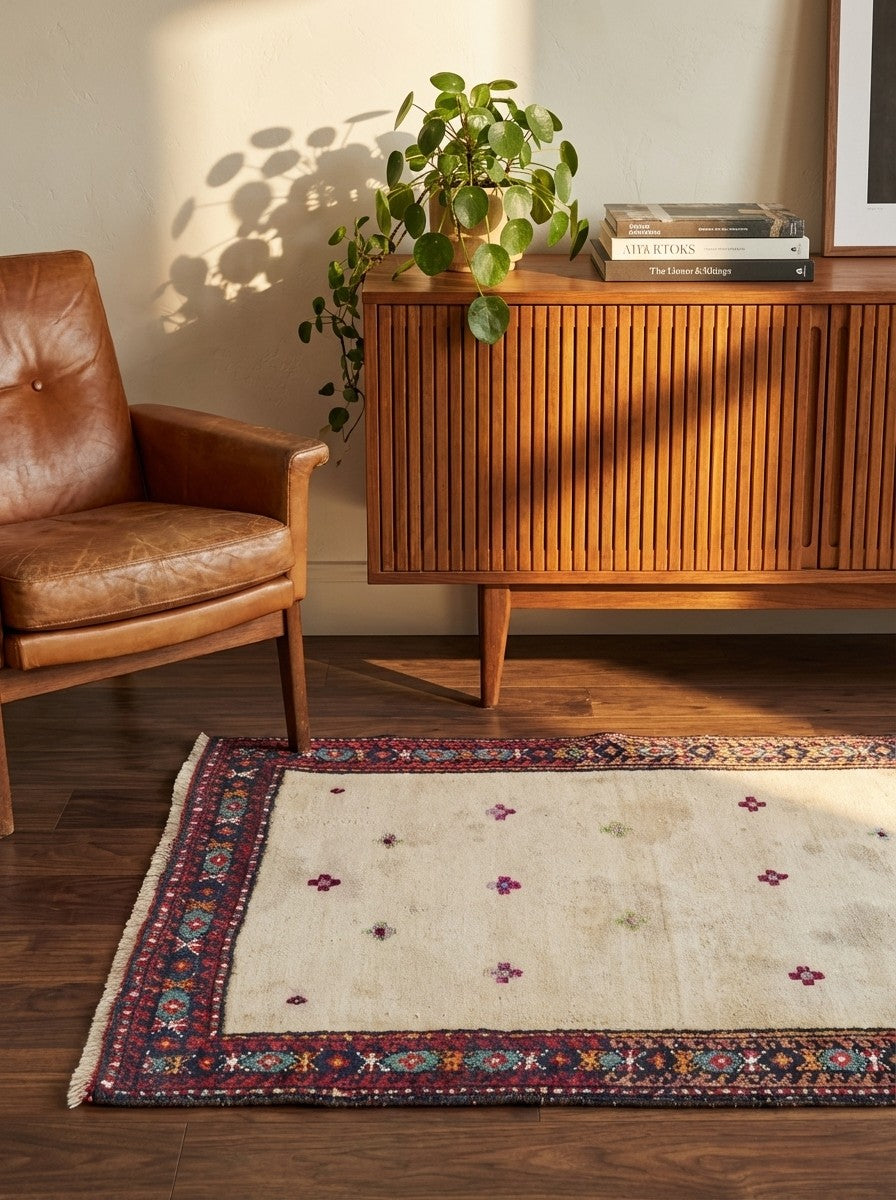
An older, unadorned Sofreh carries this dual meaning visibly within its weave: gentle patina in the centre reveals that it served as a dining spread for decades. Such a piece is far from empty; it is already rich with life, making it a wonderful wedding gift. You can find a curated selection in our nomadic rug collection.
Handwoven Stories: Materials and Craftsmanship
Sofreh are crafted on simple horizontal looms, typical of nomadic rugs. The primary material used is robust sheep's wool, often on a cotton warp. Dyeing is traditionally done with vegetable and mineral substances, producing the characteristic color variations, known as Abrash, as a hallmark of authenticity.
Crafting a Sofreh is an intimate, artisan process. In contrast to the large, vertical looms used for fine city rugs, nomadic women weave on horizontal looms. These looms are essentially just two beams secured to the ground. They are portable and can easily move with the camp. The weaver often sits directly on the already finished section of the weave, creating a very special connection to the piece.
The primary material is the resilient wool of mountain sheep from the Persian highlands, which is rich in lanolin (wool grease) and makes the Sofreh naturally dirt and water repellent. The warp threads, the invisible skeleton of the weave, are usually made of sturdy cotton or also wool. Each Sofreh is a one-of-a-kind original, shaped by the hands, mood, and creative vision of its maker. Slight irregularities in shape or pattern are not flaws, but a seal of authenticity and human craftsmanship.
Over our more than 70-year company history, which began in 1952, we have learned: from the smallest Sofreh to the largest palace rug, the story of a piece is only preserved for the next generation with proper care. You can read how to do this on our page about rug care.
A Piece of Nomadic History for Your Home: Sofreh Modernly Interpreted
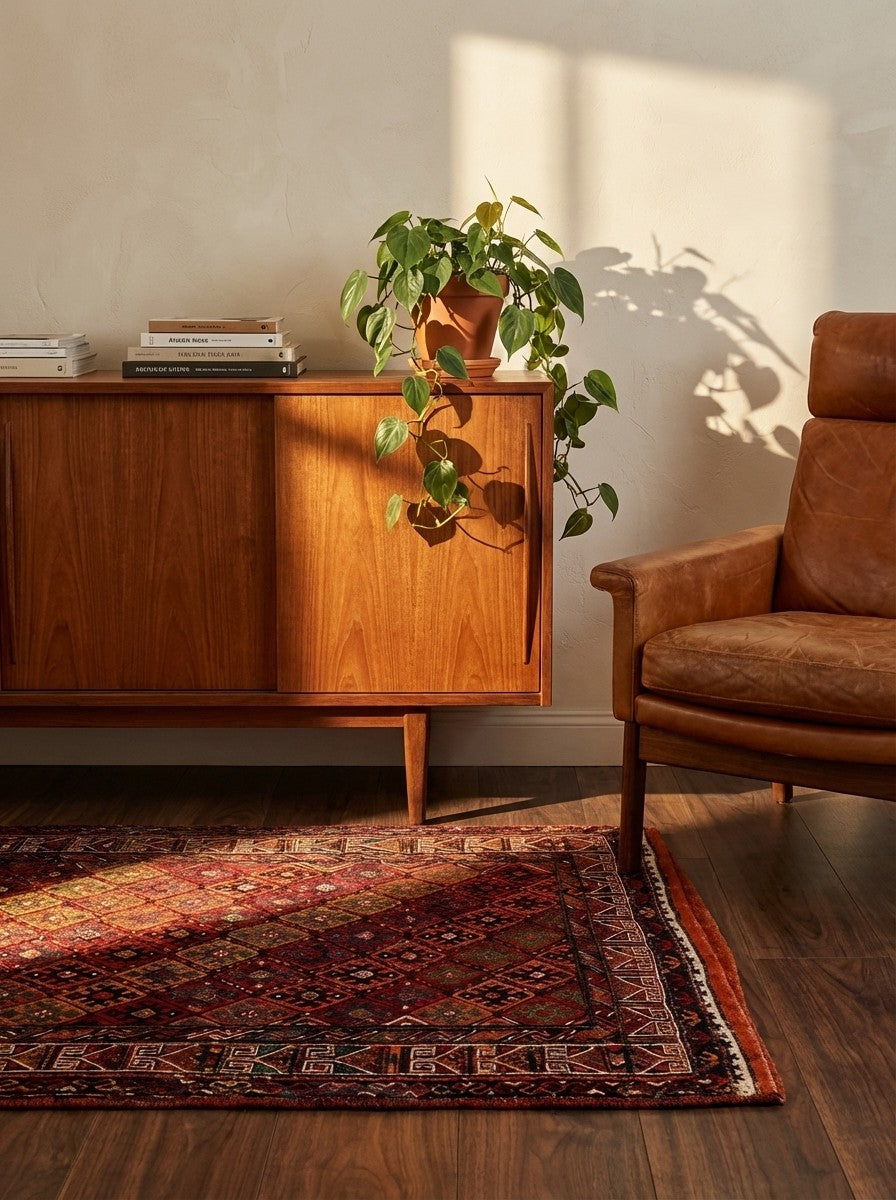
In modern living, a Sofreh is an incredibly versatile piece. Use it as an expressive wall hanging, as a colorful runner on a sideboard or dresser, as a decorative throw for a bench, or as a small accent rug in a reading nook. Its history and craftsmanship instantly make it a focal point of conversation.
While the traditional function of a Sofreh may no longer take center stage in a modern European home, its beauty and versatility make it a fascinating interior design element. Its small size and light weight open up countless decorating possibilities that extend far beyond the floor.
- As a wall hanging: The intricate patterns and vibrant colors of a Sofreh look especially stunning on a wall. Hang it like a piece of art to instantly give a room warmth, texture, and a captivating story.
- As a table or furniture runner: Place a Sofreh over a sideboard, dresser, or dining table. It protects the surface and adds a layer of color and craftsmanship that no industrially manufactured textile can match.
- As an accent rug: In a cozy reading nook, in front of an armchair, or in an entryway, a Sofreh can define an area and give it character. Its robustness makes it well suited for everyday life.
- As a decorative throw: Drape it over the foot of a bed or over the back of a simple wooden bench to create a touch of color and nomadic charm.
Combining an authentic tribal Sofreh with a minimalist or modern interior style creates an exciting contrast and demonstrates your appreciation for authentic craftsmanship.
FAQ
Is a Sofreh the same as a Kelim? Not quite. A Sofreh is often woven in Kelim technique, meaning it is a flatweave without pile. However, the term 'Kelim' describes the weaving technique, whereas 'Sofreh' describes the specific function and typically smaller, square format of a ceremonial or dining cloth. You could say that many Sofreh are Kelims, but not every Kelim is a Sofreh.
How do I clean a Sofreh rug? For everyday care, gentle shaking out or vacuuming on the lowest setting without an extended brush is sufficient. For light stains, dab the area immediately with a clean, slightly damp cloth and a little wool detergent, never rub. For thorough cleaning, we always recommend professional, organic rug washing to protect the natural fibers and dyes.
How do I recognize an authentic handwoven Sofreh? An authentic Sofreh reveals itself through its small, charming irregularities. Look for subtle variations in the pattern, edges that are not perfectly straight, and natural color variations (Abrash). The material should feel like real wool, not synthetic. The weave structure is firm and dense, yet flexible and not stiff.
Can you walk on a Sofreh? Yes, absolutely. They are woven from durable wool and made for daily use. However, due to their typically smaller size and high decorative value, in modern homes they are often placed in low-traffic areas or displayed as art on walls or furniture to showcase them effectively.
What size is a typical Sofreh? Sofreh are typically small and often square rather than rectangular. Measurements often range from about 80x80 cm to 120x100 cm. This size was practical because it was intended for a small group of people sitting around the cloth on the floor to share a meal, or as a base for ceremonial items.
Every Sofreh is a window into a rich culture and a tribute to the artistry of nomadic weavers. When you bring a piece with so much history into your home, you acquire more than just decoration; you become part of its narrative. Discover the variety of handwoven pieces from nomadic traditions and find the Sofreh whose story speaks to you. With our AR visualizer on the website, you can even use your smartphone to try out how it looks on your wall or in your favorite corner.