Article: Rug Sizes Explained: Common Dimensions and the Right Fit for Every Room
Rug Sizes Explained: Common Dimensions and the Right Fit for Every Room
TL;DR: Common rug sizes range from 40 × 60cm (16 × 24in) to 300 × 400cm (118 × 157in), alongside runners, round and square formats. There's no fixed industry standard, dimensions vary by roughly ten centimetres between manufacturers. What matters isn't the catalogue number but your room: measure your furniture first, then choose your size.
What rug sizes are available?
Common formats fall into four classes: small from 40 × 60cm (16 × 24in) to 90 × 160cm (35 × 63in), medium from 120 × 170cm (47 × 67in) to 160 × 230cm (63 × 91in), large from 170 × 240cm (67 × 94in) to 250 × 350cm (98 × 138in), and extra-large from 300 × 400cm (118 × 157in) upwards. The table below shows where each size works best.
Most size guides list dimensions and leave it there, without saying what they're actually for. So here's both together, with the column that actually matters when you're buying.
| Size class | Dimensions (cm / in) | Fits in |
|---|---|---|
| Small | 40×60 (16×24in), 60×90 (24×35in), 70×140 (28×55in), 80×150 (31×59in), 90×160 (35×63in) | Entrance hall, cloakroom, in front of a chest of drawers, as a bedside rug on one side of the bed |
| Medium | 120×170 (47×67in), 120×180 (47×71in), 140×200 (55×79in), 160×230 (63×91in) | A small Victorian terrace sitting room up to 15m², a seating corner, sofas up to 200cm wide, or the foot of a bed |
| Large | 170×240 (67×94in), 200×290 (79×114in), 200×300 (79×118in), 240×340 (94×134in), 250×350 (98×138in) | A full seating group (ideal for bay-window sitting rooms), a dining table for four to six, a double bed with generous overhang |
| Extra-large | 300×400 (118×157in), 300×450 (118×177in), 350×450 (138×177in) | Open-plan living-dining areas, dining tables for eight or more, long period-property rooms |
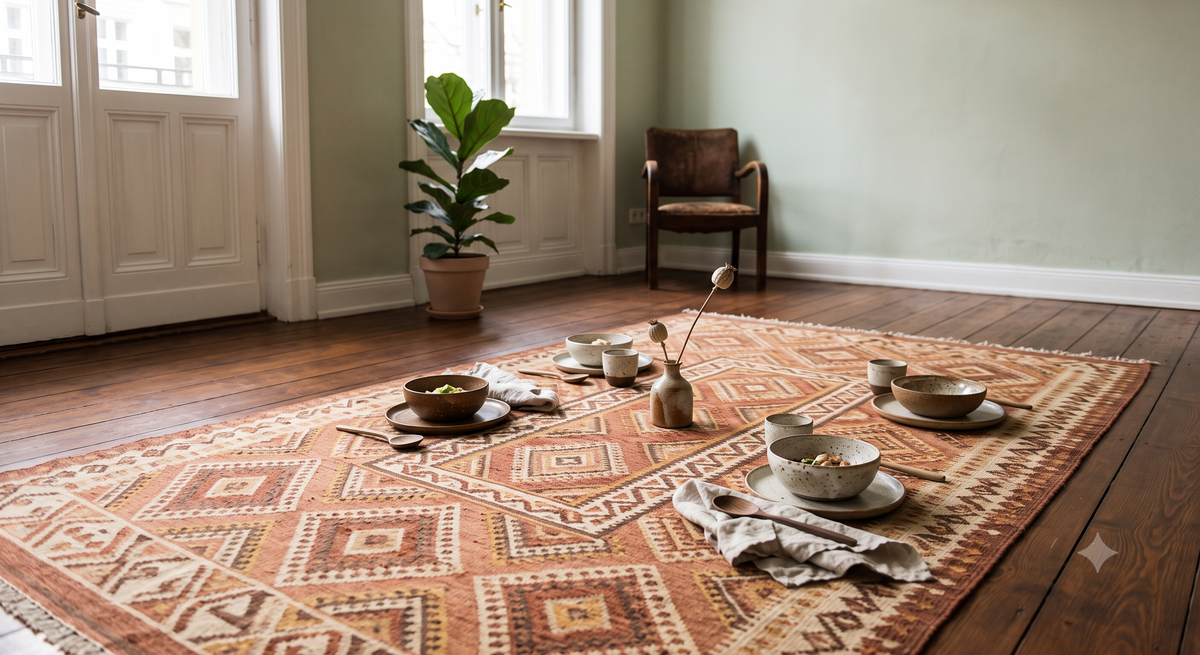
This four-way split is standard across the trade, and it's a useful first filter. The small class, incidentally, is where you'll find the pieces people love picking up and handling: a Sofreh, for instance, a small Persian flatweave originally used as a cloth for shared meals on the floor, and nowadays more often found in an entrance hall or in front of a chest of drawers. Rugtales is a family business from Hamburg, trading hand-made rugs since 1952, now in its sixth generation, and one thing never changes: every rug is one-off, made once and never repeated. If you find a size you like, it won't come back in three other colours. So it's worth settling on your size class first, then hunting for the right format within it.
Are there standard rug sizes?
No. There's no fixed rug standard: dimensions vary by country, region and manufacturer by around ten centimetres, some collections list 200 × 290cm, others 200 × 300cm. For hand-made rugs, a trade-standard tolerance of plus or minus five per cent also applies and counts as within contract. So build in some margin.
Common sizes differ from country to country, and from manufacturer to manufacturer, often by around ten centimetres (roughly 4in) in length or width. With hand-made pieces, there's a second layer to this: Germany's BVDM panel of experts has established that a tolerance of plus or minus five per cent on hand-made rugs is within contract, not a defect. In one documented case, a hand-knotted rug was ordered to a target size of 2.50 × 4.50 metres; the piece measured 2.43 to 2.46 metres in width and 4.48 metres in length, and this was ruled standard trade practice and reasonable.
When we unroll a large piece and run the tape measure over it, this is exactly what you'll find in practice: the wool has settled unevenly, and one edge pulls a finger's width tighter than the other. In practical terms, that means never calculating down to the last centimetre. If you're fitting a rug into an alcove or between two door frames, allow five centimetres (2in) of buffer. And if you need a millimetre-precise size, you need a bespoke rug, not an organically hand-made one. That's not a flaw, it's simply the nature of the material.
Why do hand-knotted rugs come in odd sizes like 137 × 207cm?
Because they're knotted to traditional formats, not off-the-shelf sizes. The Persian unit of length Sar measures around 105cm (41in); a Dozar, made up of two Sar, comes to roughly 130 to 140 × 200 to 210cm (51 to 55 × 79 to 83in). On top of that, every piece grows on the loom and varies by one to three centimetres.
Behind these seemingly odd numbers lies a system of its own. Sar is a Persian unit of length measuring around 105 centimetres, do means two, and that's how the format name Dozar came about.
| Format | Dimensions (approx.) | Origin of the name |
|---|---|---|
| Poschti | 40 × 60cm (16 × 24in) | Cushion format |
| Zaronim / Saronim | 150cm (59in) length | One and a half Sar |
| Dozar / Sedjadeh | 130–140 × 200–210cm (51–55 × 79–83in) | Two Sar |
| Kenareh | 80–120 × 250–600cm (31–47 × 98–236in) | kenār, "side" |
| Ghali | 190 × 280cm (75 × 110in) | "Main rug" for the centre of the room |
| Pardeh | 140 × 240cm (55 × 94in) | Curtain/hanging format |
These formats aren't folklore, they're room logic. Traditional Persian living spaces tended to be long and narrow, because long ceiling beams were only available in limited lengths; the formats used there differ from the sizes later produced for export. And because a rug is built row by row by hand, often over four to six months, small irregularities in shape and symmetry are completely normal. That includes the gentle colour shifts in the pile known as Abrash: these come from hand-spun yarn and are a sign of genuine handwork. Perfectly right-angled pieces with completely even colour tend to point to machine production instead; you can read more on that in our article Spotting a genuine hand-knotted rug. Once you understand that, you start thinking from the room outwards, not from the catalogue number.
Which rug size suits which room?
For a dining table, allow 60 to 75cm (24 to 30in) of overhang all round, so chairs pushed back stay fully on the rug. In the sitting room, the rug should be 20 to 60cm (8 to 24in) wider than the sofa; in the bedroom, 40 to 90cm (16 to 35in) beyond each side of the bed; in the hallway, 70 to 90cm (28 to 35in) wide.
Our four rules of thumb, short and without number-juggling:
- Dining table: big enough that every chair stays fully on the rug when someone sits down.
- Sofa: flush with the edge, or reaching slightly under the front feet.
- Coffee table: always sits fully on the rug.
- Hallway: room to breathe, at least a hand's width from the wall, ideally one to two.
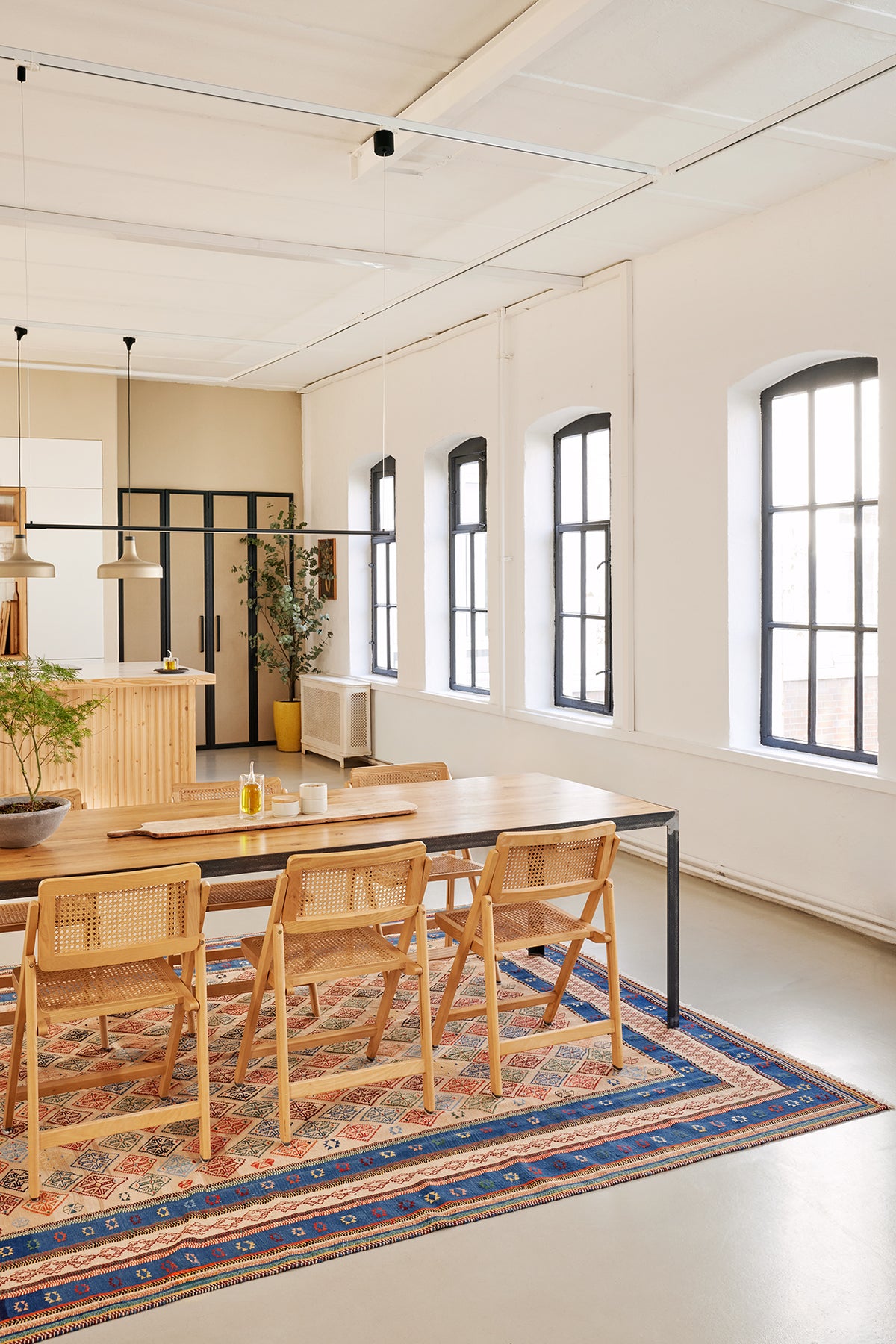
Dining tables, with the numbers. Chairs move back roughly 50 to 60cm (20 to 24in) when someone sits down or gets up; if the rug extends at least 60cm beyond the table on every side, all four legs stay safely on it. A table of 90 × 180cm therefore needs 300 × 210cm, which in practice means the 200 × 300 format. The reason recommendations wobble between 60, 70 and 75 centimetres is simple: 60cm is the minimum to keep chair legs on the rug, while 70 to 75cm gives extra legroom when standing up. What matters most is the material underfoot. A flat-woven Kelim, a pile-free flatweave, lets chairs glide almost silently, so the tighter figure is fine. A thick Gabbeh, with its deep, lanolin-rich pile spun from mountain wool, feels wonderfully soft underfoot but drags audibly against a chair, so go for the more generous measurement there. And with an extending table, measure it fully extended, otherwise half your guests end up sitting beside the rug rather than on it. For more detail, see Rug size for the dining room.
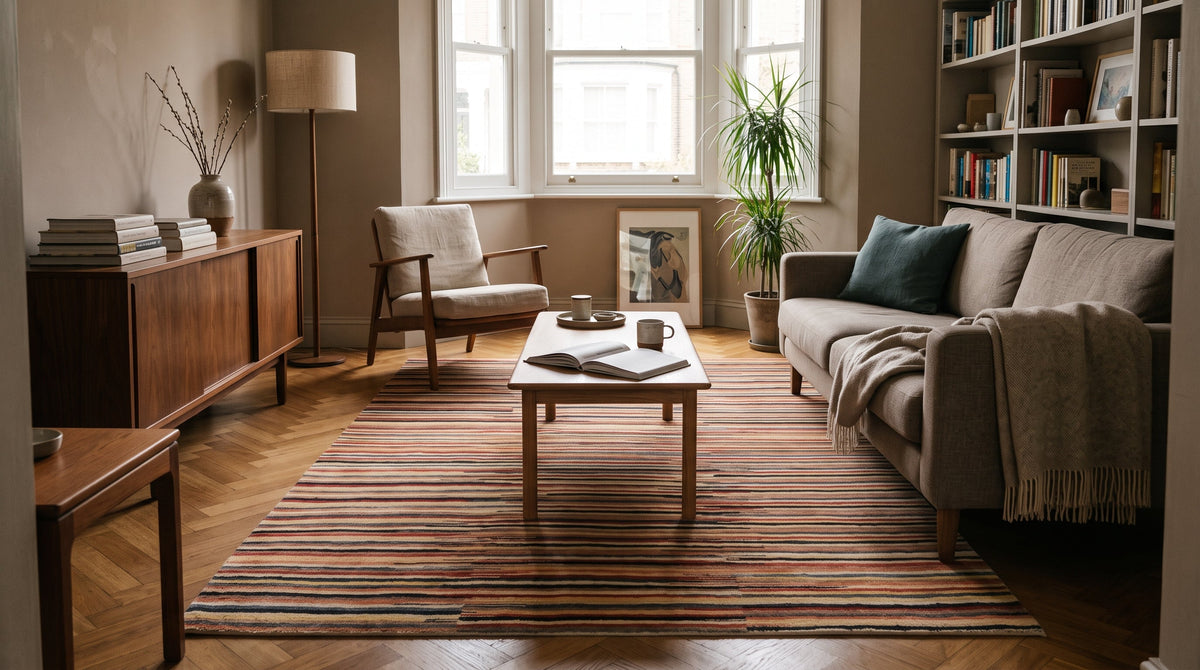
Sitting room. Option A, every piece of furniture fully on the rug: room length minus 60cm × room width minus 60cm, leaving around 30cm from the walls. Option B, just the front sofa feet: sofa width plus 60cm, with around 200cm of depth. As a house rule, I plan for 40 to 60cm (16 to 24in) more length than the sofa; the formats that come out of this most often are 160 × 230, 200 × 290 and 240 × 340. In an open-plan room, the rug becomes an interior island, pulling together furniture that would otherwise sit unrelated. More on this here: Rug size for the sitting room, in detail.
Bedroom. For a double bed measuring 180 × 200cm, plan for 40 to 90cm (16 to 35in) of overhang on each side, which lands you at 240 × 340. If you have less floor space, lay two runners either side of the bed, or a format laid widthways at the foot end; more on this at Rug size for the bedroom.
Hallway. Length equals room length minus 30 to 40cm (12 to 16in), width 70 to 90cm (28 to 35in). Check door swing, radiator recesses and passage width beforehand. In a narrow period-property hallway, a runner can bridge two zones without narrowing the walkway.
Runners, round or square: which format works when?
Runners come in widths of 70 to 90cm (28 to 35in) and lengths of 150 to 400cm (59 to 157in), ideal for hallways, galley kitchens and bedsides. Round rugs range from 80 to 300cm (31 to 118in) in diameter and work well under round tables. Squares from 100 × 100cm to 250 × 250cm (39 × 39in to 98 × 98in) suit compact rooms with roughly equal depth and width.
| Shape | Common sizes (cm) | Typical use |
|---|---|---|
| Runner | 80×150 (31×59in), 80×200 (31×79in), 80×240 (31×94in), 80×300 (31×118in), 80×400 (31×157in) | Hallway, galley kitchen, bedside |
| Round | Ø 80, 100, 120, 140, 160, 180, 200, 250, 300cm (31, 39, 47, 55, 63, 71, 79, 98, 118in) | Round dining table (Ø 200–250cm), irregularly shaped rooms |
| Square | 100×100 (39×39in), 130×130 (51×51in), 150×150 (59×59in), 160×160 (63×63in), 200×200 (79×79in), 250×250 (98×98in) | Square rooms, bay windows, corner-positioned sofas |
80 × 150cm has become the standard runner size, with 80 × 300cm the classic choice for a typical hallway; in square formats, 200 × 200cm and 250 × 250cm sell best. What's interesting is that the runner isn't a modern invention at all, it follows the same Kenareh logic once laid along the long side of the main rug. It works exactly the same way today, when a large format sits in the sitting room and a runner takes over the passage. The two then sit in a kind of visual dialogue: one rug gets to speak, the other should listen. Browse runners in every length or square rugs.
How do I measure my room for a rug?
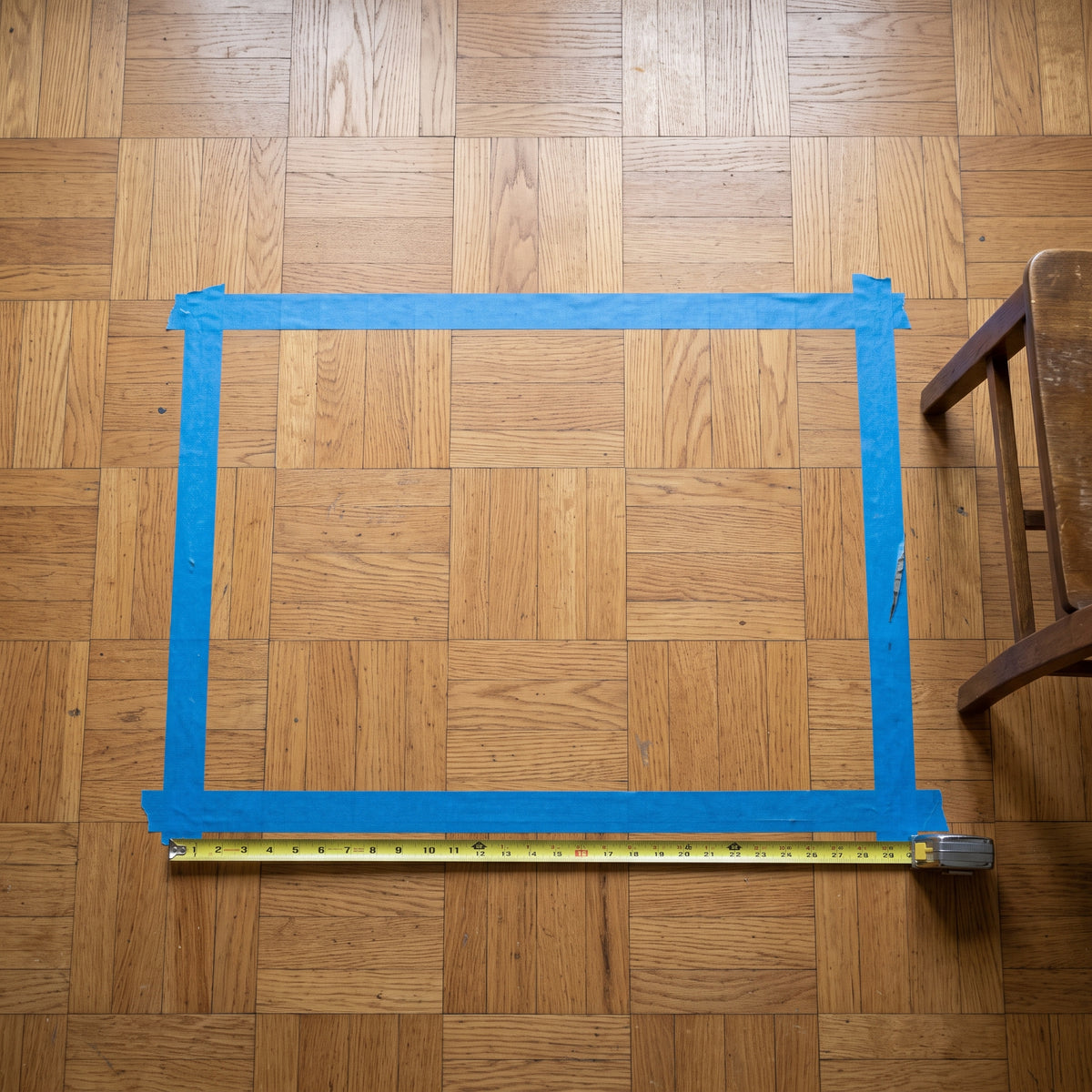
Mark out the size you're considering on the floor with masking tape, put your furniture in place as a trial run, and sit down for a moment. Check door swing, radiator recesses and passage width. Then use our AR visualiser to place any rug in your room at true 1:1 scale before you decide.
Five steps that genuinely help: measure the room. Tape off the area, it's the most honest test there is without an actual rug. Put the furniture in place. Push chairs back, open doors, walk through once. And then leave the tape down for a day, because proportions look different in the morning than in the evening.
Your checklist: Do all the chair legs stay on the taped area? Does the coffee table sit fully on it? Is there at least a hand's width of space to the wall? Test alternatives too, two rectangles, a square, a circle drawn with string and a pencil. Then comes the step that masking tape simply can't do: in the AR visualiser, you see the actual one-off piece at true 1:1 scale on your own floor, with its real colour, pattern and dimensions.
Rather too big or too small? The quick check before you buy
When in doubt, go bigger. The most common mistake when buying a rug isn't colour or pattern, it's a piece that's too small: the furniture looks like it's floating and the room feels unfinished. If no standard format fits, two smaller rugs or a runner as a bridge are often the more honest solution.
Size is the most common misstep, not colour. In the sitting room especially, when only the coffee table is used as a yardstick, the format regularly ends up too tight. The bigger format holds the room together; the smaller one merely decorates it. There are exceptions: door swing, passage width or a very small floor plan all argue for the narrower option.
As a quick check: a room under 15m² with a sofa up to 200cm wide points to 160 × 230. A room of 15 to 25m² points to 200 × 290 or 200 × 300. An open-plan room over 25m² points to 240 × 340 and upwards. Dining table: table size plus 60 to 75cm on each side. Hallway: a runner, 80cm wide. And the honest limit: in a narrow period-property hallway, a bay window or around a column, a two-rug solution beats a squeezed-in standard format, see Runner layouts for the hallway.
FAQ
What rug size do I need for my living room? Scale it to your room size: up to 15m² suits 160 × 230, 15 to 25m² suits 200 × 290 or 200 × 300, and an open-plan room over 25m² suits 240 × 340 or larger. More important than the square metres is the sofa: the rug should sit 20 to 60cm wider than it, and the coffee table should always sit fully on top.
How big does a rug need to be under a dining table? Work out the table size plus 60 to 75cm all round, since chairs move back roughly 50 to 60cm when someone sits down. A table of 90 × 180cm comes to 210 × 300cm on paper, which in practice means the 200 × 300 format. With an extending table, measure it fully extended, not folded down.
What rug size suits a double bed? For a bed measuring 180 × 200cm, plan for 40 to 90cm of overhang on each side, which gives you 240 × 340. 200 × 290 also works if the bed sits against a wall. Alternatives: two runners either side of the bed, or a smaller format laid widthways at the foot end.
How wide should a hallway runner be? 70 to 90cm, with 80cm the standard. Work out the length as room length minus 30 to 40cm, so at least a hand's width of space remains at the wall, ideally one to two. Check door swing and radiator recesses beforehand, and make sure the passage stays clear to walk through.
Rug too big or too small, which is better? When in doubt, go bigger. Too small is the most common mistake: the furniture looks like it's floating and the room feels unfinished. A rug should hold the seating group together, not just sit under the coffee table. Exceptions are door swings, narrow passages or very small floor plans, where the smaller format wins out.
Why do hand-knotted rugs come in odd sizes? Because they follow traditional formats rather than off-the-shelf sizes, and because every piece grows on the loom. Deviations of one to three centimetres are normal; a tolerance of plus or minus five per cent is standard trade practice for hand-made rugs. So plan from your room outwards, with a bit of buffer, not down to the millimetre.
What does Dozar mean for rugs? Dozar literally means "two Sar". The Persian unit of length Sar measures around 105cm, so a Dozar comes to roughly 130 to 140 × 200 to 210cm. This format is also called Sedjadeh and is one of the most common sizes of all, which is why you'll find it particularly often in our range.
Closing
Settle on your size class first, and the rest becomes easy: in Filter by size and shape, you'll see which one-off pieces are currently available in your format. And because each piece exists exactly once, it's worth taking a proper look at your own room before you decide. Rugtales is a family business from Hamburg, trading hand-made rugs since 1952, now in its sixth generation, a Label STEP partner and a supporter of CARE & FAIR.
Vida ter Hazeborg, Co-Founder