Afshar Rugs: Weaving Art from the Highlands of the Fars Region
TL;DR: An Afshar rug is a hand-knotted unique piece crafted by the Afshar nomads in the regions around Kerman and Fars in the Persian highlands. Characteristic features include their robust structure, geometric patterns, and a deep color palette often dominated by shades of red. They embody a centuries-old weaving tradition and reflect the history and environment of their creators.
Origins and History: Who Are the Afshar Weavers?
The Afshar are a nomadic people of Turkic origin who settled across centuries in the Persian provinces of Kerman and Fars. Their rugs reflect this rich history, combining nomadic traditions with influences from settled weaving centers. Each piece tells of migration, landscape, and life on the high plateaus.
The history of the Afshar is a story of movement and adaptation. Originally part of a larger confederation of Turkic peoples, they moved centuries ago from the steppes of Central Asia into what is now the Persian highlands. Their journey led them through diverse landscapes and cultures, which is still reflected in their weaving art today. Unlike many other nomadic groups that preserved their traditions in isolation, the Afshar settled near major weaving centers like Kerman. This proximity led to a fascinating exchange: the Afshar adopted elements of urban designs, such as the central medallion, but interpreted them through their own nomadic visual language; more straightforward, powerful, and grounded.
In this way, a rug style emerged that bridges two worlds: the unbound freedom of nomadism and the disciplined aesthetics of the urban workshop. Every Afshar rug is thus more than just a floor covering; it is a woven history book telling of the identity and pride of a people. This connection between craft and origin is a core aspect of the Persian rug tradition, which we have been bringing to life in our family history since 1952.
Amin Ipektchi, Co-Founder: "When I hold an antique Afshar in my hands, I feel not only the wool, but also the soul of the weaver. You can see the traces of the horizontal loom, the small irregularities that tell of a life not designed on a drawing board. For me, this honesty is what makes up the true beauty of a nomad rug. It is not perfect, but it is real."
The Language of Patterns: Symbols and Designs of the Afshar
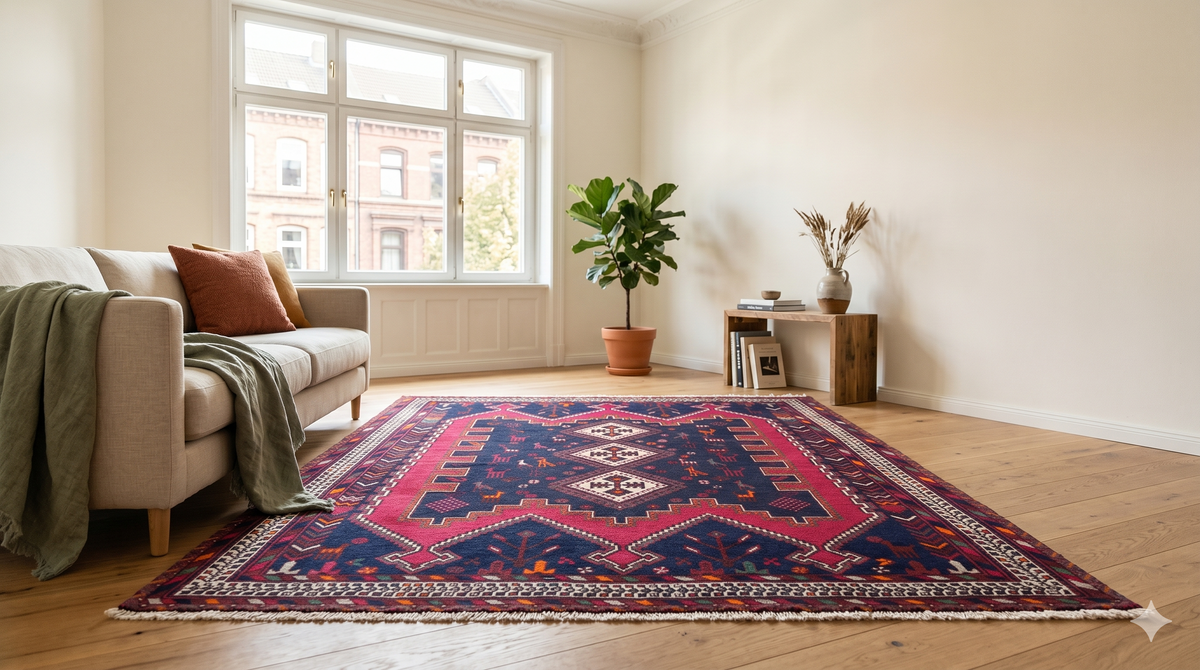
Afshar rugs are famous for their rectilinear, geometric patterns. Often, you will find a central medallion surrounded by smaller, repeating motifs like the "Boteh" (paisley motif) or stylized animals. The designs are rarely perfectly symmetrical, which underlines their authentic, handcrafted character and lends them a vibrant soul.
The symbolism of Afshar patterns is deeply rooted in their nomadic heritage. Every element carried meaning and served not only as decoration, but also as a protective symbol, a sign of fertility, or a status symbol. The central medallion, often shaped as a diamond or hexagon, can be interpreted as a stylized depiction of a waterhole or a tent camp, a central point in nomadic life.
Around this center, repeating motifs are often found. The "Boteh" pattern, reminiscent of a curved leaf or a flame, is a widespread symbol of life and eternity. Stylized depictions of roosters, dogs, or horses are also frequently seen, symbolizing protection, vigilance, and prosperity. In contrast to the floral, curved patterns of fine city rugs, the design language of the Afshar is always geometric and abstract. This directness gives the rugs a timeless and powerful aesthetic that integrates wonderfully into modern living concepts.
| Feature | Afshar Rug | Gashgai Rug | Lori Rug |
|---|---|---|---|
| Main motif | Often a single, large geometric medallion | Multiple smaller, repeating medallions or all-over patterns | Strong, often dark outlines and simple, large diamonds |
| Pattern style | Rectilinear, geometric, slightly rigid | More playful, detailed, often with small human and animal figures | Chunkier, more archaic, very minimalist and powerful |
| Color palette | Deep shades of red and blue, often with ivory accents | Broader color palette, often vibrant shades of orange and yellow | Dominated by dark brown, rust red, and deep blue |
| Influences | Urban workshops (Kerman) | Purely nomadic traditions | Distinct, very ancient tribal traditions |
These differences are subtle, but to the trained eye, they tell entire stories about origin; compared to Gashgai rugs, the influence of nearby cities on the Afshar weavers becomes clear.
From Sheep to Rug: Material and Knotting Technique
The foundation of every Afshar rug is the resilient wool of highland sheep, rich in lanolin, which makes the rug dirt-repellent. The warp and weft are usually made of cotton. Knotting is done on horizontal looms, typical of nomadic production, resulting in the characteristic, slight irregularities.
The quality of a hand-knotted rug begins with the raw material. Afshar weavers traditionally use the wool of sheep living in the rugged high altitudes of the Fars and Kerman regions. This wool is exceptionally robust and has a high natural fat content (lanolin). This lanolin acts like natural waterproofing, making the rug resistant to dirt and liquids while giving it a subtle, healthy sheen.
The dyes are traditionally extracted from plants, roots, and minerals: madder root for deep red, indigo for blue, and pomegranate rinds for shades of yellow and brown. Because hand-spun yarn never absorbs dye 100% evenly, subtle, stripe-like natural color variations occur, also known as Abrash. These are not flaws, but rather a sought-after hallmark of authenticity that gives the rug depth and vitality.
Knotting takes place on a horizontal loom laid directly on the ground. This simple, portable structure is typical of nomads. Weavers often sit directly on the section already knotted, which can lead to slight irregularities in shape and density, another sign of authentic handcraft. It is precisely this human touch that we appreciate so much in nomadic rugs.
Recognizing an Authentic Afshar: Characteristics and Quality
You can recognize authentic Afshar rugs by their firm yet supple feel and geometric patterns. Look for slight irregularities in shape and color (Abrash); they are signs of genuine handcraft.
Distinguishing an authentic Afshar from a copy requires a trained eye and a sensitive touch. An important feature is the feel: the pile should feel dense, firm, and almost slightly grainy, but never scratchy. The wool should have a subtle sheen derived from the lanolin. Turn the rug over and look at the back. The knots should be clearly discernible, but not mechanically perfect. Slight variations in knot density are normal.
Another detail can be found in the finishing edges. Afshar rugs often feature a broad, flat-woven Kelim finish at both ends, sometimes decorated with additional patterns. The side edges (shirazi) are usually firmly wrapped with wool, often in multiple colors, giving the rug extra stability.
You can discover more nomadic and village rugs in our nomadic rug collection.
Afshar Rugs in the Modern Home: A Piece of History
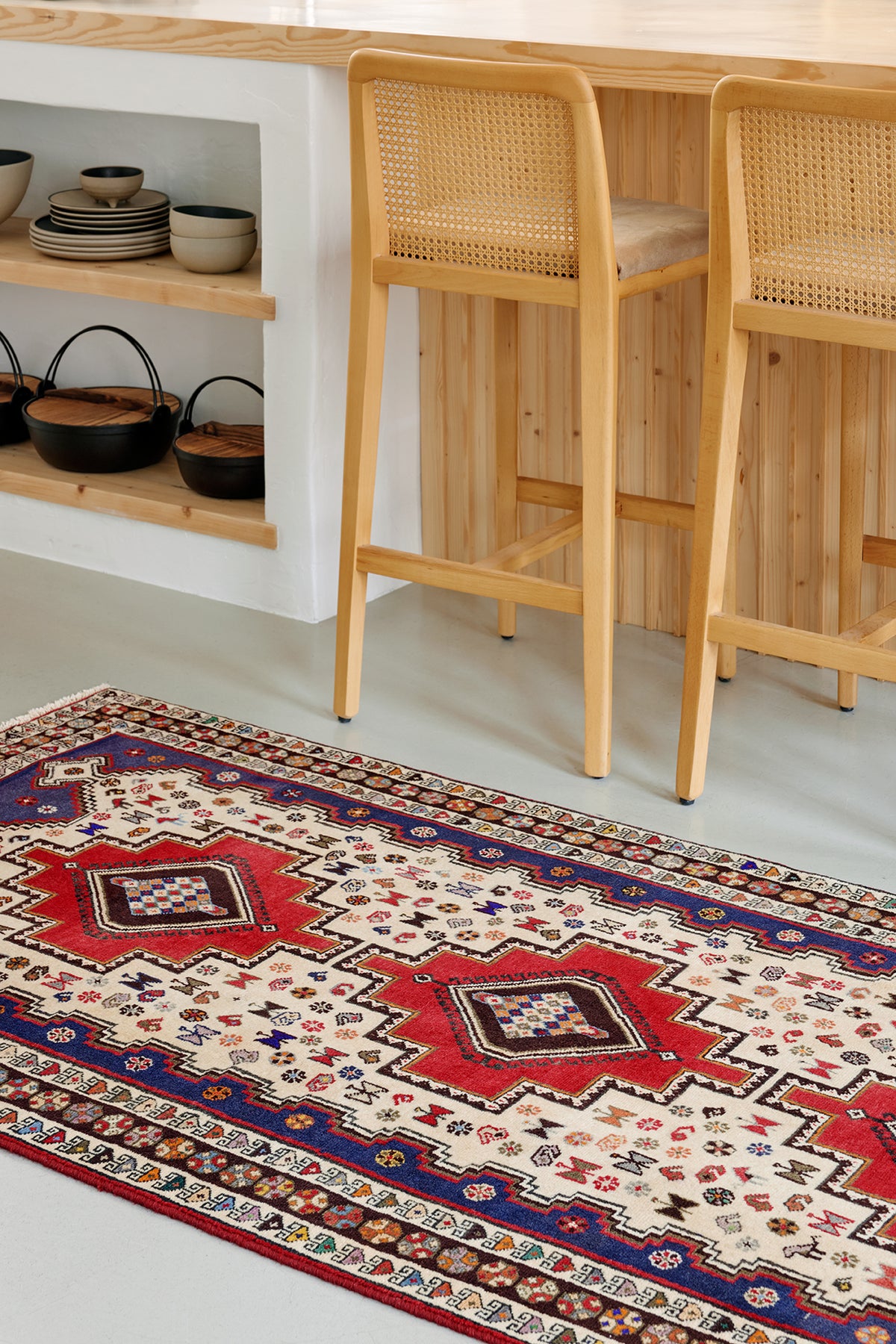
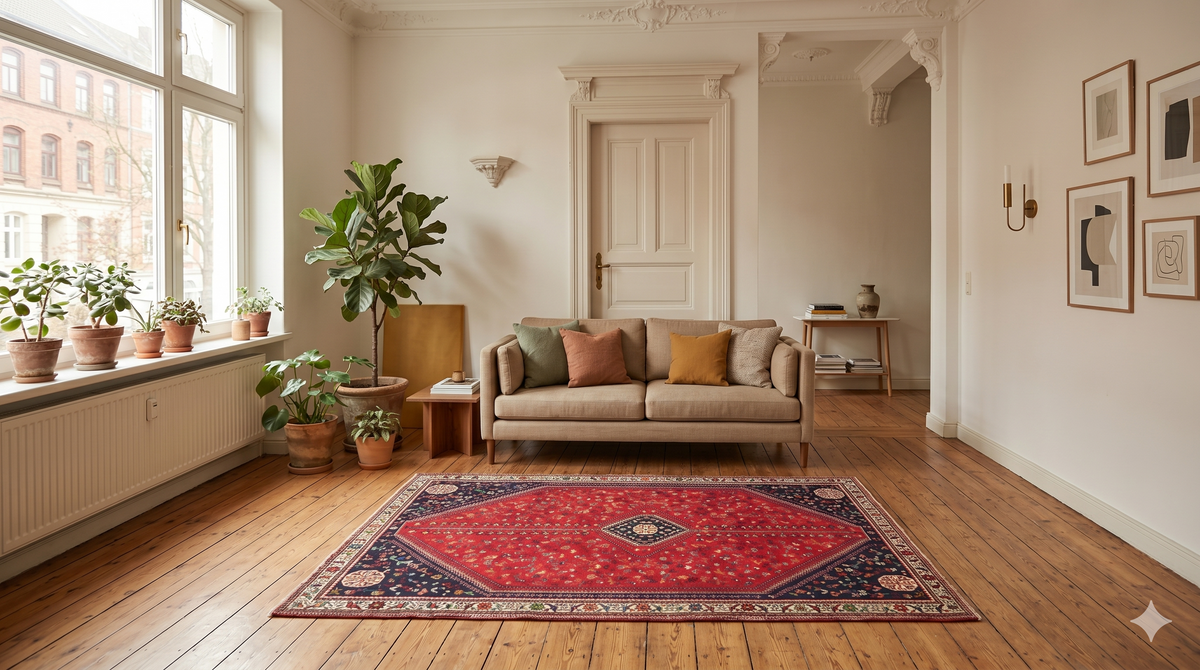
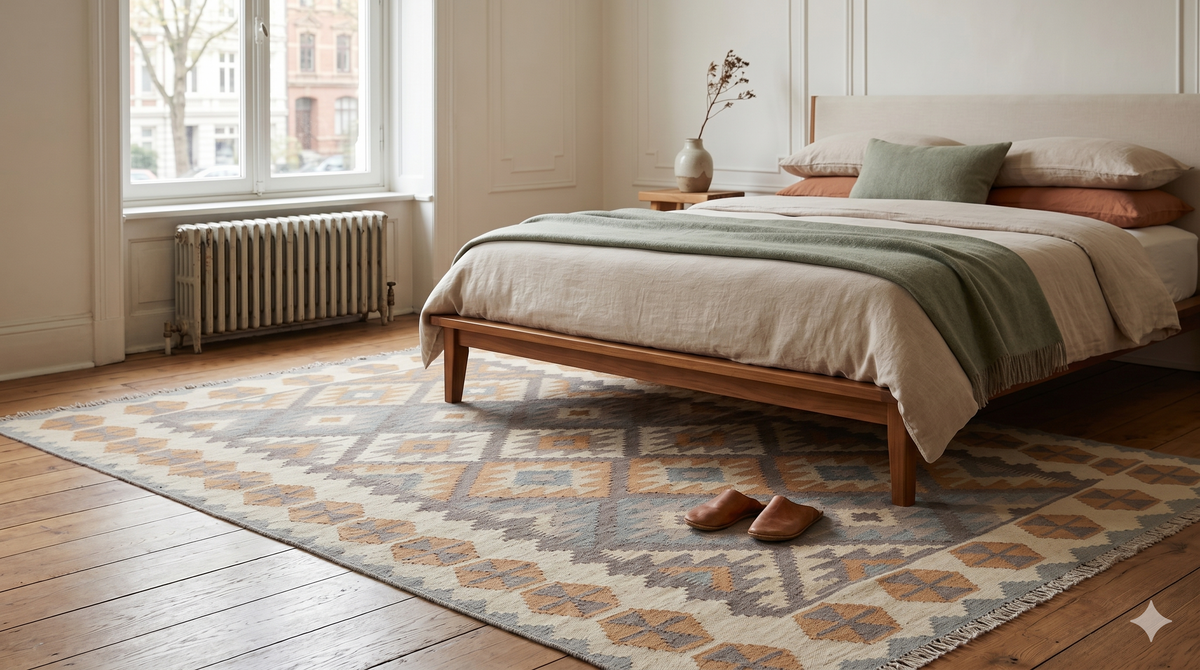
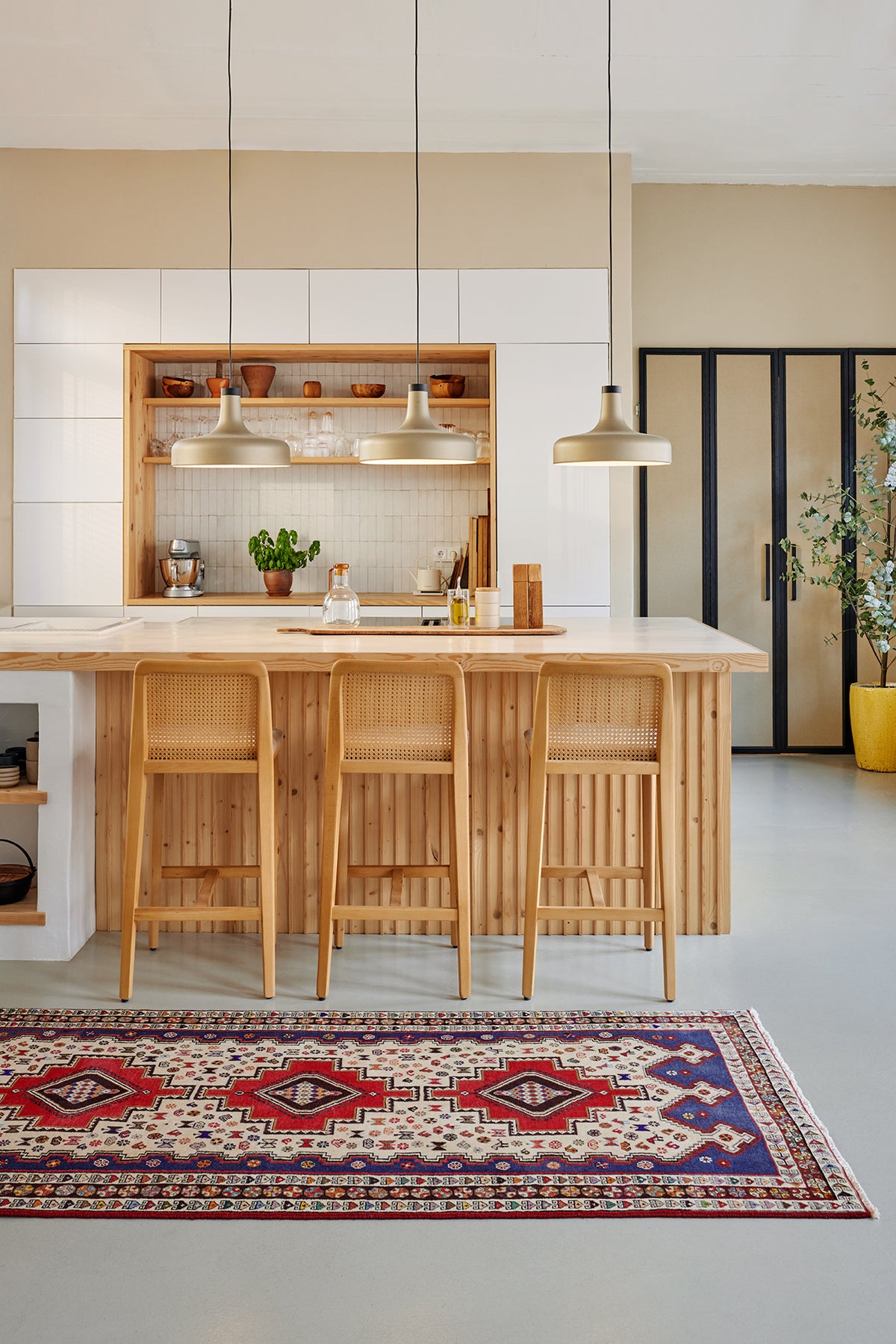
With its warm colors and geometric patterns, an Afshar rug makes a powerful statement in both modern and classic interiors. It works wonderfully as a focal point in the living room or as a sturdy runner in the hallway. Its history and authenticity give any room a deeper, personal touch and timeless elegance.
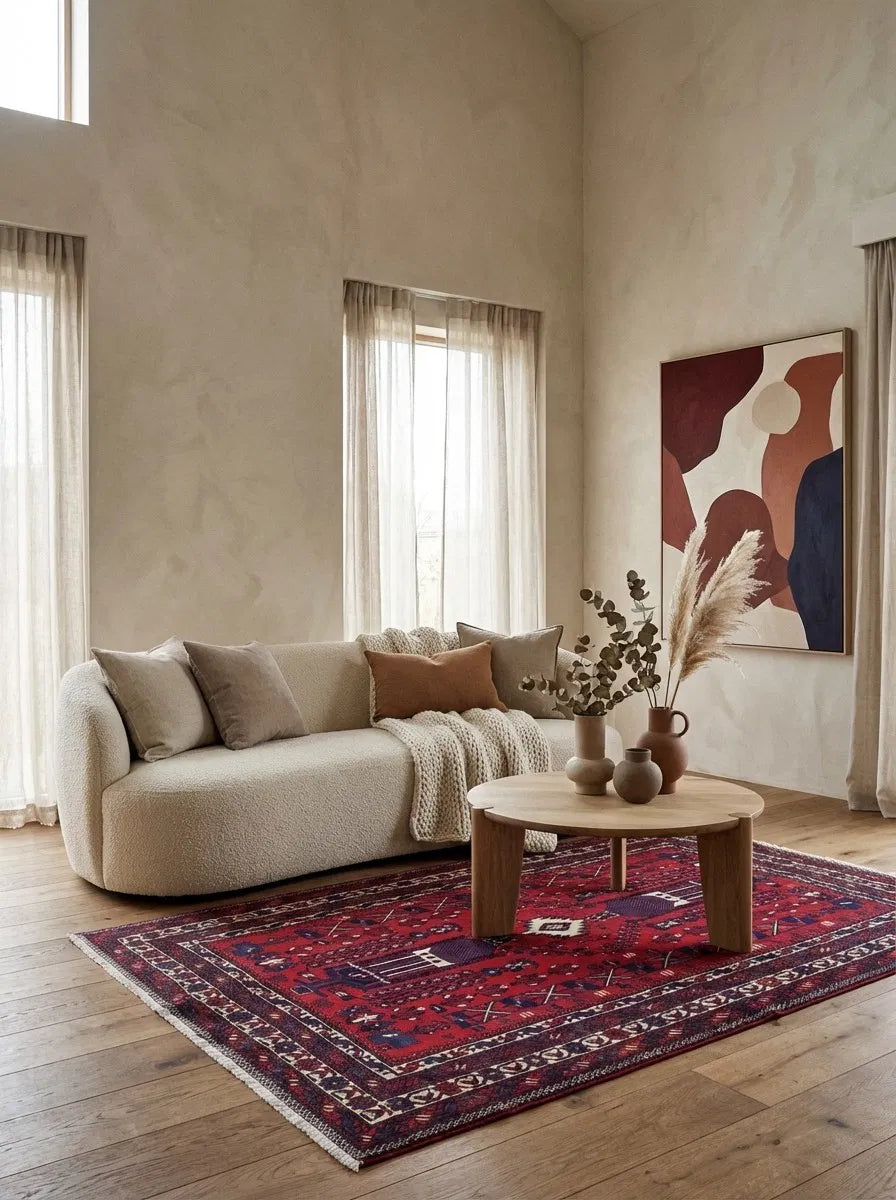
An Afshar rug is a statement piece that brings warmth and character into any room. Its clear, geometric patterns create an exciting contrast with minimalist furniture and contemporary interior styles. In a Scandinavian-inspired living room with light woods and neutral tones, an Afshar in deep red can become the heart of the space. In a more classic setting with dark wooden furniture, it blends in harmoniously, underscoring timeless elegance.
Thanks to their robust nature, Afshar rugs are ideally suited for high-traffic areas such as hallways, dining rooms, or living areas. They are not only beautiful, but also exceptionally practical and durable. To make sure you find the right size for your room, you can use our AR visualizer. With your smartphone, you can virtually place any rug in your home to scale and see how it looks.
FAQ
Are Afshar rugs valuable? The value of an Afshar rug depends on several factors: age, condition, knot density, and the rarity of the pattern. Older, well-preserved pieces from before 1950 are often particularly sought after by collectors. But newer pieces featuring fine knotting and high-quality natural dyes also represent a lasting investment in craftsmanship that can bring joy across generations.
How robust is an Afshar rug? Afshar rugs are among the most robust nomad rugs. The use of high-twist, lanolin-rich highland wool combined with dense knotting makes them extremely resilient and durable. They are an excellent choice for high-traffic areas such as hallways or living rooms, as they conceal dirt well and are easy to maintain.
What is the difference between Afshar and Gashgai rugs? Although both originate from nomadic peoples in similar regions, they differ in design. Afshar patterns are often stricter, more symmetrical, and dominated by a central medallion. Gashgai designs frequently appear more playful and free, featuring multiple smaller medallions and a wider variety of small, figurative motifs. The color palette of the Afshar is often more restrained and defined by red-blue contrasts.
Which colors are typical of Afshar rugs? The classic color palette is dominated by deep, rich shades of red (from madder root) and indigo blue. These primary colors are often complemented by accents of ivory, orange, yellow, or earthy brown tones. Through the use of natural dyes, the colors appear especially harmonious and develop a beautiful patina over the years, underscoring the rug's character.
How do I clean my Afshar rug? For everyday care, regular vacuuming in the direction of the pile without an extended brush is sufficient. Spills should be blotted immediately with a damp cloth. Every few years, we recommend a professional organic wash to remove deep-seated dirt and refresh the wool fibers. This preserves the value and beauty of your rug for a long time to come.
Every Afshar rug is a window into another world, filled with symbols and stories. If you are ready to bring such a piece of soul into your home, I invite you to explore our handpicked selection. Discover the variety of our nomad rugs and use our AR visualizer to experience your favorite right in your room.