Article: The Perfect Rug Size for Your Living Room: The Ultimate Guide
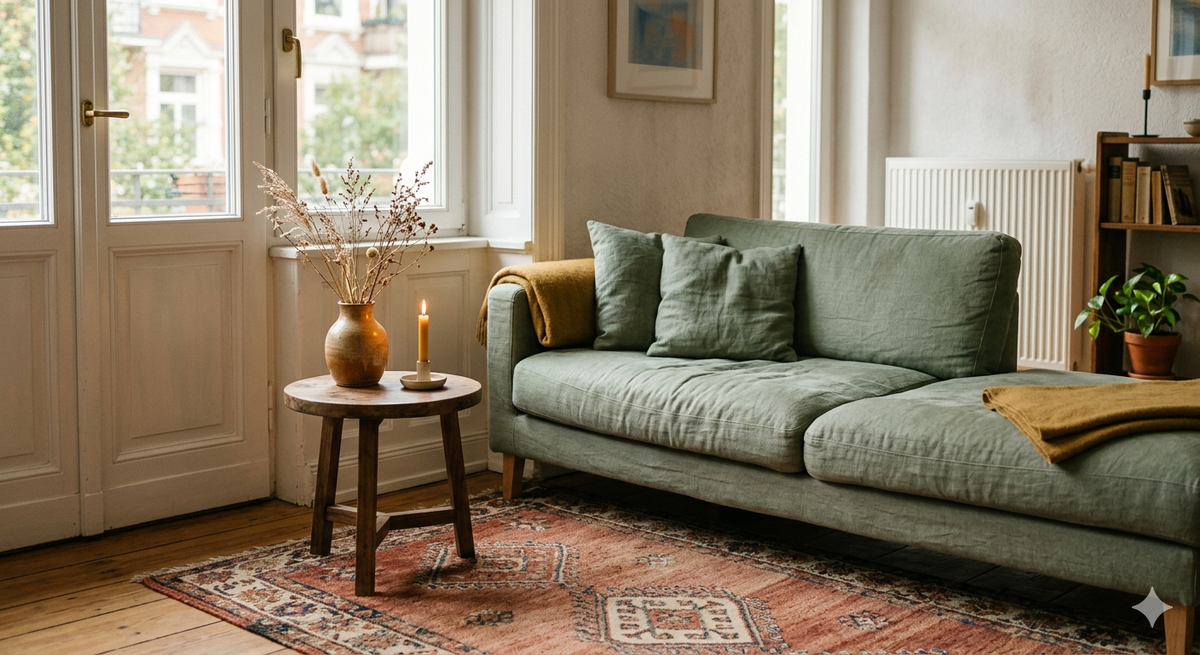
The Perfect Rug Size for Your Living Room: The Ultimate Guide
TL;DR: The ideal rug size for your living room depends on your sofa layout. A common rule of thumb is that the rug should be at least 40 cm wider than the sofa. Whether all furniture legs rest on it, only the front ones, or none at all defines the final size and creates a harmonious living island in your room.
Why the Right Rug Size Is Crucial for Your Sense of Space
The rug size is crucial because it visually defines and unifies the living area. A rug that is too small makes furniture look lost and the room feel unfinished, while a suitable size creates a cozy, harmonious living island. It influences the proportions and the overall ambiance, from spacious to cluttered, and is therefore the foundation of your interior design.
A rug is so much more than just a floor covering. It is the stage where your life unfolds, the anchor point for your furniture, and the soul of your living room. Choosing the right size is not just a matter of taste, but a fundamental design decision. A rug of the right size brings your seating area (sofa, armchairs, coffee table) together into a cohesive whole. It draws an invisible boundary and says: "Here is the place of coziness; here is where we gather."
If the rug is too small, on the other hand, it looks like a lonely island where the coffee table has been stranded. The surrounding furniture seems disconnected, and the entire room can feel fragmented and unsettled. A generously sized rug, by contrast, makes the space appear wider and more luxurious. It gives your feet and your eyes room to rest, contributing significantly to a welcoming atmosphere. Along with the size, the authentic texture and haptics of a hand-knotted piece naturally enhance this effect.
Vida ter Hazeborg, Co-Founder Rugtales: "I always see a rug as the foundation of a room. It is like a blank canvas on which the furniture is arranged. If the foundation has the wrong proportions, the whole structure feels unstable. The right size creates an island of comfort where life can take place, from game nights to relaxing with a book."
The 3 Proven Layout Options for Sofa and Rug
The three proven layouts are: 1. All furniture legs rest completely on the rug, which creates a generous, luxurious feel. 2. Only the front legs of the sofa and armchairs rest on the rug, a flexible and popular solution. 3. The rug lies only in front of the sofa, with just the coffee table placed on it.
Which size is right for you depends heavily on how you want to arrange your furniture. There are three classic approaches to guide you. Before you decide, you can use our AR visualizer on the website to virtually place each of our pieces in your room and test the different layouts live.
Layout 1: All Legs on the Rug
This is the most generous and luxurious option. All furniture in your seating group (sofa, armchairs, side tables) stands entirely on the rug. This arrangement creates a clearly defined, self-contained living island and makes the room as a whole feel larger and tidier. It is especially well suited for large, open-plan living areas where you want to create a clear separation from the dining or working area. For this layout, rugs starting from 240x340 cm or even 300x400 cm are often the best choice.
Layout 2: Only the Front Legs on the Rug
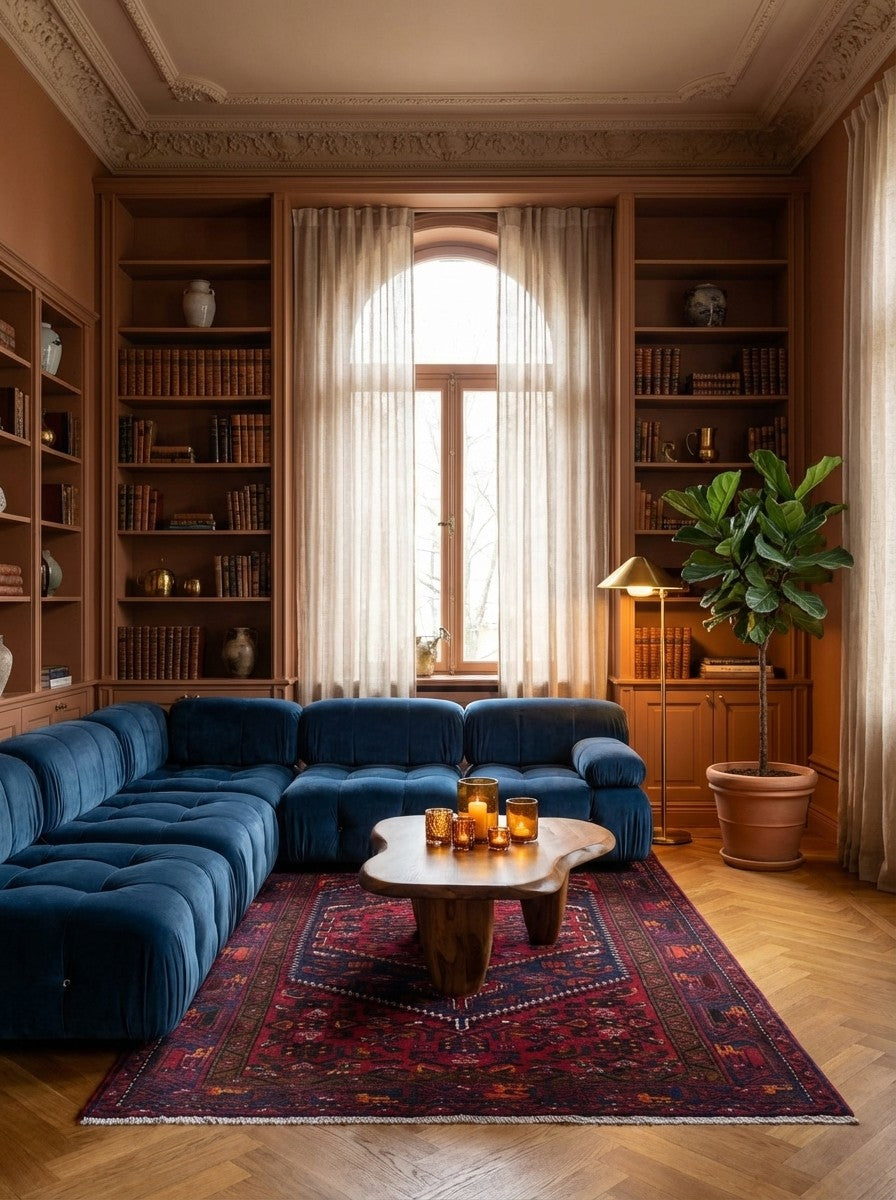
This is arguably the most popular and flexible compromise. The rug is large enough for the front legs of the sofa and armchairs to sit comfortably on it. It visually connects the furniture pieces without covering the entire floor. This method creates a harmonious connection and keeps the room feeling airy. It is ideal for most medium-sized living rooms and works wonderfully with our living room rugs in standard sizes such as 200x300 cm.
Layout 3: No Furniture Legs on the Rug
In this arrangement, the rug lies in front of the sofa and armchairs. As a rule, only the coffee table sits centrally on it. This layout works well for smaller rooms, as it keeps the flooring visible and does not visually reduce the space. It serves to introduce a colorful or textural accent and define the focal point of the seating group. Just make sure that the rug is not too small; it should still be wider than your sofa so it does not look lost. Expressive pieces such as plush Berber rugs are particularly well suited here.
| Layout Option | Ideal for… | Achieved Effect | Typical Rug Size |
|---|---|---|---|
| All legs on | Large, open living spaces | Luxurious, unified, framing | 240x340 cm and larger |
| Front legs on | Most living room sizes | Connecting, harmonious, flexible | 200x300 cm |
| No legs on | Smaller living rooms, narrow spaces | Accenting, centering | 160x230 cm |
Standard Sizes and Rules of Thumb: A Clear Guide
Common standard sizes for living rooms are 160x230 cm, 200x300 cm, and 240x340 cm. A reliable rule of thumb: the rug should extend roughly 20 to 30 cm on both sides of the sofa, meaning it should be 40 to 60 cm wider than the sofa in total. Additionally, keep at least 30 to 50 cm of distance from the walls so the room does not feel cramped.
Numbers provide reassurance. Even though every space is unique, there are proven measurements and guidelines that make getting started easier.
The most common formats for living rooms are: * 160 x 230 cm: Ideal for smaller living rooms and the "No legs on" layout in front of a 2-seater sofa. * 200 x 300 cm: The versatile all-rounder. Perfect for most living rooms and the "Front legs on" layout with a 3-seater sofa and armchairs. * 240 x 340 cm: The right choice for larger rooms and the "All legs on" layout to create an expansive living island.
The most important rule of thumb is: * Sofa width + 40 to 60 cm = ideal rug width. Your rug should extend 20 to 30 cm on each side of the sofa. This creates a balanced visual harmony. A sofa that is 200 cm wide pairs perfectly with a rug that is at least 240 cm wide.
The second important rule is wall distance: * Leave 30 to 50 cm of space between the rug edge and the wall. When a rug reaches directly to the wall, it can visually shrink the room and feel overwhelming. A clear border allows the room to breathe and lets your flooring stand out. To strike this balance, many of our robust Gabbeh rugs, for example, are knotted in ideal standard sizes.
The 5 Most Common Mistakes When Choosing a Rug (and How to Avoid Them)
The most common mistake is a rug that is too small, looking like an ill-fitting postage stamp. Other mistakes include ignoring the room shape, overlooking doors and walking paths, choosing the wrong proportion relative to the furniture group, and measuring without visual aids. These mistakes make the room look discordant and smaller than it really is.
From our consulting experience, we know that most hesitation comes from the fear of making a mistake. Here are the top 5 mistakes you can easily avoid.
-
Mistake: The "postage stamp effect" A rug that is too small and floats adrift in the room is the most common mistake. It makes even the most beautiful furniture appear disconnected and lost. Solution: When in doubt, always choose the larger size! A generously proportioned rug almost always looks better.
-
Mistake: Focusing only on the sofa Many people measure only the sofa and forget the armchairs or side tables. But the rug should unify the entire seating arrangement. Solution: Include all furniture pieces in your planning that belong to the living island.
-
Mistake: Ignoring walking paths and doors A rug should not disrupt traffic flow. Make sure doors can open freely and main paths do not become tripping hazards due to a rug edge. Solution: Allow at least 50 cm of clear space for primary walkways.
-
Mistake: Disregarding the room shape A square rug in a long, narrow room can emphasize proportions awkwardly. Solution: Choose a rug shape that follows the shape of the room or the seating arrangement. In most cases, that is a rectangular format.
A classic scenario: you love a 140 × 200 cm rug, but your living room is spacious and your sofa is large. Mask out the rug dimensions on the floor in front of the sofa using painter's tape; you will immediately see whether it gets lost next to it. Often, a similar piece in 200 × 300 cm proves to be the more harmonious choice. This visualization is often the decisive step toward finding the right rug for your living room.
Practical Tip: How to Measure the Perfect Rug Size Accurately
Set up your furniture exactly as you want it arranged in the end. Then mark out the desired rug area on the floor using painter's tape or old newspaper. This gives you a true sense of the proportions and lets you take precise measurements. Alternatively, you can use our AR visualizer to test different sizes virtually in your room.
Theory is good, practice is better. Before you decide, take a moment for this simple exercise, which will give you complete confidence.
- Arrange furniture: Position your sofa, armchairs, and coffee table exactly where you want them to stay.
- Tape the area: Use painter's tape (it comes off easily) or lay down old newspapers to outline your desired rug on the floor. Start with a standard size such as 200x300 cm.
- Assess the effect: Live with it for a day. Walk around the furniture. Do the edges get in the way? Does the size feel right? Does the room feel harmonious?
- Measure: Once you are satisfied with the outlined area, simply measure the length and width. That is your ideal rug size.
For an even quicker and simpler approach, you can use the Rugtales AR visualizer. Simply pick a rug on our website and project it live and true to scale into your living room using your smartphone. This allows you to compare different sizes and designs within seconds. A great tool to help you choose the right rug for your home.
Where exactly the rug sits in front of the sofa is explained in the three layout rules for sofas. How much wider than the sofa it should be is covered in the guide rug larger or smaller than the sofa. Under the dining table, different guidelines apply: rug size for the dining room.
FAQ
How large should a living room rug be? The rug should be large enough to visually link your seating arrangement into a unified whole. As a rule of thumb, it should be about 40 to 60 cm wider than your sofa. The exact size depends on whether all furniture legs, only the front ones, or none at all will sit on it.
Should the rug be larger than the sofa? Yes, definitely in width. Ideally, it extends roughly 20 to 30 cm on each side of the sofa to create visual balance. In depth, it should reach at least under the front legs of your seating furniture to tie them together harmoniously.
What rug size for a 3-seater sofa? For a typical 3-seater sofa with a width of approximately 200 to 220 cm, a 200x300 cm rug is often an excellent choice. If you also want to incorporate one or two armchairs into the seating group, a 240x340 cm size is even better suited to provide ample room for all furniture.
Should the rug lie in front of or under the sofa? Both are valid, depending on personal style and room size. The most popular and flexible method is placing the rug so that the front legs of the sofa and armchairs rest on it. This unifies the furniture without overwhelming the room.
How much does a large living room rug cost? Prices are as unique as the rugs themselves and depend heavily on material, knot density, age, and origin. A hand-knotted rug made from virgin wool is a long-lasting investment. Prices can range from several hundred euros for a small Kelim to several thousand for a large, finely knotted piece.
Are you ready to find the perfect foundation for your living room? Discover our collection of hand-knotted living room rugs, from classic to modern. Use our AR visualizer on each product page to experience your favorite piece directly in your home and determine the ideal size with complete confidence.