What Rug Size for Your Dining Room?
TL;DR: The ideal rug size for your dining room depends on your dining table. The basic rule is: the rug must be large enough so that all chairs remain completely on it even when pulled out. To achieve this, calculate the dimensions of your table plus at least 60 to 70 cm on each side used for seating.
The Golden Rule: Why the Chairs Must Stay on the Rug
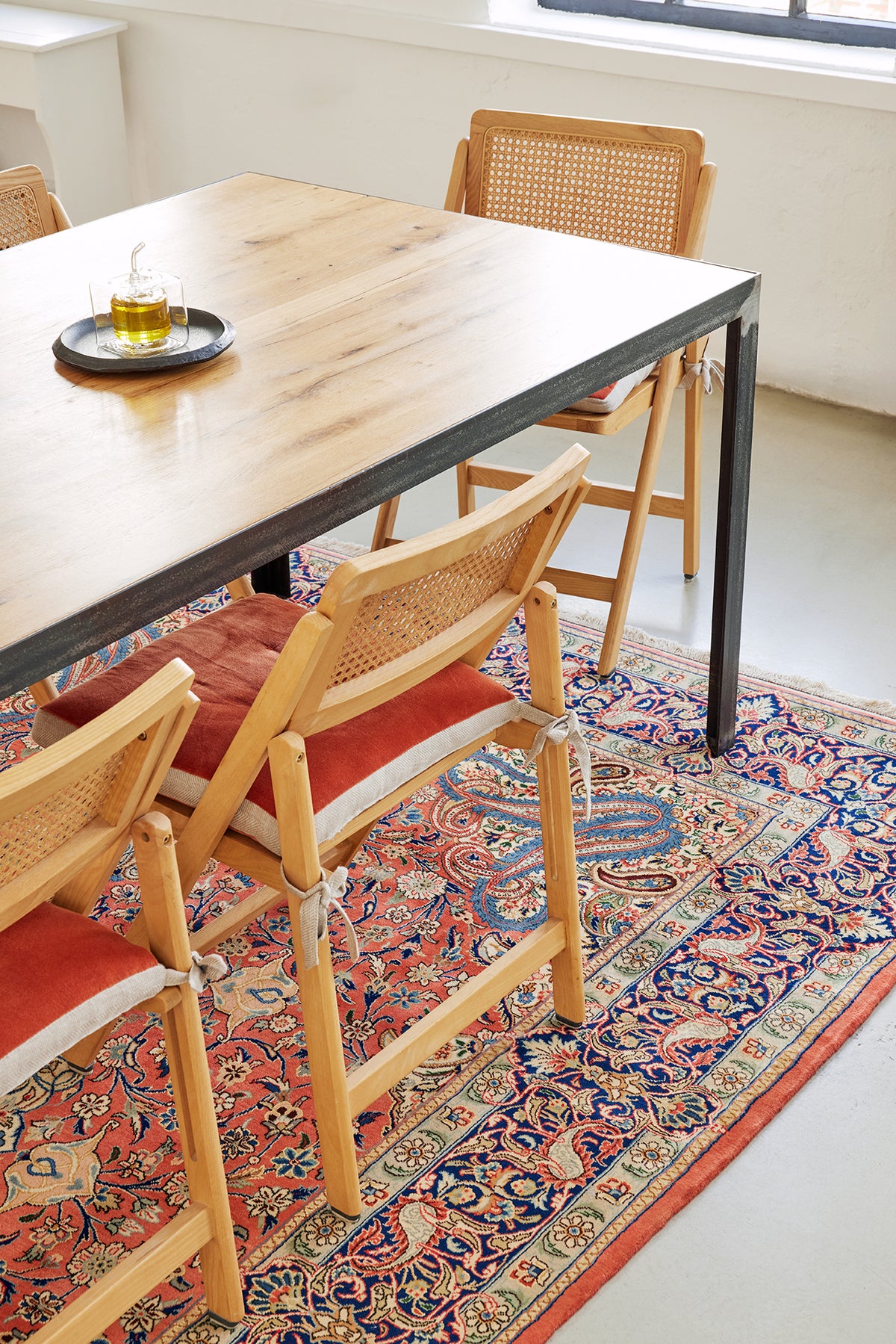
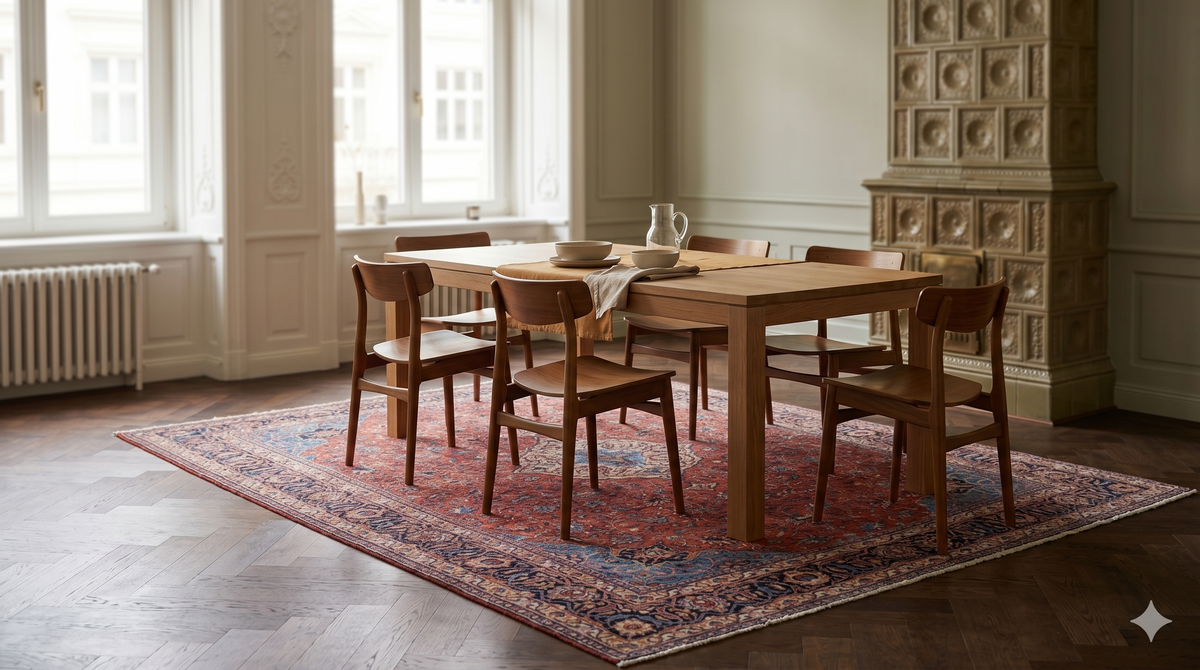
The most important rule for the rug size in the dining room is that the chairs must not wobble. When you pull your chair back to sit down, all four legs must remain on the rug. This prevents catching on the rug edge, protects the rug, and creates a harmonious, generous sense of space.
A dining room rug is more than just decoration; it is a functional stage for your dining area. The most important task of this stage is to provide comfort and stability. Imagine you or your guests pull back the chairs and get caught with the rear legs on the rug edge. This is not only annoying, but over time it can also damage the edge of the rug. The "golden rule" ensures that this scenario never happens in the first place.
By adding 60 to 70 centimetres to your table dimensions on each side where chairs stand, you create a sufficiently large surface. This buffer gives you and your guests the freedom to sit down and get up comfortably without leaving the rug. A rug that is too small, on the other hand, looks lost and makes the dining area appear disproportionate. It visually chops up the room instead of connecting it into an inviting unit. If you are unsure about the measurements, you can find further fundamentals in our general rug size guide.
Vida ter Hazeborg, Co-Founder Rugtales: „A generously sized rug in the dining room is a welcoming statement. It signals: there is space for everyone here, you can move freely here. It anchors the dining table and chairs, turning a simple group of furniture into a genuine social centre, an island of conviviality that invites you to linger.“
A rug that follows this rule clearly defines the dining area and creates a visual oasis. It frames your dining set and gives it weight and significance in the room. The result is a tidy, well-thought-out, and above all comfortable atmosphere where shared meals bring even more joy. You can find suitable pieces in our selection of dining room rugs.
Table Shape Meets Rug Shape: What Goes Together?
Ideally, the shape of your rug should echo the shape of your dining table to create visual harmony. A rectangular table works best on a rectangular rug, a round table on a round or square rug. This symmetry clearly anchors the dining area and creates a cohesive overall look in the room.
Choosing the rug shape is a crucial step in creating a harmonious overall picture. When table and rug correspond in form, a natural visual order emerges that the eye perceives as pleasant. It is as if the furniture and the rug speak the same language.
A rectangular dining table is the classic choice and finds its perfect counterpart in an equally rectangular rug. The parallel lines of table and rug create a clear structure and emphasise the length of the room or the dining table.
With a round dining table, you have two excellent options. A round rug mirrors the shape of the table perfectly and creates a very centred, self-contained arrangement. A square rug can also work wonderfully, as it frames the round shape of the table and creates an exciting geometric contrast.
An oval table is elegant and somewhat rarer. Here, a rectangular rug often works best, as it creates a clear base on which the curved shape of the table comes into its own. An oval rug is ideal, but often harder to find in the matching size.
Here is a simple overview to help you decide:
| Table shape | Matching rug shape(s) | Effect |
|---|---|---|
| Rectangular | Rectangular | Classic, harmonious, structured |
| Round | Round, Square | Centred, modern, communicative |
| Square | Square, Round | Symmetrical, clear, geometric |
| Oval | Rectangular, Oval | Elegant, balancing, generous |
Ultimately, the choice is also a matter of your personal style. A deliberate style break, such as a round rug under a square table, can be charming in a modern setting. The only important thing is that the size is right and all chairs find space. In our collection of large-format rugs, you will find many options for common table sizes.
Measuring Like a Pro: How to Determine the Perfect Size
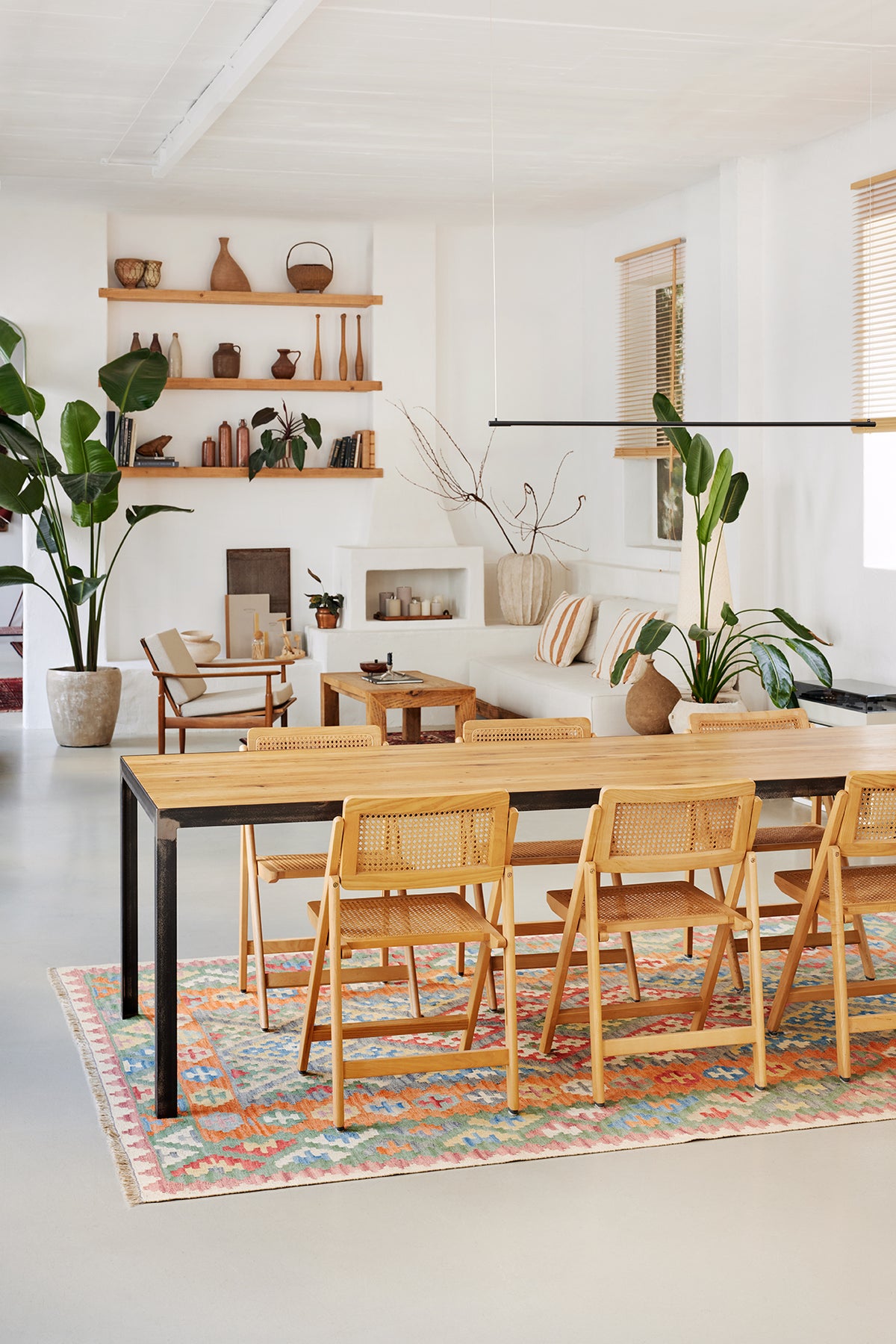
Measure your dining table and add 60 to 70 centimetres to each side where chairs stand. Then pull the chairs as far back from the table as you would when standing up, and measure the required area. Mark the corners with tape to visualise the effect in the room.
The theory is clear, but how do you proceed in practice? With this simple step-by-step guide, you can find the exact dimensions for your dream rug:
-
Measure the table: Start with the basics and measure the length and width of your dining table. Note down these measurements. Example: 200 cm x 100 cm.
-
Calculate the buffer: Now add the buffer for the chairs. Add at least 60 cm, ideally 70 cm, to each side used for seating. For our example table, that would be:
- Length: 200 cm + 70 cm + 70 cm = 340 cm
- Width: 100 cm + 70 cm + 70 cm = 240 cm
- The ideal rug size would therefore be approx. 340 x 240 cm.
-
The practical test: Now it gets hands-on. Move all chairs as far back from the table as someone would when standing up. This is the maximum space requirement. Now measure the total area occupied by the outer chair legs. This measurement is your absolute minimum; your rug should not be any smaller.
-
Visualise the area: The best trick to get a feel for the size is visualising directly on the floor. Take painter's tape or another type of easily removable tape and mark the corners of your calculated rug dimensions on the parquet or tiles. Leave the tape in place for a day or two. This way, you can genuinely experience the proportions in the room and make sure the size fits.
A tip from our consultation team: Mark out the rug's outline on the floor using painter's tape and send us a photo. This allows us to see right away if the proportions work, and we can offer tailored guidance in your personal rug consultation.
If you want to make it even easier, use our AR visualizer on the website. With your smartphone, you can project our rugs virtually and true to scale into your dining room. That way, you immediately see how shape, colour, and size work.
The Right Material: Robustness and Care in the Dining Area
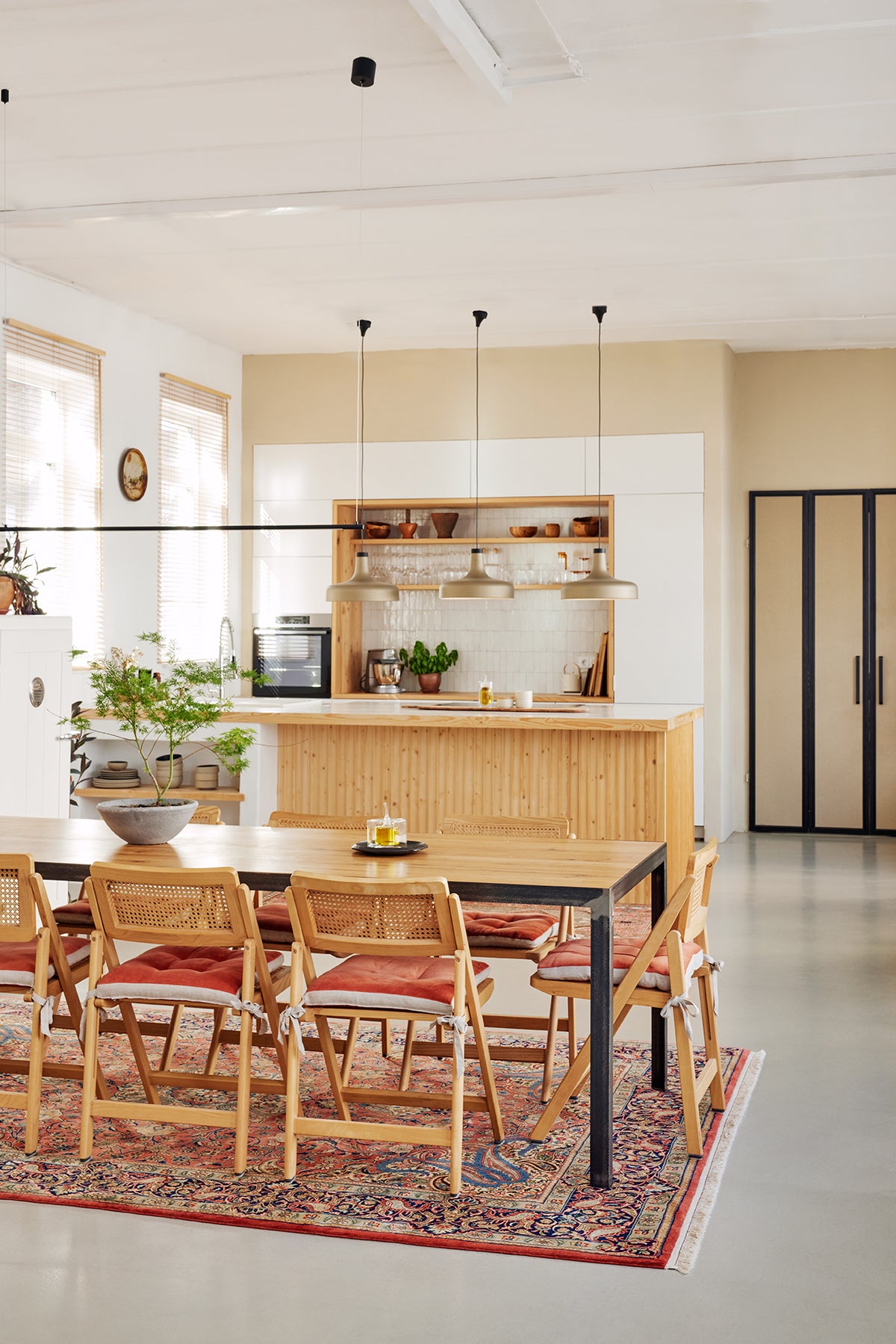
Particularly robust and easy-care materials are suitable for the dining room. Hand-knotted virgin wool is ideal, as its natural lanolin content makes it dirt-repellent. Flatweaves like Kelim are also an excellent choice, as chairs glide easily across them and crumbs are simple to remove. Avoid high-pile or delicate rugs.
The dining room is a high-traffic place where mishaps can happen. A dropped piece of bread, a few splashes of red wine; the rug has to withstand quite a bit. That is why choosing the right material is just as important as choosing the right size.
Virgin wool is our top recommendation for the dining area. Wool from mountain sheep, as used for Persian nomad rugs, is naturally rich in lanolin (wool fat). This natural impregnation acts like a protective shield: liquids initially bead off and do not immediately soak into the fibre. This gives you time to quickly dab away small accidents with a cloth. In addition, wool is extremely durable and long-lasting.
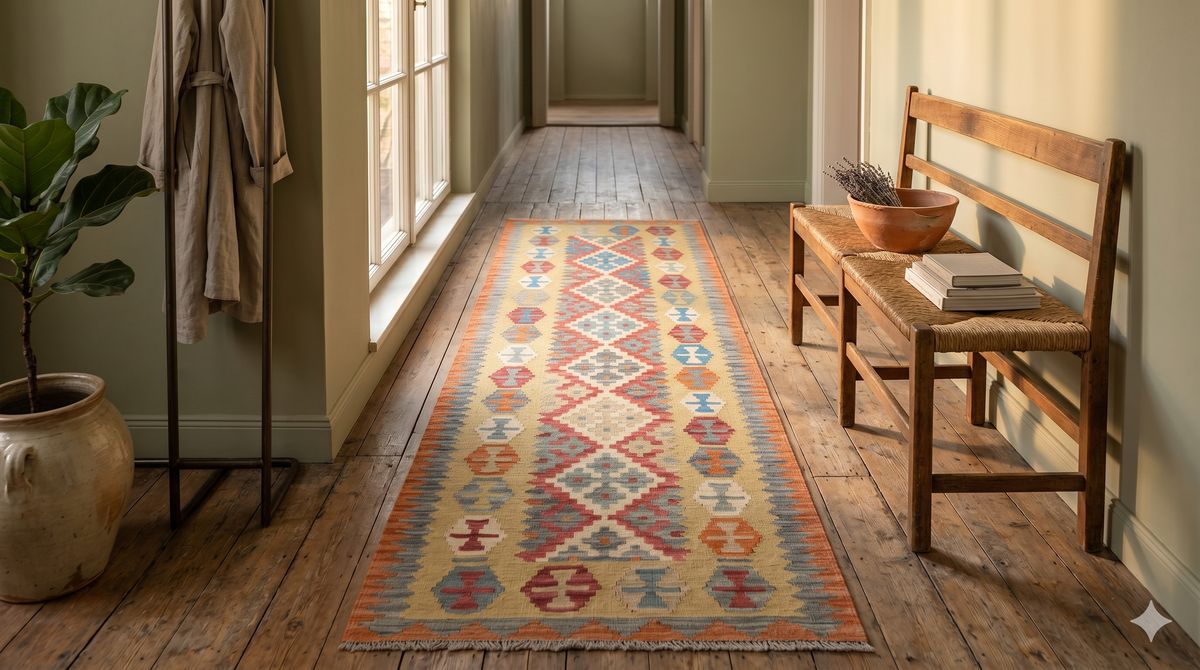
Flatwoven rugs like Kelim are another fantastic option. Because they have no pile, chairs can glide over them effortlessly. Crumbs and dust are very easy to vacuum up, as they remain on the surface and do not penetrate deep into the rug. Their often geometric patterns are not only stylish, but also very forgiving of small stains. Discover the variety of our robust Kelim rugs.
What you should avoid are high-pile rugs (shaggy rugs). Chair legs sink into them, making it difficult to move the chairs. In addition, they are a paradise for crumbs and extremely difficult to clean. Delicate materials like viscose or silk are also less suitable in the dining area.
Our experience shows time and again: a good, dense wool rug, whether with a short pile like a classic Gabbeh or flatwoven, is the best investment for a long-lasting and beautiful dining room. If a larger stain does occur, you can find our best tips for rug cleaning here.
More Than Just Flooring: How the Rug Shapes the Atmosphere
A rug in the dining room is more than just a practical element. It defines the dining area as a cosy island, improves room acoustics, and brings colour, texture, and personality into the space. A well-chosen rug unites pieces of furniture into a harmonious whole and creates an inviting atmosphere for shared meals.
Once you have found the perfect size and the ideal material, the most enjoyable part begins: shaping the atmosphere. A rug has the power to transform the entire feel of your dining room.
It creates a zone of cosiness: In open-plan living and dining areas, a rug is the most effective way to visually separate the dining area from the rest of the room. It creates a clearly defined island that radiates security and togetherness.
*It improves acoustics:* Especially in rooms with many hard surfaces like parquet, glass, and concrete, it can quickly become reverberant and noisy. A wool rug is an outstanding sound absorber. It dampens sounds like moving chairs or lively conversations, providing significantly more pleasant, calmer acoustics.
It brings colour and personality: A rug is the perfect canvas to express your style. Choose a piece with bold colours to liven up a neutral room, or a subtle pattern that elegantly complements your interior. Every unique hand-knotted piece tells its own story and brings character and warmth into your home. Let our inspiration for other rooms guide you for your dining room as well.
Ultimately, a rug under the dining table is the connecting element that lets chairs and table merge into a harmonious unit. It completes the room and turns it into a place where you do not just eat, but love to come together for a long, relaxed time.
For large tables with eight chairs, we calculated the dimensions in the guide Rug for an 8-Person Dining Table. For the living room, different rules apply, where the sofa sets the dimension: Living Room Rug Size.
FAQ
What do I do with a very small dining room? In a small room, you can reduce the buffer for the chairs to around 50 cm, as long as stability when pulling them back remains guaranteed. A round rug can also make the room appear visually larger, as it emphasises fewer corners. Choose light colours to make the area seem more open.
Can I place a round rug under a rectangular table? Yes, this modern style break can be very appealing. The contrast between the straight lines of the table and the soft shape of the rug creates visual interest. However, make sure the rug is large enough to comfortably accommodate the corners of the table and the chairs as well. This often requires a very large diameter.
How much clearance should the rug have from the wall? As a rule of thumb, keep a distance of at least 30 to 50 cm from walls and other large furniture pieces such as sideboards. The rug should define the dining area as an island, not replace the entire flooring. Leaving a border of the floor visible makes the room feel airier and larger.
Which rug material is best for families with children? For families, we clearly recommend hand-knotted virgin wool or robust flatweaves like Kelim. The natural dirt-repellent property of wool is worth its weight in gold during minor accidents. Kelim pieces are extremely easy to clean. A rug with a lively pattern is additionally clever, as it visually conceals small stains.
Is a high-pile rug a good idea in the dining room? We strongly advise against this. The chair legs sink into the high pile, which makes sitting down and getting up laborious. Crumbs and food remnants disappear deep into the rug and can only be removed with great effort. A short-pile or flatwoven rug is by far the more practical and hygienic choice for the dining area.
Are you ready to give your dining room the finishing touch? A well-chosen rug can transform the room. Discover our collection of suitable rugs for your dining area and try out your favourites directly in your home with our AR visualizer.