A Rug for the Hallway: Robust, Beautiful, Long-Lasting
TL;DR: The ideal rug for the hallway combines extreme durability with easy-care properties. Flatweaves such as Kelim or low-pile rugs made of virgin wool are best suited. These materials are naturally dirt-repellent and resistant to heavy foot traffic. Pay attention to the right size so doors can swing freely and a harmonious overall look is created.
Why Your Hallway Places Special Demands on a Rug
Your hallway is the calling card of your home and at the same time one of the most heavily used areas. A rug here must withstand heavy foot traffic, outdoor dirt, and moisture. It should therefore be extremely durable, stain-resistant, and easy to clean without losing any of its cosy aesthetic. The narrow, elongated shape also often requires a dedicated runner format.
The hallway is more than just a transit area; it is the first handshake your home gives a guest. This is where it is decided whether you feel immediately welcome and comfortable. At the same time, it is a room of extremes: outdoor shoes bring in moisture and dirt, groceries are set down, children run through. The mechanical stress on a floor covering here is higher than anywhere else in the home. A rug must not only withstand this daily ordeal, but also look good doing it.
The challenge lies in finding a rug that meets these functional requirements without compromising on aesthetics. It needs to combine the durability of a doormat with the warmth and style of a living room rug. In addition, hallways are often architecturally demanding: long, narrow, and sometimes angled. A standard rug rarely fits here. You need a format, usually a runner, that captures the proportions of the space and accentuates it favourably instead of making it feel cramped.
Basic synthetic runners in hallways often flatten out after just a few months, showing permanent traffic paths that cannot be cleaned away. A hallway runner should never be a disposable item, but rather an integral part of your home that welcomes you and sees you off every single day.
The Best Materials: What Really Makes a Hallway Rug Durable
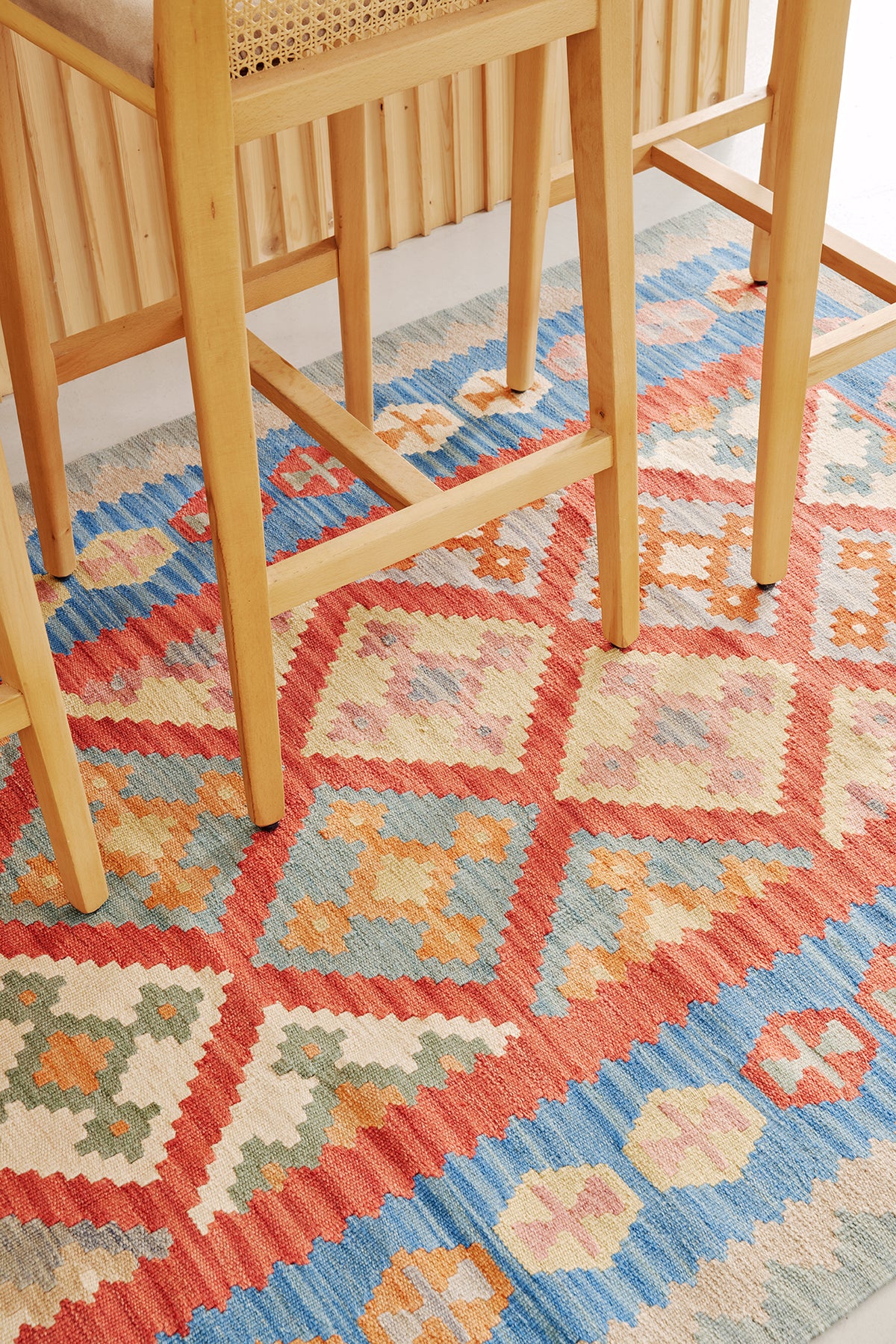
Virgin wool is the best material for a hallway rug. Its natural lanolin content acts like an impregnation that repels dirt and moisture while keeping the fibre elastic. Flatwoven Kelim rugs made of wool are especially ideal because they do not have a high pile where dirt can settle. They are long-lasting, resilient, and easy to clean.
When it comes to longevity and easy care, choosing the right material is crucial. Synthetic fibres like polypropylene or polyester may seem inexpensive and colourful at first glance, but they have major disadvantages in high-traffic hallway areas. They tend to attract dirt electrostatically, and the fibres are quickly crushed under constant pressure, leading to unsightly traffic paths.
Nature has a far better solution ready: virgin wool. In particular, the wool from mountain sheep in the Persian highlands is a true functional wonder. Due to the harsh climate, the sheep develop an exceptionally dense and resilient fleece with a high content of lanolin, the natural wool grease. This lanolin coats every single fibre and acts like a protective shield. It simply repels dirt and water droplets so they cannot penetrate deep into the fabric in the first place. That is why a good wool rug can often be cleaned simply by vacuuming or beating it out.
In addition, the wool fibre is naturally crimped, which gives it enormous elasticity and dimensional stability. Even if a heavy piece of furniture stood on it, the pile will bounce back by itself after some time. This property makes virgin wool perfect for the hallway, where constant stress is part of everyday life. Cotton often serves as the foundation for warp and weft in many of our rugs, giving the rug additional stability and structure.
| Property | Virgin Wool | Synthetics (e.g. Polypropylene) |
|---|---|---|
| Dirt Resistance | Naturally repellent (lanolin) | Attracts dirt electrostatically |
| Durability | Very high, fibre bounces back | Low, quickly forms traffic paths |
| Cleaning | Easy, often self-cleaning | Stains penetrate deeply |
| Feel & Climate | Warm, breathable, moisture-regulating | Cold, non-breathable, can off-gas |
| Longevity | Decades, grows more beautiful with age | A few years, visible wear and tear |
Choosing virgin wool is an investment in longevity. A hand-knotted wool rug lasts for generations, whereas a synthetic rug often needs to be replaced after a short time. Since our founding in 1952, we have experienced in our family business that quality always pays off here.
Kelim & Co.: Why Flatweaves Are the Heroes of the Entrance Area
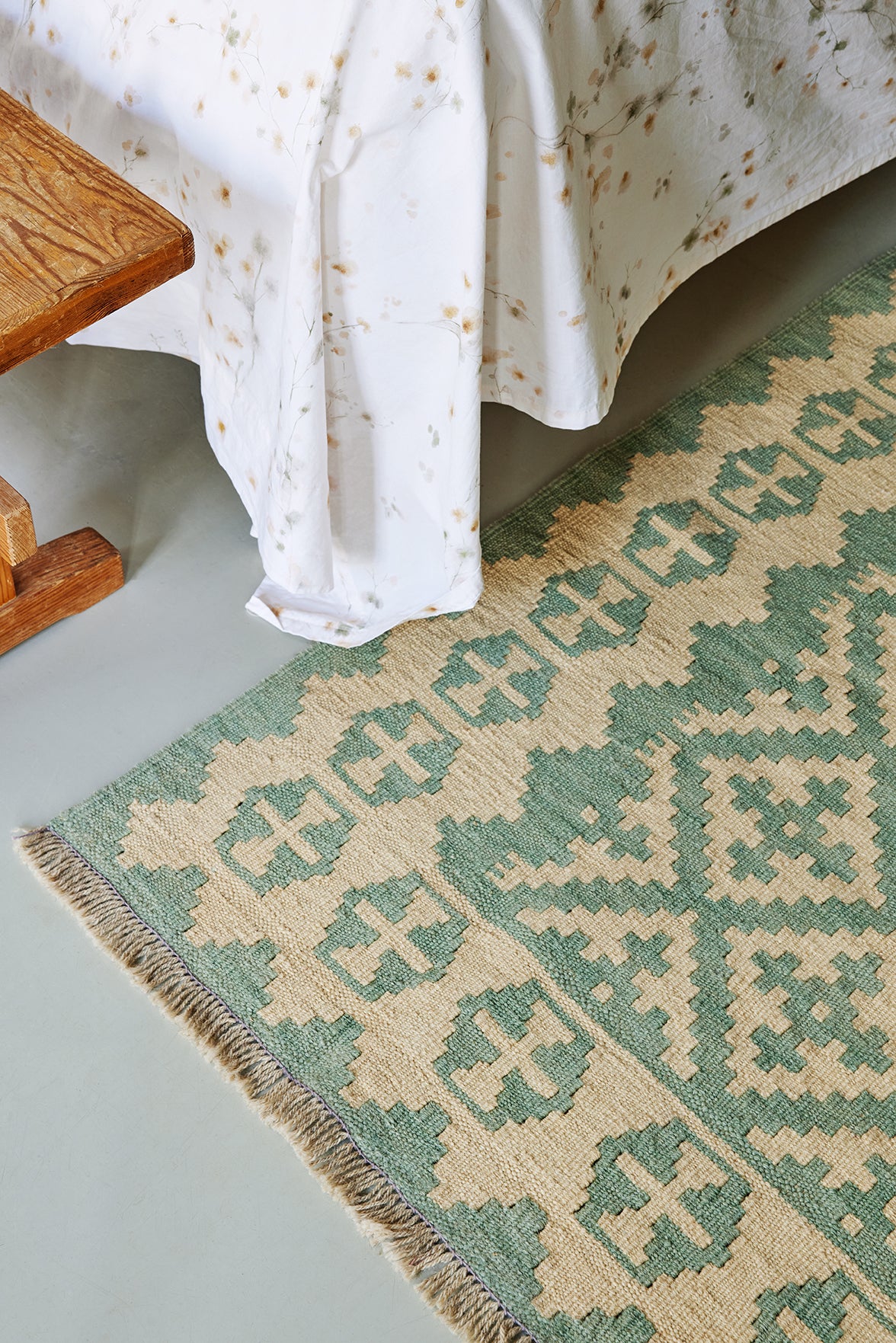
Flatwoven rugs like Kelim are the first choice for the hallway. Thanks to their flat structure without pile, dirt and dust can hardly settle, making cleaning remarkably easy. Doors can open over them without difficulty, and they are extremely durable. Furthermore, many Kelim rugs are reversible, which virtually doubles their lifespan.
Within the world of wool rugs, there is one category that seems tailor-made for the hallway: flatweaves, above all the Kelim. In contrast to knotted rugs with an upright pile, a Kelim is woven, similar to a tapestry. The result is a flat, dense, and incredibly robust structure.
This construction offers several unbeatable advantages for the entryway. First, the low profile is a blessing. Front doors, wardrobe doors, or room doors can glide smoothly over the rug without snagging or pushing it out of place. Second, the absence of a pile makes it extremely easy to maintain. Dirt, crumbs, or pet hair stay on the surface and cannot penetrate deep into the weave. Give it a good shake or run the vacuum cleaner over it (without a brush), and the Kelim is clean again.
Another practical feature: Many Kelim are woven identically on both sides. You can simply turn them over so they wear evenly and last even longer.
The weaving technique also allows for an incredible variety of geometric patterns and vibrant colours. Whether a traditional Kelim Gashgai with its powerful symbols or a modern interpreted runner, a Kelim adds character to the hallway without visually cluttering the narrow space. It is a work of art for the floor that can withstand daily challenges. So if you are looking for the perfect rug runner for your hallway, chances are high that you will find it in our selection of handwoven Kelim pieces.
The Right Size and Shape: How to Make Your Hallway Look Bigger
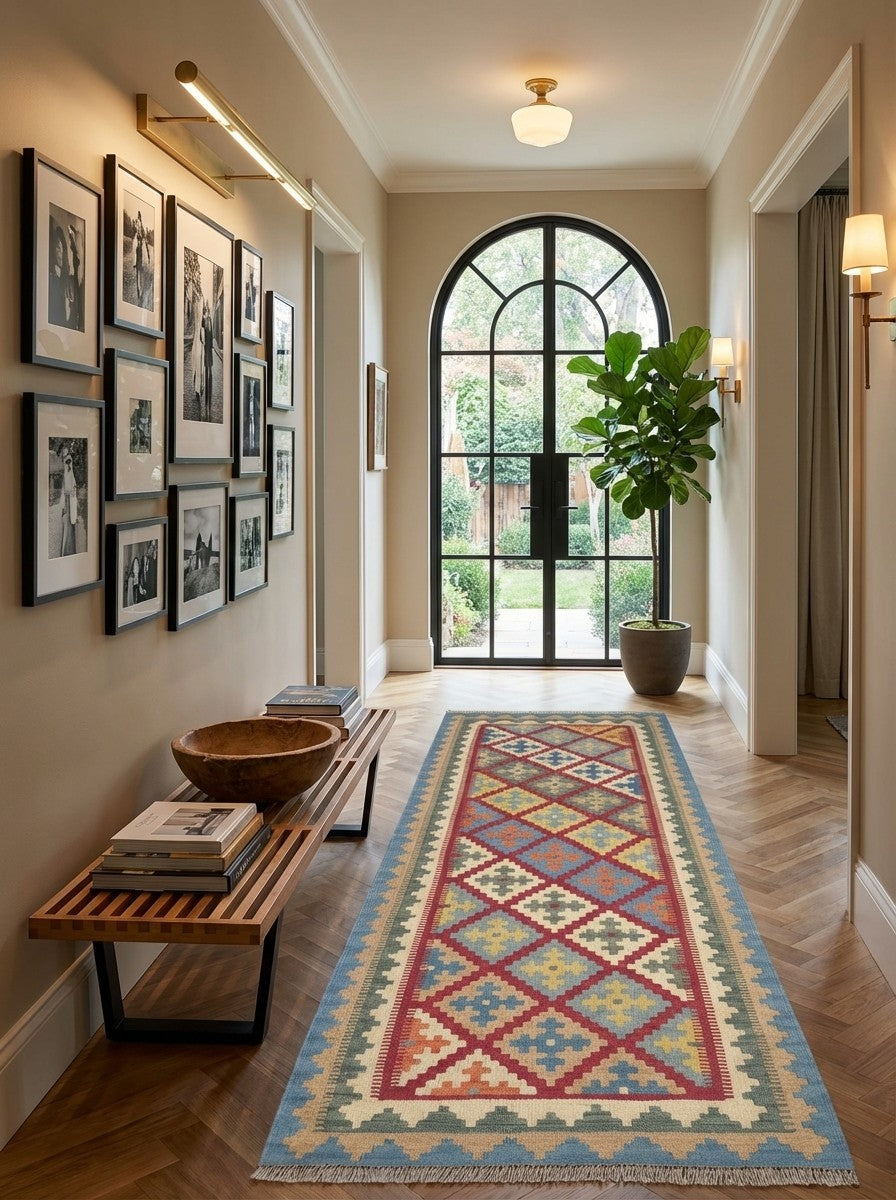
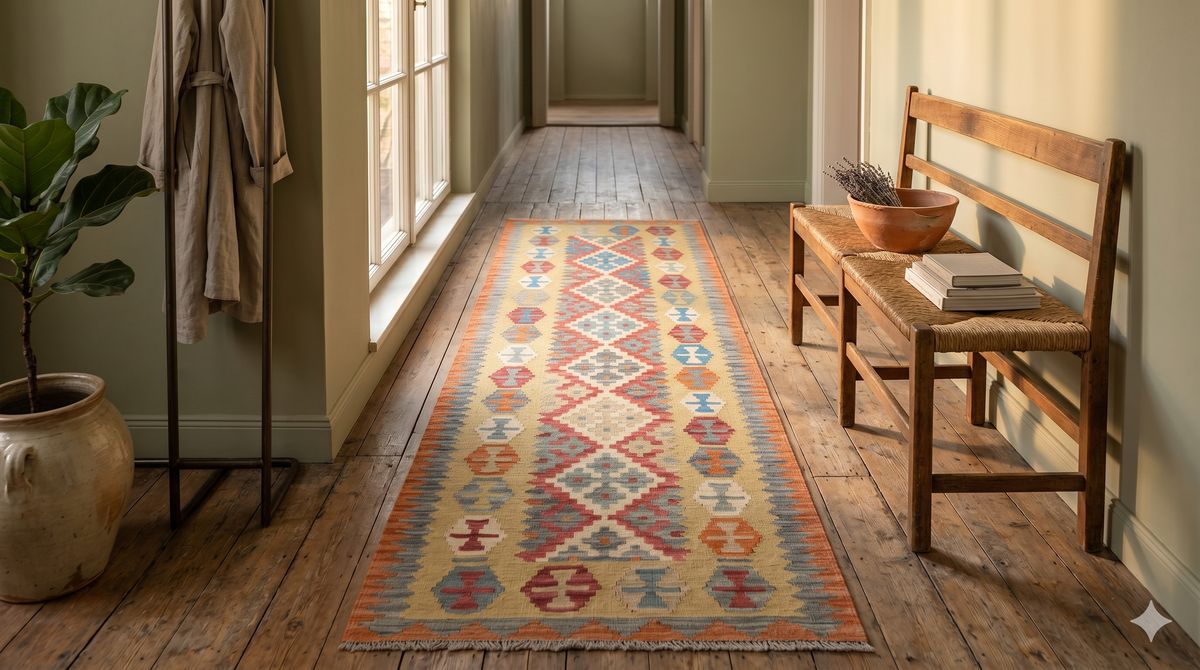
The right rug size is crucial for how your hallway feels. As a rule of thumb: leave about 15 to 20 cm of the floor exposed along the long sides. The rug should cover the main walkway, but not fill the entire width. This creates a clear line that visually elongates the space and makes it appear larger.
The wrong rug size can overwhelm a hallway and make it look smaller than it is. A rug that is too wide, reaching almost from wall to wall, makes the room appear cramped. A rug that is too short looks lost and disproportionate. The art is to choose a size that defines and guides the space without dominating it.
The most important rule is: show some floor. Ideally, 15 to 20 centimetres of the underlying floor should remain visible along the long sides of the rug. This border creates a clear visual line that draws the eye lengthwise, visually stretching the hallway. The rug should mark the main walkway, but not cover the entire area. A similar principle applies to the length: the runner should not start directly at the threshold or end flush against a wall. A little breathing room at both ends creates space and makes the overall picture look more harmonious.
During consultations, we see time and again how crucial proportions are. A well-chosen runner can transform a narrow, dark hallway into an inviting and elegant entrance area. To help you decide, we have integrated an AR visualizer on our website. With it, you can use your smartphone to place any rug virtually and to scale right in your own hallway. That way, you immediately see which size and pattern fit best. You can find more on this in our detailed rug size guide.
Care Tips: How Your Hallway Rug Stays Beautiful for Years
Caring for a wool rug in the hallway is straightforward. Regular vacuuming without a brush attachment removes loose dirt. You should dab stains immediately with a damp cloth and a little wool detergent, do not rub. Every few years, professional washing can refresh the colours again and care for the fibres; that is what our washing and repair service is there for.
The resilience of a hand-knotted wool rug is also reflected in its easy care. Forget complicated cleaning routines. The most important thing is regular but gentle care. Vacuum your hallway rug once or twice a week using a flat nozzle. Avoid rotating brush attachments, as these can put too much strain on the wool fibres over time.
Another simple yet effective tip is to rotate the rug 180 degrees every six to twelve months. This ensures it wears and fades evenly, especially if one side receives more sunlight or more foot traffic. With a reversible Kelim, you can take this opportunity to flip it over as well.
If a mishap does happen (a spilled drink or a muddy paw print), quick action is required. Absorb liquids immediately with an absorbent cloth or paper towel. Carefully lift off solid dirt with a spoon. Then, gently dab the stain from the outside inward with a clean, damp cloth and perhaps a bit of pH-neutral wool detergent. Important: never rub, as this works the dirt deeper into the fibres.
Every three to five years, depending on wear, we recommend a professional hand wash. It refreshes the colours and conditions the wool fibres thoroughly; you can request it via our washing and repair service. This way, your rug remains a loyal companion for many years to come.
FAQ
Which rug is suitable for a hallway with a dog or cat? For households with pets, durable, low-pile wool rugs such as Gabbeh or flatweaves like Kelim are ideal. Dense virgin wool is dirt-repellent and resilient thanks to its natural lanolin. The short fibres or flat weave offer claws little to grip, and pet hair can easily be vacuumed up.
Can you place a rug on tiles in the hallway? Yes, absolutely. A rug on tiles provides warmth, impact sound insulation, and a cosy atmosphere. To ensure safety and prevent slipping, we strongly recommend using a non-slip rug underlay. This also protects both the rug and the tiled floor beneath.
How long should a rug runner be in the hallway? A runner should cover the main walkway, but not fill the entire hallway. Leave about 20 to 30 cm of space at both ends, in front of the entrance door and at the end of the hallway. This prevents the rug from looking pinched and keeps the room's proportions harmonious. It should not end right at a door threshold.
Are light-coloured rugs unsuitable for the hallway? Not necessarily. Hand-knotted wool rugs, especially those with mottled patterns or natural colour variations (called Abrash), are remarkably forgiving. Minor dirt is barely noticeable in the lively texture. In addition, the natural lanolin content of the wool ensures that dirt only clings to the surface anyway and can be easily removed.
What is the advantage of a hand-knotted rug in the hallway? The decisive advantage is longevity and repairability. A hand-knotted wool rug is a lifetime investment that lasts for decades with good care and often even appreciates in value. Unlike machine-made rugs, it can be repaired by experts if necessary. Each piece is unique with its own story.
Are you ready to transform your entryway? A good rug makes all the difference between a simple passageway and a warm welcome. Discover our collection of durable and stylish runners, curated especially for the demands of the hallway. With our AR visualizer, you can try out your favourite right at home: open one of the rugs for the hallway and tap "View in your room" on the product page.