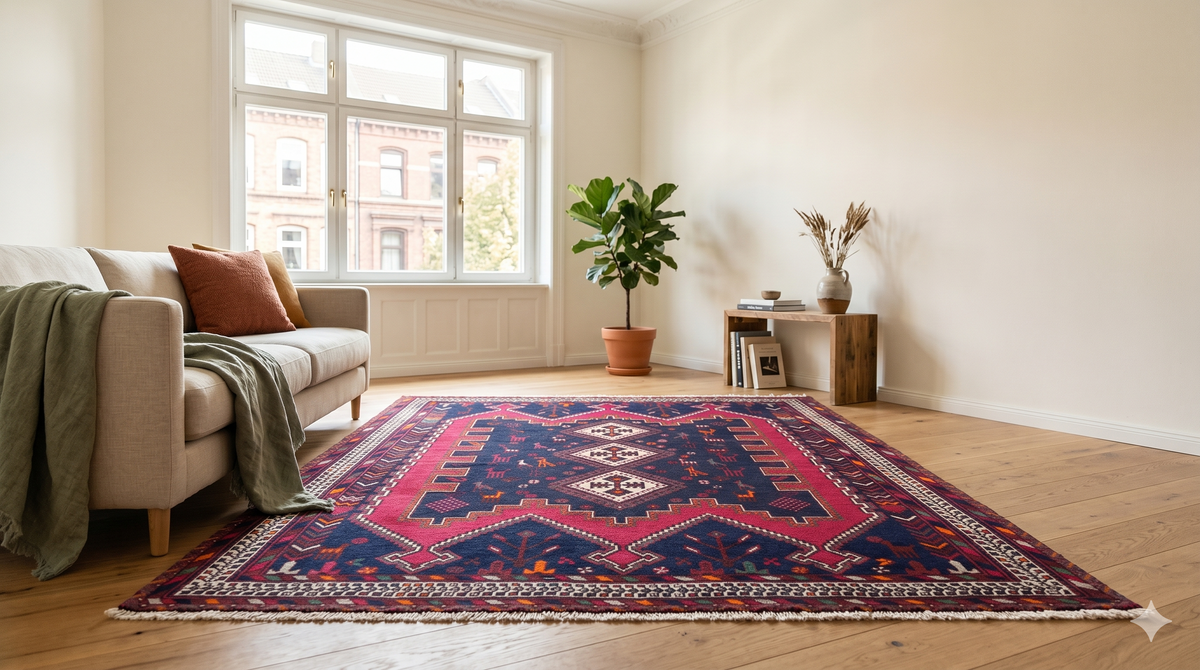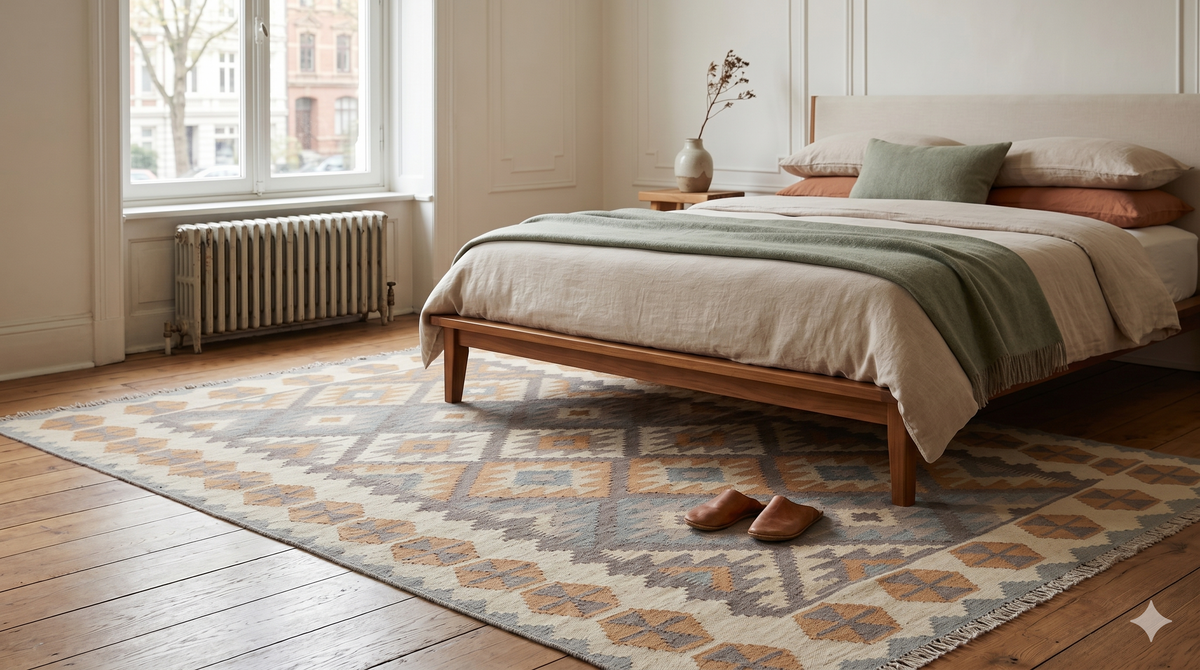
Which Rug Size for Your Bedroom?
TL;DR: The ideal rug size for your bedroom depends on your bed and room dimensions. Common layouts include: a large rug completely framing the bed and nightstands, a version placed two-thirds under the bed, or two runners along the sides of the bed. The goal is always to create a warm, soft "island" for your feet.
Why the Right Bedroom Rug Size Changes Everything
The right rug size defines zones, creates visual unity, and ensures a luxurious feel when getting up in the morning. A rug that is too small looks lost and disproportionate, while a well-fitting rug makes the room appear larger and cozier. It is the foundation that ties your bed and furniture together into a harmonious whole.
A bedroom is more than just a place to sleep; it is your retreat, your personal oasis of calm. Your choice of rug plays a decisive role in this. Imagine waking up in the morning, and the first contact your feet make with the floor is not cold and hard, but soft and warm. That little moment can set the tone for the entire day.
A rug in the right size creates a visual "island" that anchors the bed as the centerpiece and gives it a frame. It connects the individual pieces of furniture (bed, nightstands, perhaps a bench at the foot of the bed) into a cohesive overall look. At the same time, it noticeably improves room acoustics by absorbing sound and creating a quieter, more peaceful atmosphere. A rug that is too small, on the other hand, can break this effect and leave the bed "floating" lost in the room. Proportions are the key to a harmonious, welcoming ambiance.
Vida ter Hazeborg, Co-Founder: "The first step out of bed in the morning sets the tone for the whole day. When your feet land on soft, warm wool instead of a cold floor, it creates a small, daily moment of grounding. In the bedroom, a rug is less a piece of furniture and more the foundation of your personal sanctuary."
Ultimately, it is about creating a sense of comfort and security. A well-proportioned rug clearly defines the sleeping area and turns it into an inviting, self-contained space. Find inspiration for your bedroom here and discover how a rug can transform your space.
The 3 Proven Layouts: Which Arrangement Fits You?
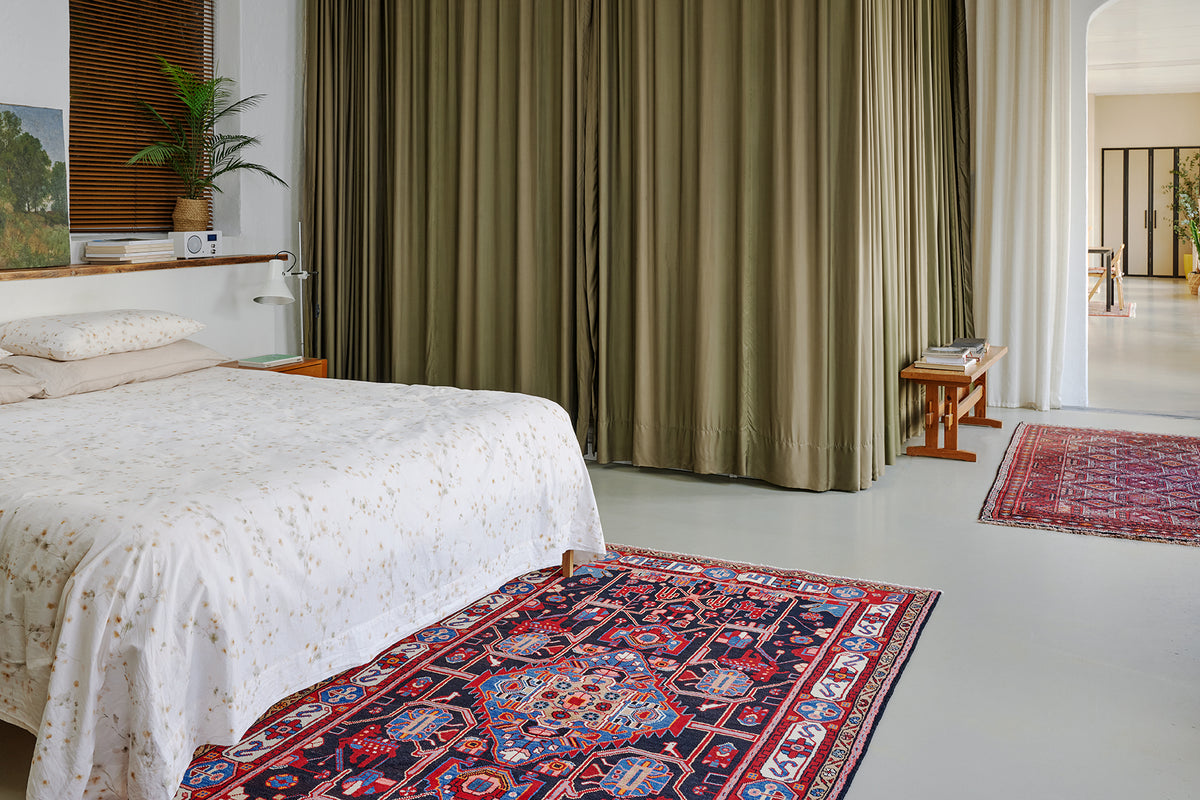
The three most common layouts are: the 'all-in' look, where the rug extends generously under both the bed and nightstands; the 'two-thirds' rule, where the rug starts in front of the nightstands; and the flexible 'runner' option with rugs on both sides of the bed. Your choice depends on your budget, room size, and desired effect.
Choosing a rug size is not just a matter of taste; it follows proven interior design principles. Here are the three most successful arrangements to help you find the perfect solution for your bedroom.
Layout 1: The Generous Frame ("All-in")
This is the most luxurious option. The rug is large enough to accommodate not only the entire bed, but also the nightstands and any bench at the foot of the bed. It should extend at least 50 to 60 cm on all sides. * Effect: Creates a sense of spaciousness and elegance, similar to a hotel suite. Defines the sleeping area as a large, cohesive unit. * Ideal for: Large bedrooms where you want to make a clear statement. * Example (for a 180x200 cm bed): Rug size approx. 300x400 cm.
Layout 2: The Practical All-Rounder ("Two-Thirds")
This is the most popular and often most practical solution. The rug is positioned so that it starts just in front of the nightstands, covering about two-thirds of the bed, and extends generously at the foot of the bed. That way, you still get a soft surface underfoot on both sides when getting up. * Effect: Effectively anchors the bed without completely dominating the room. A balanced, harmonious solution. * Ideal for: Most standard bedrooms. A great balance between visual impact and budget. * Example (for a 180x200 cm bed): Rug size approx. 250x300 cm.
Layout 3: Flexible Runners
With this option, you place two matching runners parallel along both sides of the bed. They should be slightly wider than the nightstands and stop short of the head and foot of the bed. * Effect: Creates symmetry and provides a soft landing on both sides. A modern, airy alternative. * Ideal for: Smaller or narrower rooms, asymmetrical layouts, or when you do not want to completely cover beautiful wood floors. * Example (for a 180x200 cm bed): Two runners, each approx. 80x250 cm.
To make your decision easier, we have compared the options below. For the "all-in" look, you can find our large-format rugs for the all-in look here.
| Feature | Layout 1: All-in | Layout 2: Two-Thirds | Layout 3: Runners |
|---|---|---|---|
| Effect | Generous, luxurious, cohesive | Harmonious, practical, anchoring | Flexible, modern, symmetrical |
| Ideal for | Large rooms, statement look | Most room sizes | Small/narrow rooms, wood floors |
| Typ. size | 300x400 cm | 250x300 cm | 2x 80x250 cm |
| Benefit | Maximum coziness | Great balance | Cost-effective, flexible |
Unsure which layout works best in your room? Use our AR visualizer on the website to test different sizes and styles virtually in your home.
Step by Step: How to Measure for the Perfect Rug Size
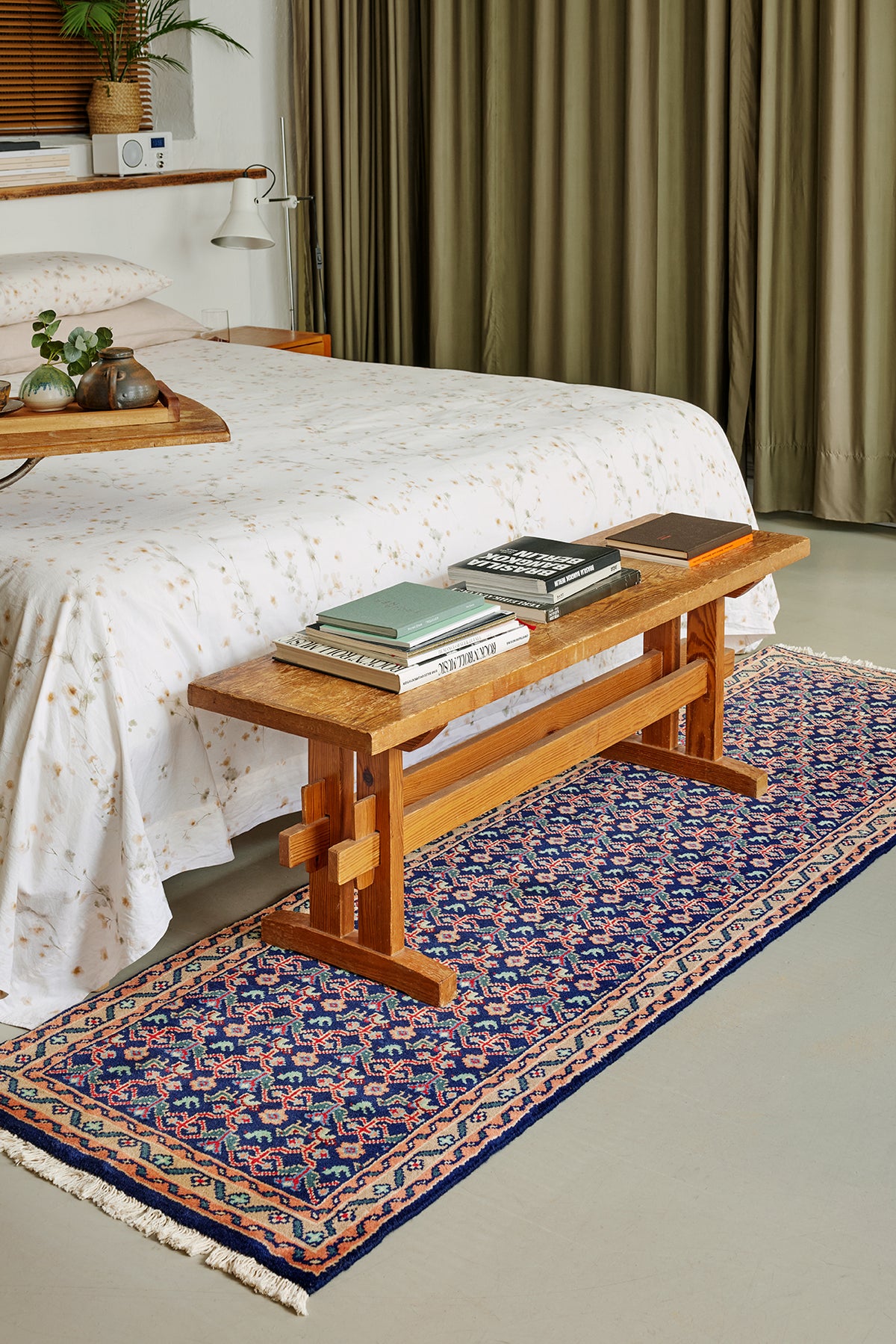
Use your bed measurements as a starting point. For a generous look, the rug should extend at least 50 to 60 cm on each side and at the foot of the bed. Lay out newspaper or painter's tape on the floor to visualize the final size. Also keep doors and wardrobe doors in mind so they can open smoothly.
Measuring is easier than you think. With a few simple steps, you can determine the exact dimensions your bedroom needs.
- Measure your bed: Start with the width and length of your bed. This is your anchor point. Note down the measurements.
-
Define the overhang: Decide how much rug should be visible at the sides and the foot of the bed. A good rule of thumb is at least 50 cm. In a larger room, this can easily be 80 cm or more. Add this overhang to your bed dimensions.
-
Example for Layout 2 (180x200 cm bed):
- Width: 50 cm (left) + 180 cm (bed) + 50 cm (right) = 280 cm
- Length: approx. 2/3 of the bed length (130 cm) + 50 cm overhang at the foot = 180 cm.
- A rug around 300x200 cm would already be a good choice here, 300x250 cm even better.
-
Example for Layout 2 (180x200 cm bed):
- Visualize the area: This is the most crucial step! Use painter's tape, newspapers, or old bed sheets to map out the calculated rug area on the floor. This gives you a true sense of the proportions in the room.
- Check practicality: Can all doors (room door, wardrobe doors) open smoothly without catching on the rug? Can you still open drawers on dressers or nightstands? Adjust the size slightly if necessary.
It is even easier to do digitally with our AR tool: open any of our bedroom rugs and tap "View in your room" directly on the product page.
The Right Material: From Fluffy Wool to Lightweight Kelim
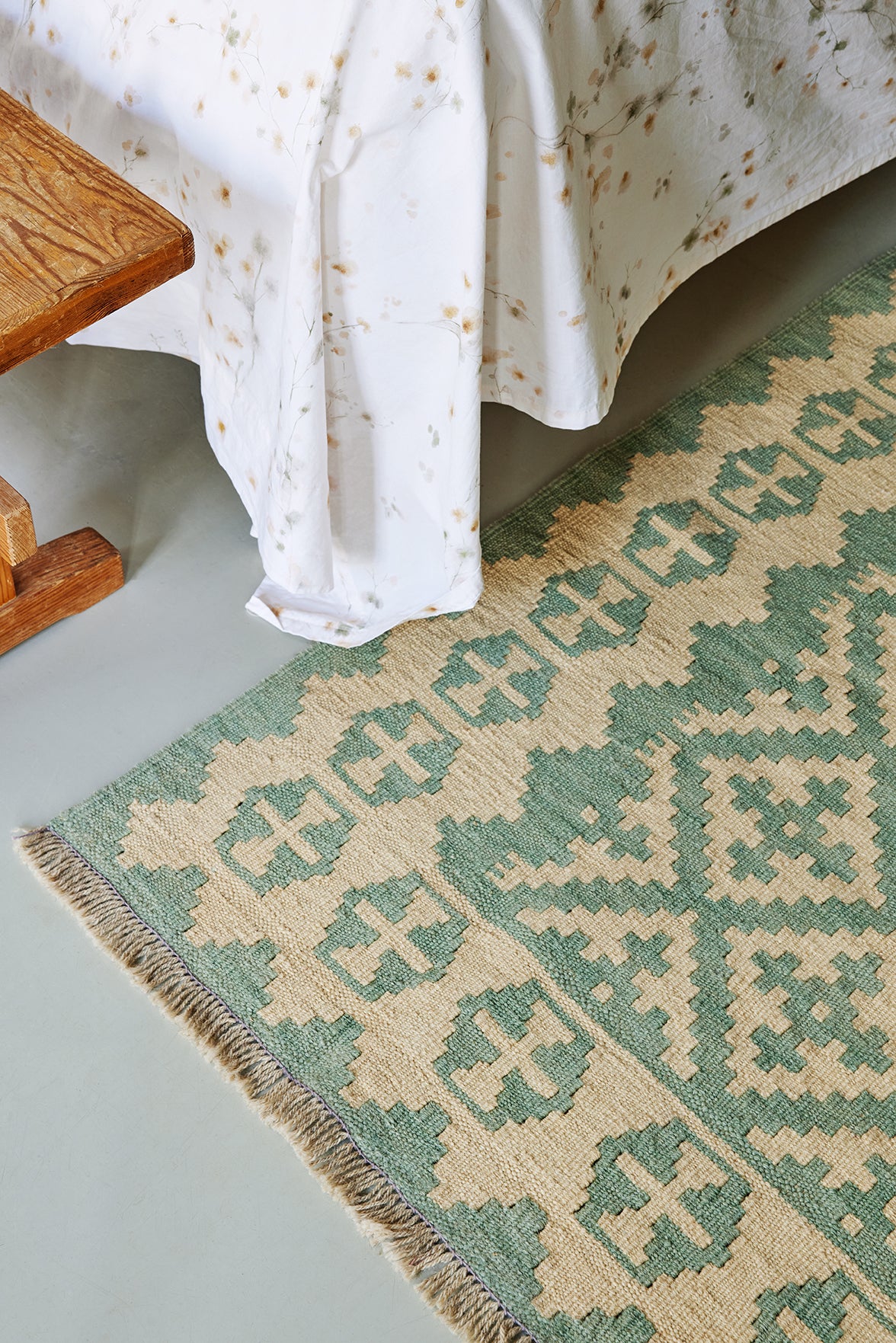
For the bedroom, virgin wool is the premier choice. It is soft, dirt-repellent, and naturally balances indoor humidity. A high-pile Berber rug maximizes coziness. A flatwoven Kelim offers an easy-care, often more colorful alternative that works particularly well for allergy sufferers or in smaller rooms.
Size is one aspect, the feeling underfoot is another. In the bedroom, where you often walk barefoot, the material is crucial to your well-being.
-
Virgin wool: The classic and our clear recommendation. Hand-knotted virgin wool rugs are incredibly soft and durable. The natural fiber contains lanolin (wool grease), which makes it naturally stain-resistant. Furthermore, wool regulates ambient humidity, contributing to a healthier sleeping environment. The benefits of pure virgin wool are truly unbeatable in the bedroom.
-
High-pile rugs: If you are looking for maximum comfort, high-pile rugs such as the renowned Moroccan Berber rugs are perfect. Their thick, shaggy pile is pure bliss for your feet and creates an exceptionally warm, cozy atmosphere. They are ideal for creating a luxurious, welcoming island in the bedroom.
-
Flatweaves (Kelim): A Kelim has no pile, making it flatter and lighter. This makes it remarkably easy to clean and ideal for allergy sufferers, as less dust can settle into the fibers. Our Kelim collection showcases just how versatile these pieces are; with everything from geometric patterns to vibrant colors, they bring character to the room without overwhelming it.
Time and again, we see how differently materials perform, from the dense, robust wool of a Gabbeh to the delicate structure of a Kelim. Each material tells its own story and brings a distinct feel to your home.
Common Rug Sizing Mistakes: And How to Avoid Them
The most common mistake is choosing a rug that is too small, leaving the bed "floating" instead of anchored. Another mistake is pushing the rug flush against a wall, which makes the room look smaller. Always leave at least 20 to 30 cm between the rug and the walls to create an airy, elegant look.
Sometimes small oversights disrupt the overall impression. Keep these points in mind to ensure your rug looks its absolute best.
- Mistake #1: The "postage stamp rug." A rug that is too small and sits lost in front of the bed makes the entire room appear disproportionate and unfinished. Solution: Follow the two-thirds rule. The rug should visually embrace and anchor the bed.
- Mistake #2: The rug hugs the wall. A rug should never sit right against a wall; this visually compresses the space. Solution: Always keep a "border" of at least 20 to 30 cm of exposed flooring between the edge of the rug and the walls. This makes the room feel airier and larger.
- Mistake #3: Proportions do not match the bed. The rug might be large enough overall, but the shape is off. A rug that is very wide but short can look awkward. Solution: Make sure the rug extends sufficiently beyond the sides of the bed so you can comfortably step onto it.
- Mistake #4: The door catches. A gorgeous high-pile rug quickly becomes frustrating if your bedroom door snags on it. Solution: Check the pile height and measure the clearance under your door before buying. When in doubt, a flatter rug or an alternative placement is the better choice. A quality underlay and proper rug care also help keep the rug in shape.
Whether the rug sits entirely under the bed, two-thirds under it, or in front depends on your room and bed. You can find the ideal overhangs for each option in our guide Rug Under or in Front of the Bed.
FAQ
Should the rug go under the nightstands? That depends on the look you want. If you want to create a very cohesive, luxurious hotel-suite feel, the "all-in" layout with the rug placed under the nightstands is ideal. For most rooms and budgets, however, having the rug start right in front of the nightstands (the "two-thirds" rule) is perfectly balanced and practical.
How much space should be between the rug edge and the wall? As a rule of thumb, leave a gap of 20 to 50 cm. This band of exposed floor acts like a passe-partout around a picture: it frames the rug and makes the entire room appear larger and more open. In very small rooms, the gap can be slightly smaller, but it should always be visible.
What rug size should you choose for a 180x200 cm bed? For a standard double bed, we recommend the following dimensions: for the practical "two-thirds" look, a size of at least 250x300 cm is ideal. If you prefer the generous "all-in" look including the nightstands, go for a rug around 300x400 cm. As a flexible alternative, two runners measuring 80x250 cm work beautifully.
Does a round rug also work in the bedroom? Yes, absolutely! A round rug can be a wonderful, playful alternative that softens rigid lines. It works best placed asymmetrically; for example, tucking under just one corner of the bed to define a reading nook. It can also sit freely in front of the bed to create a soft focal point in the room.
What is the best rug type for a bedroom with underfloor heating? Hand-knotted rugs made from natural fibers like virgin wool or cotton are generally well suited for underfloor heating. Flatwoven pieces like Kelim are especially ideal because they let heat pass through easily. High-pile rugs may slightly reduce heat transfer, but this is usually not an issue and adds a particularly cozy feel.
Find the Foundation for Your Oasis of Calm
Now you have the knowledge you need to find the perfect size for your bedroom rug. But the best theory is the one you can feel underfoot. Ready to transform your space? With our AR visualizer, you can view different sizes and styles directly in your own bedroom before making a decision.
Discover our selection of one-of-a-kind hand-knotted pieces in our bedroom collection and find the foundation for your personal oasis of well-being.