The Journey of a Hand-Knotted Rug — From Sheep to Your Living Room
TL;DR: A hand-knotted rug is created through a months-long process. It all begins with virgin wool from highland sheep, which is hand-spun and dyed with natural colours. At the loom, weavers then knot thousands of knots to form a pattern. After washing, shearing, and finishing, each piece undergoes a final inspection at our Hamburg warehouse.
Step 1: The Soul of the Rug – Selecting the Wool
The quality of a rug begins with the sheep. We primarily use virgin wool from the Persian highlands, as it is exceptionally robust and rich in lanolin. This natural wool grease makes the rug dirt-repellent and durable. The yarn is traditionally hand-spun, giving it a lively, authentic texture.
The journey of every rug doesn't begin at the loom, but on the vast highlands of Persia. There, sheep live whose wool must withstand harsher climatic conditions. The result is a fibre that is naturally thicker, more resilient, and richer in lanolin – the natural wool grease. This lanolin is a small miracle of nature: it envelops each individual fibre, acting like a protective shield against dirt and moisture. One reason why a high-quality wool rug is so easy to care for and durable.
After shearing, the wool is washed and then carded, or combed, to align the fibres for spinning. Hand-spinning is a crucial step that significantly shapes the rug's later appearance. Unlike machine-made yarn, which is perfectly uniform, hand-spun yarn has tiny, intentional irregularities in its thickness. These subtle variations ensure that the yarn absorbs the dye with varying intensity later, giving the finished rug unparalleled vibrancy and depth.
In our 6th-generation family business, established in 1952, we have learned over the generations to feel the quality of the wool with our hands. It's an almost instinctive ability to recognise whether a yarn has the right tension and character for a long-lasting rug.
Step 2: The Colours of Nature – Dyeing the Yarn

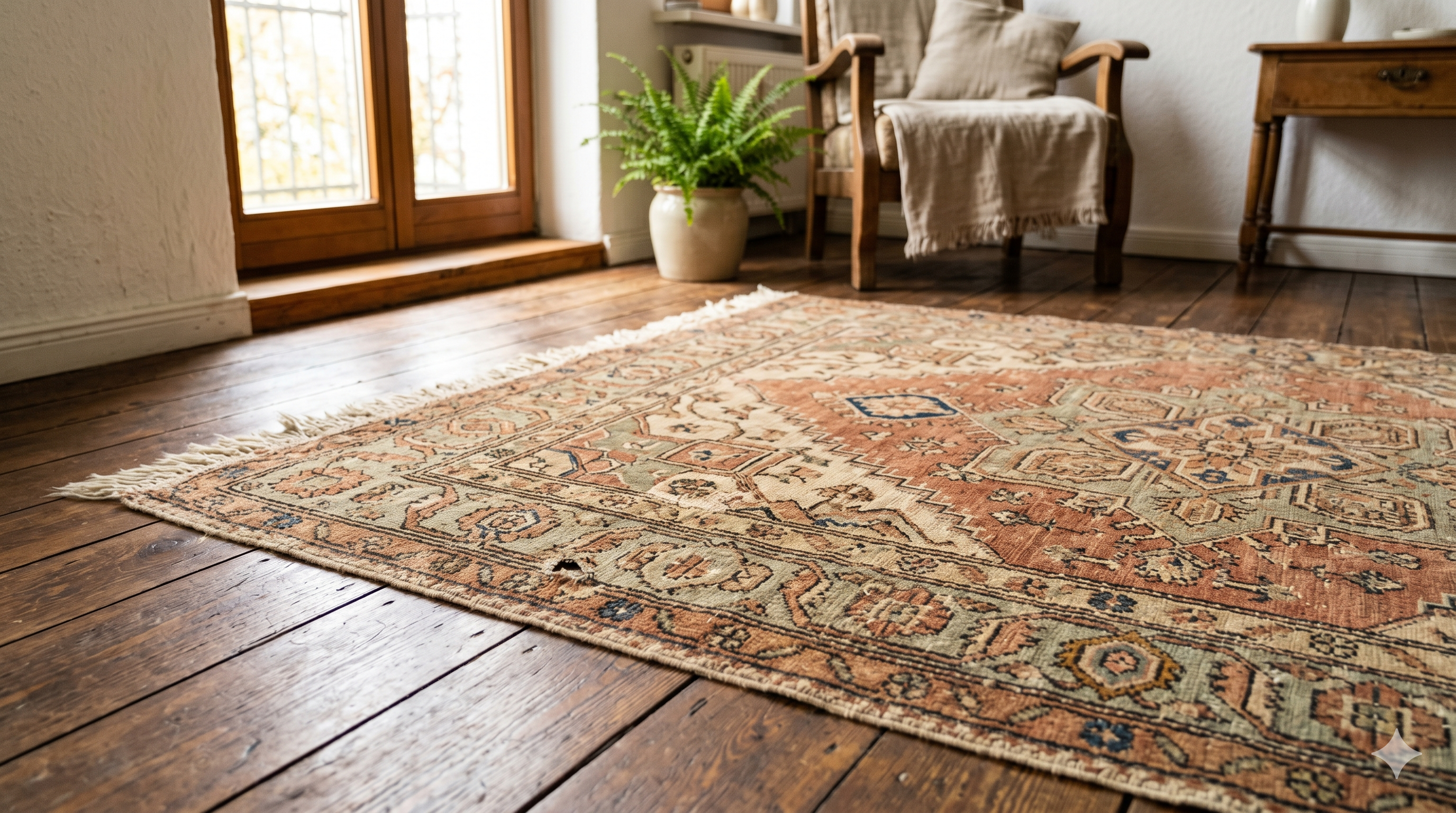
The colours tell the story of a region. Traditionally, natural dyes from plants like madder root for red or indigo for blue are used. These colours develop a unique patina over decades. Slight colour variations, known as Abrash, are due to different yarn batches and are a clear sign of genuine handcraft.
Colouring is the poetry of a rug. Instead of resorting to synthetic dyes, traditional production utilises a wealth of knowledge passed down from generation to generation. The colour palette comes directly from nature: vibrant red is extracted from the madder root, deep blue from the leaves of the indigo plant, and warm yellow and brown tones from pomegranate peels or walnut leaves.
The hand-spun wool strands are dyed in large vats over an open fire. This process requires immense experience, as temperature, water quality, and the duration of the dye bath all influence the outcome. Since only small batches can be dyed at a time, minimal colour variations occur between individual yarn strands. These nuances, known as what Abrash truly is, are not a flaw but the most beautiful certificate of authenticity. They create gentle, cloud-like transitions in the finished rug and prove that nature and craftsmanship were at work here.
| Feature | Natural Dyes | Synthetic Dyes |
|---|---|---|
| Source | Plants, minerals, insects | Chemical compounds |
| Colour Brilliance | Harmonious, deep, complex | Often bright, uniform |
| Ageing | Develop a beautiful patina | Can fade or discolour |
| Special Feature | Abrash (natural colour variations) | Perfectly uniform surface |
| Sustainability | Renewable resources | Petroleum-based, energy-intensive |
Step 3: The Heart of the Matter – The Knotting Process at the Loom

Knotting is the heart of the process and pure handcraft. On a vertical or horizontal loom, each individual knot is hand-tied around the warp threads and tightened. Depending on the fineness, a rug can have over 500,000 knots per square metre, which means months or even years of work.
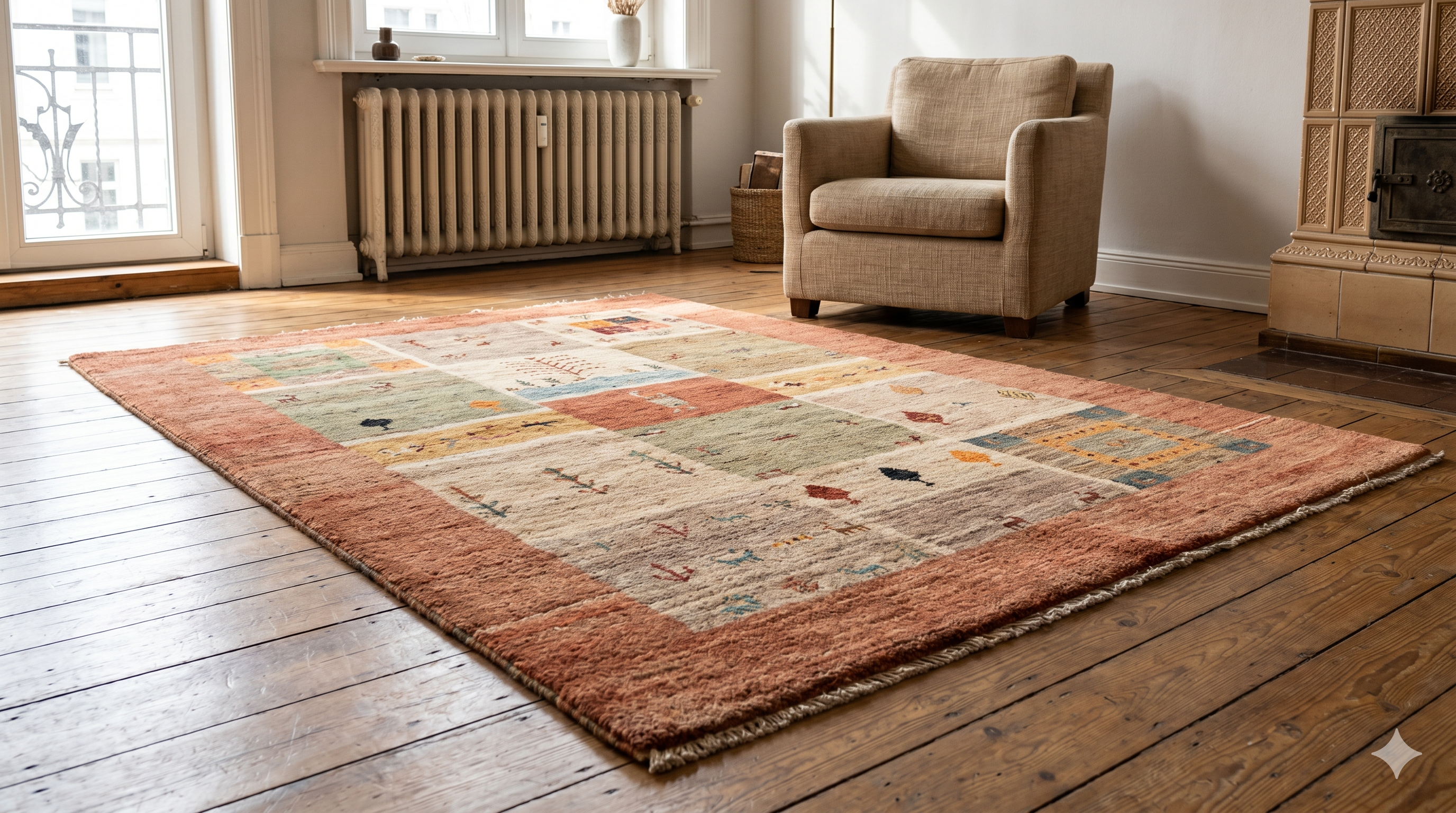
At the loom, the dyed yarn transforms into a work of art. This is where the full mastery of the weavers is truly evident. Depending on tradition, different types of looms are used. Nomadic tribes like the Gashgai often use horizontal looms, which lie on the ground. These practical looms can be easily rolled up when moving and are characteristic of producing authentic nomadic rugs.
In cities, however, where finer rugs are created, large, vertical looms dominate. On these, multiple weavers can work simultaneously on complex patterns, often read from a template, known as a 'Karton'. This is where, for example, the detailed fine city rugs with their floral ornaments originate. The technique differs fundamentally from weaving a flat-woven Kelim, as here a pile is created by thousands of individual knots.
Amin Ipektchi, Co-Founder: „I always look at the back of a rug first. That's where You see the truth – the density and uniformity of the knots. It’s fascinating to imagine that each of these tiny points was a deliberate hand movement. An experienced weaver might create 1,000 knots per hour. When You extrapolate that to an entire rug, You gain a deep sense of reverence for the patience and the craftsmanship behind it.“
After each row of knots, a weaver inserts a weft thread and compacts the weave with a heavy comb. Knot by knot, row by row, the rug thus grows in height over months.
Step 4: The Finishing Touch – Washing, Shearing, and Stretching

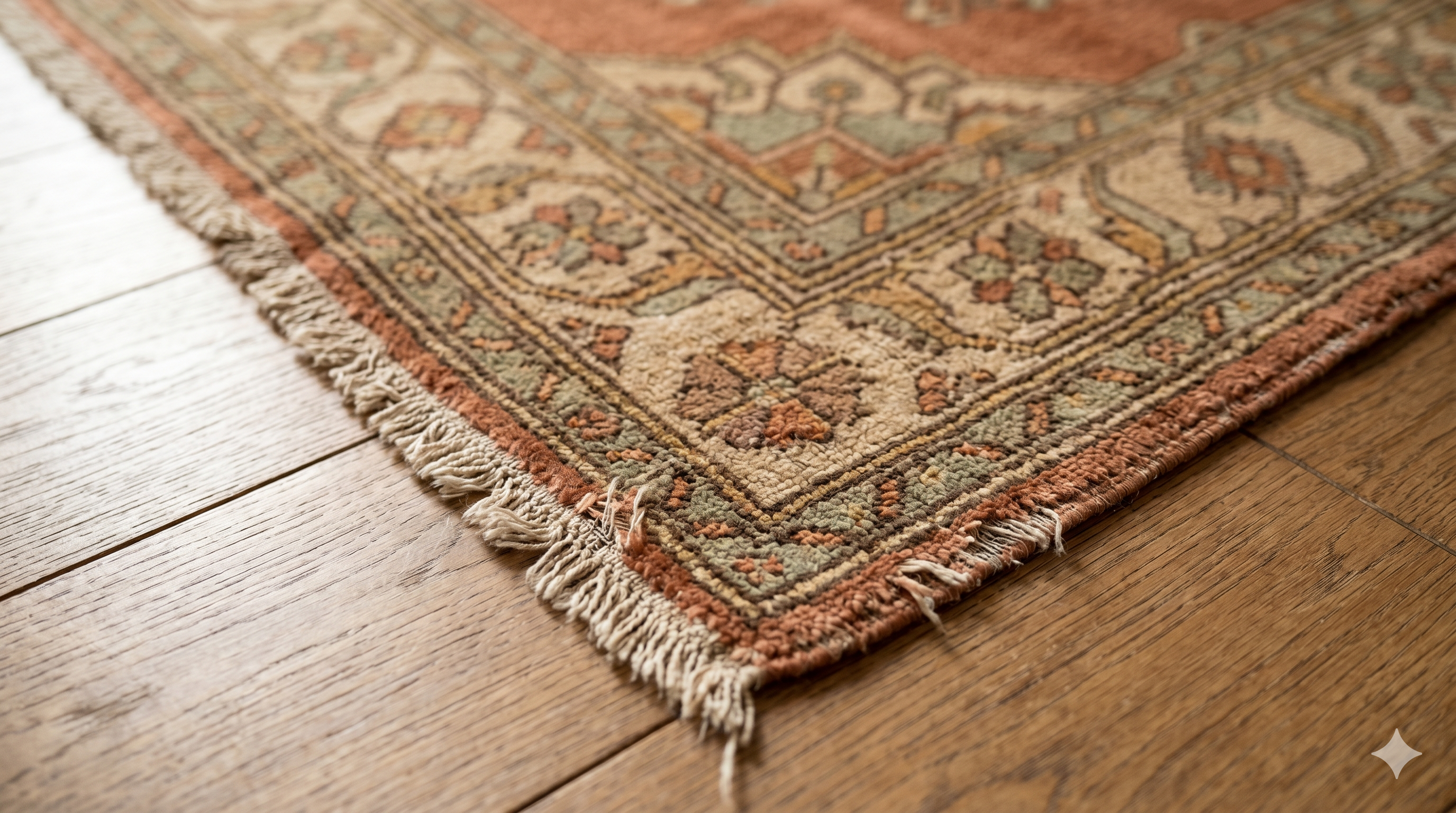
After knotting, the rug is not yet finished. It is washed several times to remove excess dye and dirt and to soften the wool. Subsequently, the pile is sheared to a uniform height, which gives the pattern its final sharpness. Finally, the edges are secured and the rug is stretched.
When the last knot is tied, the rug is cut from the loom. It still feels rough and shaggy at this point. The finishing is a crucial step that gives the rug its final sheen and structure. First, a thorough wash follows. This not only removes dust and dirt from the knotting process but also excess dye pigments. The wool becomes softer, and the colours begin to glow.
After that comes the shearing. With special scissors, requiring great skill, the pile is trimmed to a uniform length. This step is like the final polish of a diamond: it brings out the contours of the pattern sharply and clearly. Too short a shear would destroy the pattern; too long would make it appear blurry.
Finally, the side edges (Shirazi) are reinforced and the fringes secured. The rug is stretched onto a frame so that it lies perfectly flat and doesn't warp. Only after these steps is the weavers' work complete and ready for its journey. A professional rug wash is also an important part of its later care to preserve this beauty.
Step 5: Arrival in Hamburg – Our Quality Inspection
Every rug that arrives with us undergoes a strict inspection at our Hamburg warehouse. We check the knotting, the edges, and the overall condition. Subsequently, each piece receives a professional, organic hand wash. Only rugs that meet our quality standards become part of the Rugtales collection.
The journey ends in our Hamburg warehouse. For us, this is perhaps the most important moment. Here, we personally handle each individual piece and inspect it according to the standards our family has maintained for over 70 years. We check the knot density, the firmness of the edges, and look for any small imperfections that might have arisen during the long process.
Subsequently, every rug receives a final, gentle organic hand wash. This makes the colours truly shine and ensures that Your new rug arrives absolutely clean. Should we find a small, loose spot, it is expertly repaired by our specialists before the rug goes on sale. This process is part of our promise as a family business.
I recall an old Gashgai rug we received for our vintage collection. During washing here in Hamburg, a tiny, re-dyed spot suddenly came to light, barely visible. A weaver had made a small repair decades ago with a slightly different yarn. For us, this was not a flaw, but a touching signature – a story within a story. It is precisely these traces of human handiwork that make each piece truly unique. Our certifications through STEP and CARE & FAIR ensure that fair working and living conditions always underpin these stories.
FAQ
How long does it take to make a hand-knotted rug? The production time largely depends on the size, knot density, and complexity of the pattern. A small, simply patterned nomadic rug can be completed in a few months. A large, finely knotted city rug with over 500,000 knots per square metre can, however, represent over a year's work for a single person.
What is the difference between a hand-knotted and a machine-made rug? The main difference lies in character and longevity. Hand-knotted rugs exhibit small, charming irregularities – such as Abrash or edges that aren't perfectly straight – which prove their authenticity. Each knot is individually tied, which makes them extremely durable. Machine-made items are perfect and uniform, but often less robust and lack the soul of a handmade piece.
Why are hand-knotted rugs so valuable? Their value stems from several factors: the immense time investment (often hundreds or thousands of hours of handiwork), the high quality of materials (natural virgin wool and plant dyes), and the invaluable cultural heritage. Each rug is a work of art that carries the knowledge and traditions of generations.
What does ‘Abrash’ mean in a rug? Abrash refers to the natural colour variations within a single colour in the rug. These occur because the yarn is hand-dyed in small batches, which never achieve exactly the same shade. Instead of a flaw, Abrash is a highly valued characteristic that proves the authenticity and handmade nature of a rug.
Are Rugtales rugs made in Hamburg? No, the rugs are knotted in their traditional regions of origin by experienced weavers, for example, by Gashgai nomads. Our Hamburg warehouse is the centre for finishing and quality assurance. Here, every rug is finally inspected, organically hand-washed, and, if necessary, professionally restored before it comes to Your home.
Now that You know the soul and months of work behind each unique piece, we invite You to discover the finished stories in our collection. Find out which rug best suits Your life with our AR visualiser, right on Your smartphone. Browse our selection of hand-knotted individual pieces.