Frayed Rug Edges: Repair or Replace?
TL;DR: A damaged rug edge does not mean the end for your favorite piece. With high-quality, hand-knotted rugs, a repair is almost always possible and worthwhile. You can often secure minor, loose threads yourself, while structural damage such as fraying edges requires a professional hand to preserve the rug's value and longevity.
Why do rug edges fray in the first place?
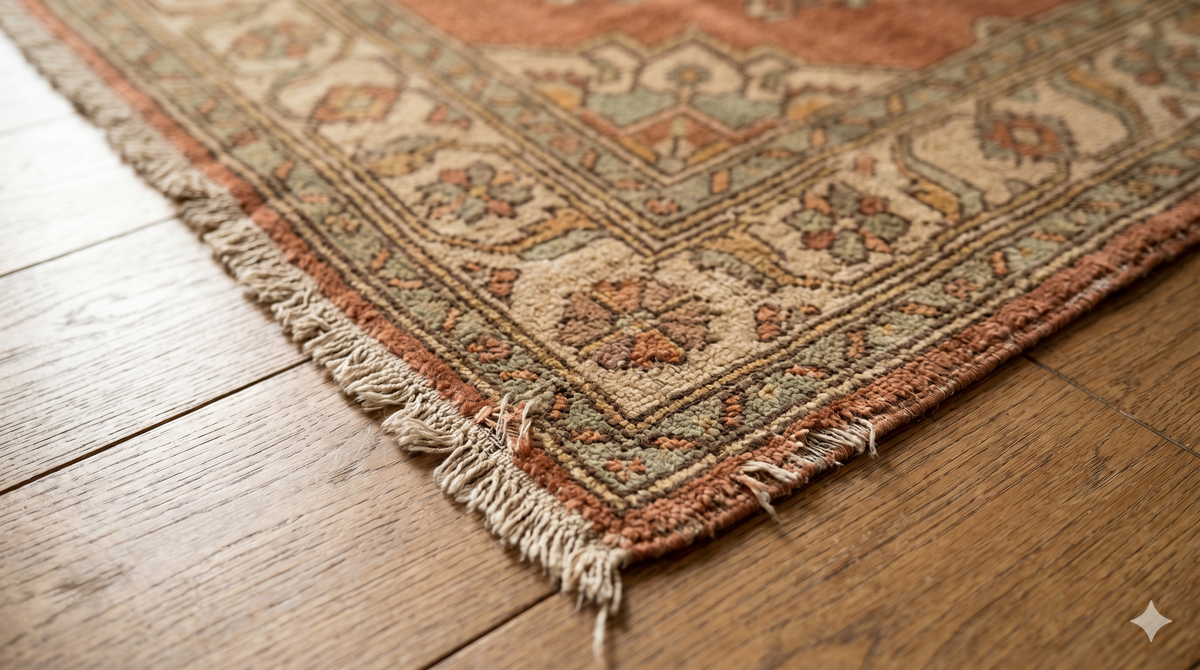
Rug edges, also known as sides or selvedges, are the most heavily stressed parts of a rug. They suffer from constant friction caused by foot traffic, sharp vacuum cleaner nozzles, and natural material fatigue. The corner areas are especially vulnerable, as fabric tension is highest here and they frequently bend over or get caught.
The edges of a hand-knotted rug are its structural backbone. They enclose and protect the warp threads, which form the foundation of the entire weave. This side wrapping, known as the selvedge, is crafted by hand during the knotting process and is crucial for stability. Yet it is precisely this exposed position that also makes them vulnerable.
The main cause of damage is everyday mechanical wear and tear. Every step, every shifting of a chair, and every pass of a vacuum cleaner creates friction. Vacuum cleaners with rotating brushes are especially problematic. These can catch in the wool fibers of the edge and tear out individual threads or even entire bundles. Over time, the fibers fatigue, lose their elasticity, and break. The corners are the most critical points, as this is where the warp and weft threads meet and tension is at its highest.
A frequent culprit is the robot vacuum: when the device runs along the exact same edge day after day for months, it continually tugs at the wool until the fibres yield and the selvedge unravels. Mindful care offers far better protection here than any later repair.
Assessment: DIY or take it to a professional?
The decision between a DIY repair and professional help depends on the damage and the value of the rug. Securing a single loose thread is often straightforward. However, as soon as the underlying structure is affected, warp threads become visible, or entire sections fray, professional help is essential to avoid greater damage and loss of value.
Before reaching for needle and thread, you should carefully assess the damage. Is it just a single protruding pile thread? Or is the side binding, the edge itself, damaged and unraveling? The latter is a structural issue that, if ignored, can trigger a domino effect: the outer rows of knots lose their hold and the rug begins to unravel from the side.
Another factor is the value of your rug. For an authentic, hand-knotted piece made of high-quality virgin wool, a professional repair is almost always an investment that preserves or even enhances its value. For an inexpensive, machine-made rug, repair costs can quickly exceed the replacement value. The risk of causing more damage with an improper DIY repair is high. The wrong yarn, or tension that is too tight or too loose, can distort the edge and worsen the problem. To prevent such damage from the outset, proper care of your hand-knotted rug is crucial.
| Feature | DIY repair | Professional repair |
|---|---|---|
| Damage type | Single, loose pile thread; minimal, superficial wear | Unraveled edge, visible warp threads, frayed corners, tears |
| Suitable for | Minor, cosmetic touch-ups in inconspicuous spots | Hand-knotted rugs, vintage pieces, valuable heirlooms |
| Risk | Low if done carefully. Incorrect technique can worsen the damage. | Minimal. Experts use original materials and techniques. |
| Cost | Low (needle, matching yarn) | Depends on damage and length; usually calculated per linear meter |
First aid: What you can do yourself right away
With minor damage, you can prevent worse issues. You should never cut off a single protruding thread, as this further unravels the structure. Instead, try to gently tuck the thread back into the weave using a needle. Loose edge threads can be temporarily secured by wrapping them manually with a strong, color-matching yarn.
If you notice minor damage to your rug edge, prompt action is needed to prevent it from spreading. The most important rule: never reach for the scissors! A protruding thread is often a long wool fiber from a knot. If you cut it off, the knot slowly comes undone, leaving a small hole behind. Instead, take a blunt needle and try to gently push the thread back into the dense pile fabric so that it is no longer visible.
If the edge wrapping has come loose in a small spot, you can apply a temporary fix. Use a strong wool or cotton yarn that matches the color as closely as possible, and wrap the damaged section firmly without bunching the fabric together. This is not a permanent solution, but it prevents the damage from expanding until a professional repair is done. Avoid glues or textile adhesives under all circumstances. These harden the fibers, make them brittle, and render a subsequent professional repair nearly impossible.
Prevention is simple: Much edge damage is caused by vacuum brushes that are too aggressive. A smooth nozzle without rotating elements protects the edges of your rug best.
How a professional edge repair works
A professional repair begins with a precise analysis of the original material and weaving technique. Then, the damaged edge is restored by hand, re-knotting or wrapping it thread by thread with wool that matches in color and material. This allows the original stability and appearance to be faithfully restored. You can request such a repair through our cleaning and repair service.
When a rug comes to us for repair, we treat it with the respect that a handcrafted piece of art deserves. Since our founding in 1952, our family has passed down this knowledge across generations. Every one of our rug experts knows that a good repair must be invisible.
The process follows clear steps: 1. Analysis: First, the rug is thoroughly examined. Which region does it originate from? Which knotting technique was used? Which type of wool, which dye? 2. Material selection: The crucial step is selecting the right yarn. Hand-spun virgin wool is needed, matching the original precisely in thickness, twist, and color. The natural color variations, known as Abrash, are also carefully matched so the final result looks authentic. 3. Handcraft: The actual repair is pure manual craftsmanship. Damaged threads are removed, and the edge is rebuilt using the original technique. This means the warp threads are wrapped with the new wool yarn in precise stitches to recreate the original density and firmness. 4. Quality control: After the repair, the edge is inspected multiple times. It must feel smooth, remain sturdy, and blend seamlessly into the rug's overall appearance. Only when these criteria are met is the work complete.
When a repair no longer makes sense
Although a great deal is possible, there are limits. If repair costs exceed the emotional or material value of the rug, a replacement may be more sensible. This also applies to extensive moth damage that has destroyed the underlying structure, or severe rot caused by water damage. In these cases, stability can no longer be guaranteed.
A repair is a craft that requires time and expertise, and that comes at a price. For a valuable heirloom or a rare nomadic rug, this investment is almost always justified. For a rug whose material value is less than the repair costs, you have to make a personal decision. How attached are you to the piece?
There are also technical deal-breakers. If the foundation fabric, meaning the warp and weft threads made of cotton or wool, has become brittle or rotted from extensive moth damage or prolonged water exposure, the base for a stable repair is missing. You cannot attach a new edge to a foundation that is itself falling apart. In such rare cases, we sometimes have to inform a customer with a heavy heart that saving it is no longer possible. Sometimes, it is then time to begin a new story. Perhaps you will find a new favorite piece with us, such as one of our particularly robust Kelim pieces, which are renowned for their durability.
Prevention: How to protect your rug edges effectively
Prevention is the best protection for your rug edges. Use a non-slip rug underlay to minimize friction on the floor. Rotate your rug 180 degrees every six months to avoid one-sided wear. When vacuuming, skip rotating brushes along the edges and use a smooth nozzle instead.
The best way to avoid a repair is to keep damage from happening in the first place. With a few simple habits, you can significantly extend the lifespan of your rug and its edges. * The right underlay: A high-quality rug underlay not only prevents slipping, but also acts as a shock absorber. It reduces friction between the rug and the floor and cushions pressure with every step. * Regular rotation: Your rug is rarely walked on evenly; traffic pathways usually develop. Rotate it 180 degrees every six months. This distributes the stress evenly and prevents one side from wearing out prematurely. * Gentle vacuuming: As mentioned, aggressive brushes are poison for edges. Always use a smooth upholstery or crevice nozzle for the borders of your rug. You can gently clean the pile in the center with a standard rug nozzle. * Immediate action: Inspect your edges regularly. If you discover the first small loose spot, act immediately according to the first-aid tips above. That way, a minor problem will not turn into a major one. You can also find more valuable rug care tips in our guide.
FAQ
How much does a professional rug edge repair cost? The cost depends heavily on the extent of the damage, the fineness of the rug, and the material used. As a rule, pricing is calculated per linear meter of edge. Prices may start at around €30 to €50 per meter, but can be higher for very fine or complex repairs. For an accurate estimate, an individual quote following an inspection of the piece is always required.
Can every type of rug edge be repaired? Yes, in principle, the edges of nearly all hand-knotted rugs, whether made of wool, cotton, or silk, can be professionally repaired. The artisanal structure allows for a faithful restoration. For machine-made rugs with serged or glued edges, a repair is often more difficult, less durable, and less frequently economical.
How do I recognize a high-quality repair? An excellent repair is barely noticeable at first glance. The yarn used should match the original perfectly in color, thickness, and texture. The new edge must be firmly and evenly wrapped without pulling or distorting the rug fabric. It feels smooth and sturdy again, without hard, uneven spots or visible transitions.
Is a repair worthwhile even for a less expensive rug? That is a very personal decision. If the rug holds great emotional value for you because it is an heirloom or a special memory, a repair can be entirely worth it. From a purely economic standpoint, repair costs should not substantially exceed the replacement value. For any hand-knotted piece, however, it is almost always an action that preserves its value.
What is the difference between serging and a handmade edge? Serging is a machine process in which yarn is stitched around the cut edge of fitted carpets or area rugs using a specialized sewing machine. A handmade edge on a hand-knotted rug, the selvedge, is an elaborate, manual wrapping of the outer warp threads that is an integral component of the rug's structure and is crafted entirely by hand.
How long does a professional repair take? The turnaround time depends directly on the extent of the damage. Securing a small loose spot can be completed in a few days. Completely renewing the edges on a large rug, however, is time-consuming handwork and can take one to two weeks or longer. Precision and patience are essential here for a flawless result.
Is your rug beyond saving after all, or are you longing for a change? Sometimes it is time for a new chapter in your home. Discover our collection of unique hand-knotted rugs, whose sturdy edges are made for a long life right from the start. With our AR visualizer, you can view each piece directly with "View in your room" before making your decision.