Bakhtiari Rugs: The Art of Four Seasons Patterns
TL;DR: A Bakhtiari rug is a hand-knotted work of art created by the tribes of the same name from the Zagros region. It is characterized by the Khesti pattern, which is reminiscent of a Persian garden and often depicts the four seasons. These robust rugs are knotted from high-quality mountain wool and are renowned for their durability and vibrant, plant-based dyes.
What exactly is a Bakhtiari rug?
A Bakhtiari rug is more than just a floor covering; it is a piece of nomadic culture from the Zagros Mountains. Knotted by the Bakhtiari tribes, it stands out for its robust structure made of thick mountain wool and the famous Khesti or garden design. Each panel tells its own little story.
A Bakhtiari is the result of generations of knowledge passed down in the high plains of the Persian Zagros Mountains. These pieces are knotted by the semi-nomadic Bakhtiari tribes, whose lives are closely intertwined with nature and the changing seasons. This is precisely what is reflected in every single one of their rugs. Unlike the delicate, floral patterns of city rugs or the abstract geometry of other nomadic rugs, Bakhtiari rugs often tell a very structured, pictorial story.
The foundation of their extraordinary durability is the material: the wool comes from sheep that live in the harsh high elevations of the mountains. This wool is naturally dense, resilient, and rich in lanolin, the natural wool grease. This lanolin acts like a protective shield, making the rug dirt-repellent and ensuring that it retains its shape and beauty even after decades of intensive use. The knotting itself is firm and compact, giving the rug a heavy, reassuring feel. When you hold an authentic Bakhtiari in your hands, you immediately sense its substance and longevity. It is made to last. Discover the world of robust nomadic rugs and village artworks.
The Khesti pattern: A garden for eternity
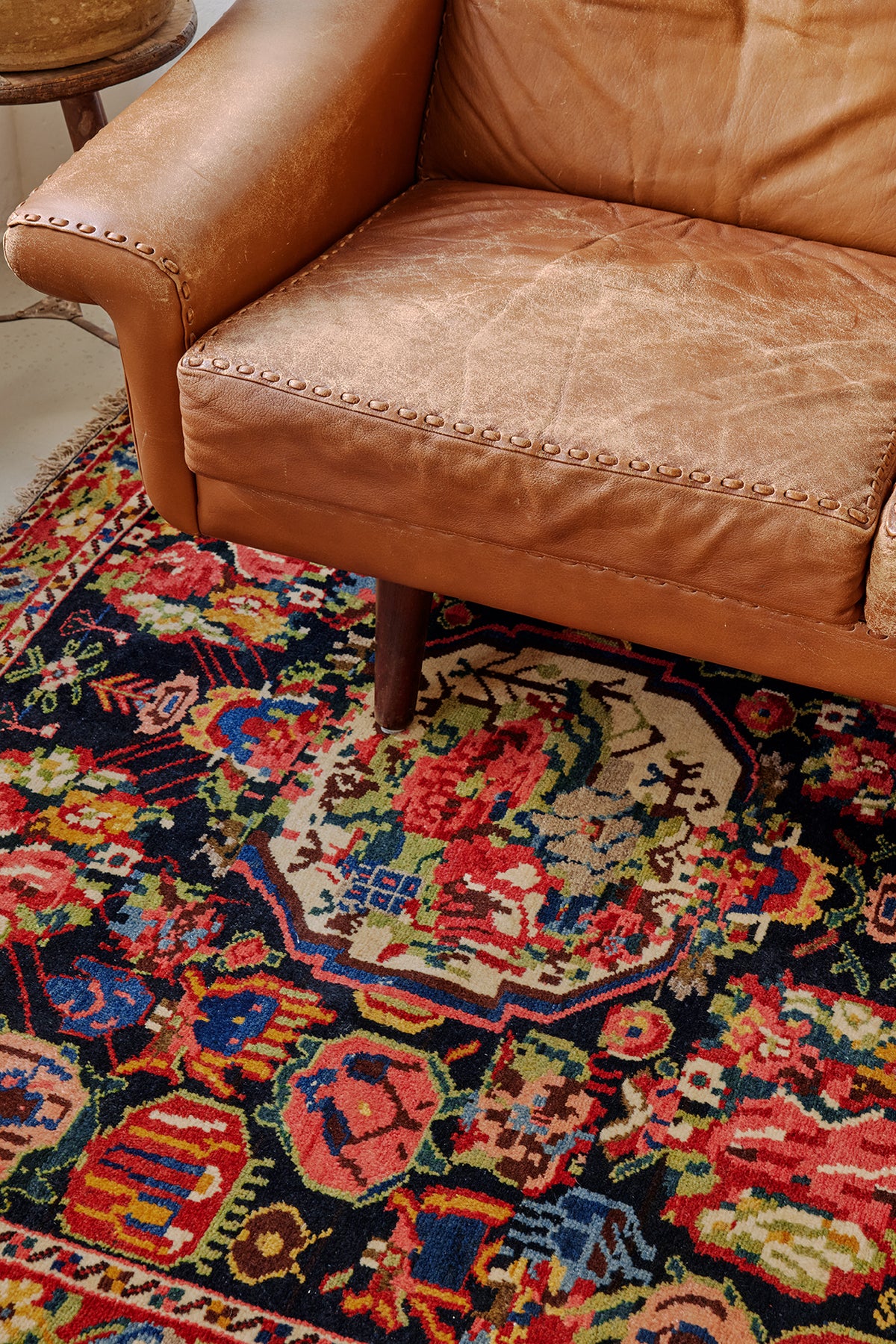
The Khesti pattern is the heart of many Bakhtiari rugs. It divides the rug into rectangular or diamond-shaped compartments, each filled with individual motifs such as cypresses, willows, or blossoms. This layout symbolizes the Persian garden (Tschahār Bāgh) and often represents the harmony of the four seasons.
Perhaps the most fascinating feature of Bakhtiari rugs is their design, especially the Khesti pattern, which translates roughly to "tile". Imagine a magnificent Persian garden viewed from above: a clear layout of pathways and flowerbeds in which a diverse variety of plants thrives. It is precisely this image that the weavers translate into wool. The rug is divided into many small panels by a grid, with each of these panels becoming a canvas for its own motif.
In one panel, you might find a stylized weeping willow, a symbol of love and sorrow; in the next, a cypress tree, representing eternal life. Still other panels display blossoms, birds, geometric ornaments, or even small animal figures. No two panels are alike, yet together they form a harmonious, balanced whole. This arrangement pays homage to the "Tschahār Bāgh", the quadripartite Persian garden, which is considered an earthly reflection of paradise. A Bakhtiari rug brings this garden into your home, creating a space of order, beauty, and eternal spring.
Amin Ipektchi, Co-Founder: "For me, a Bakhtiari is the most beautiful expression of longing. The nomadic tribes live in what is often a barren mountain landscape. Through the Khesti pattern, they weave the memory of and hope for a blooming garden directly into their tents. Each panel is a small window into an ideal world, full of life and symmetry. That is not mere decoration; that is living culture."
From wool to artwork: Material and knotting technique
The exceptional durability of a Bakhtiari rug begins with the wool. The Bakhtiari use the particularly fatty, lanolin-rich wool of their high-mountain sheep, which they often spin by hand and dye with vegetable dyes. Knotting is usually done with the symmetrical Turkish knot on sturdy cotton warps, making the rugs extremely resilient.
The quality of a hand-knotted rug stands and falls with its wool. The Bakhtiari have a decisive advantage here: their sheep graze at high altitudes where the climate is harsh. As a result, the animals' fleece becomes exceptionally dense and rich in lanolin. This highland virgin wool is the secret behind the rugs' legendary longevity. It is less susceptible to dirt and abrasion, and it develops a natural sheen that becomes even more beautiful over the years.
The shorn wool is traditionally spun by hand. This process gives the yarn a subtly irregular thickness, which later lends the rug a vibrant, authentic texture. It is generally knotted using the symmetrical knot, also known as the Turkish knot. This knot is looped around two warp threads and then packed down firmly, resulting in an exceptionally tight and stable structure. The warp and weft, the foundation of the rug, are usually made of durable cotton. The dense, sturdy firmness of a well-made Bakhtiari never fails to impress; it is a true workhorse among Persian rugs.
Nature's color palette and its significance
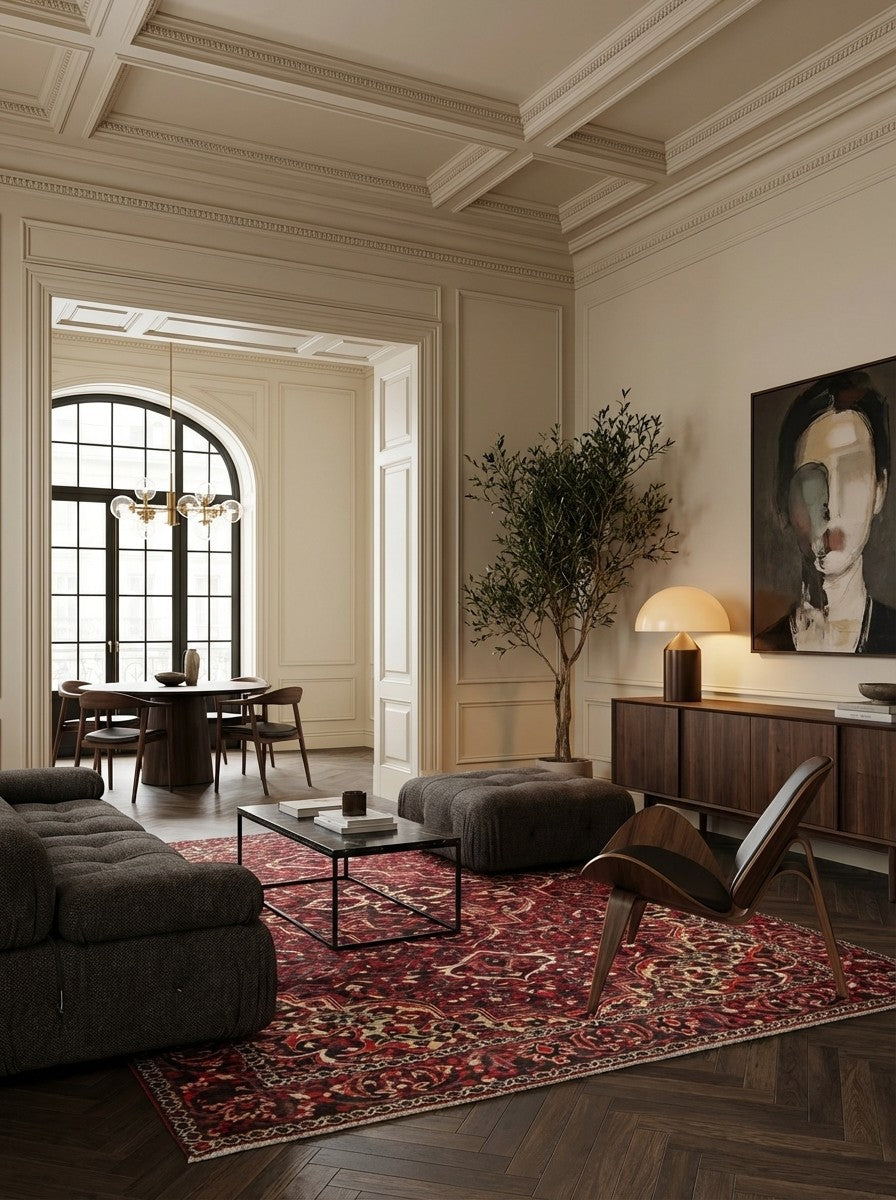
The colors of a Bakhtiari rug are deeply rooted in nature. Madder root for red, indigo for blue, and pomegranate rinds for yellow are typical sources. These natural dyes produce the characteristic Abrash effect, gentle color gradations that give the rug vitality and depth, proving its artisanal authenticity.
The color world of the Bakhtiari is a direct reflection of their surroundings. Rather than relying on synthetic dyes, the weavers have always drawn upon the treasures of nature. The rich red tones come from the root of the madder plant, the deep blue from indigo, and vibrant yellow and brown shades are derived from pomegranate rinds, walnut husks, or onion skins. These plant-based dyes have an incomparable depth and luminosity that set them apart from chemical colors.
A fascinating result of this traditional dyeing method is what is known as Abrash. Because the wool is dyed by hand in small batches, subtle color variations occur between individual skeins of yarn. When these yarns are then knotted, gentle, striated shifts appear across a single field of color in the rug.
Seeing such a shift within a deep red field for the first time, one might easily mistake it for an imperfection. The opposite is true: Abrash is like the weaver's signature and proof of authentic handcraft. It gives the rug a vibrant depth that machine-dyed surfaces could never achieve. If you would like to delve deeper, read our guide What is Abrash in a rug?.
Bakhtiari in comparison: What makes them so special?
Compared to other nomadic rugs such as Gabbeh or Gashgai, Bakhtiari stand out primarily through their structured garden design. While Gabbeh rugs are often minimalist and Gashgai rugs feature intricate geometric designs, Bakhtiari offer a unique combination of formal structure and floral, almost pictorial imagery. Their weave is also typically denser and firmer.
To understand what makes a Bakhtiari special, it helps to look at its neighbors. Persian nomadic rugs are diverse, yet every tribe has its own design language. The Bakhtiari occupies an interesting middle ground here, combining the raw, honest energy of a nomadic rug with the structured elegance more commonly found in city rugs.
| Feature | Bakhtiari | Gabbeh | Gashgai |
|---|---|---|---|
| Design | Structured, grid (Khesti) | Minimalist, large fields of color | Detailed, intricate geometric |
| Motifs | Floral, pictorial (garden, animals) | Abstract, often with small animals | Diamonds, hooks, tribal symbols |
| Texture and feel | Dense, firm, heavy | Soft, high pile, flexible | Fine, dense, often low pile |
| Color palette | Diverse, often earthy tones | Bold, monochrome fields | Dominant red and blue tones |
While a typical Gabbeh rug creates a calm, almost meditative mood with its minimalist aesthetic and expansive fields of color, a Kelim Gashgai is a firework of small, complex geometric symbols. The Bakhtiari takes a different path: it organizes its pictorial, nature-inspired motifs within a clear, formal grid. This unique combination makes it a versatile companion that bridges worlds in both rustic and elegant interiors.
A Bakhtiari rug in your home: How to find the perfect piece

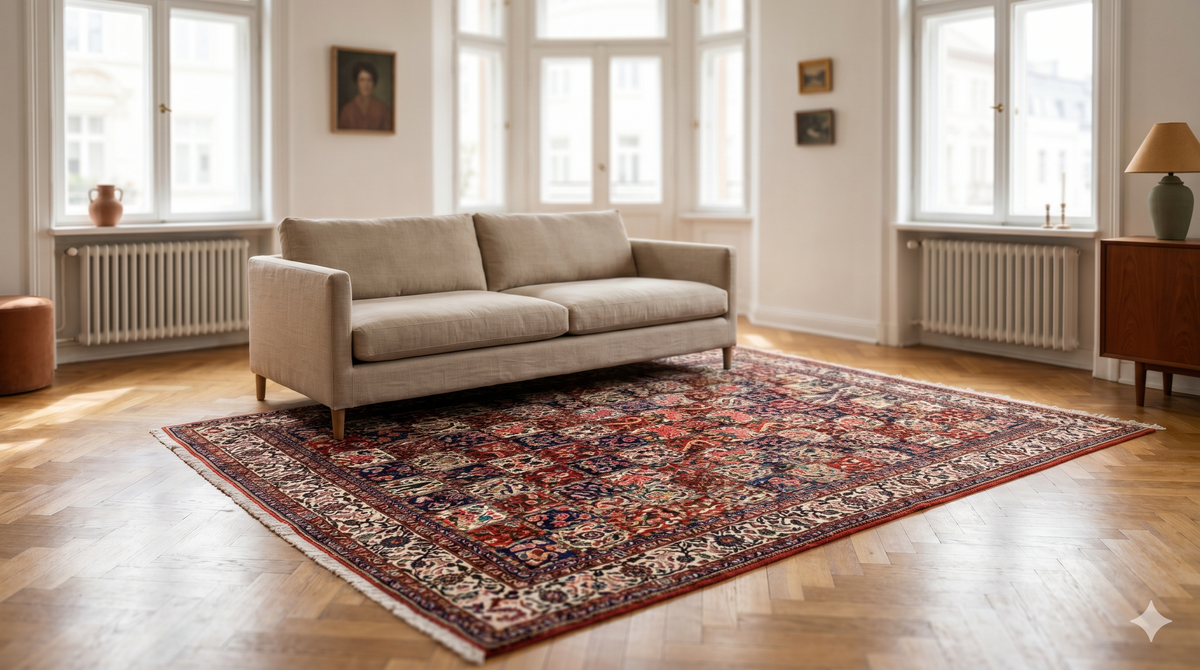
Incorporating a Bakhtiari rug means bringing a piece of history into your home. Thanks to their robust nature, they are ideally suited for lively areas such as living rooms or dining rooms. The earthy tones and floral patterns harmonize with classic wooden furniture as well as modern, minimalist interior styles, creating a warm, grounded focal point.
A Bakhtiari is not a timid rug. It is a statement piece with character and history. Thanks to its remarkable resilience, you do not need to treat it with kid gloves. It is the ideal companion for the heart of your home: the living room, the dining room, or a busy hallway. Wherever life happens, a Bakhtiari feels right at home.
Stylistically, it is surprisingly versatile. In a classic ambiance with dark wood furniture and antique pieces, it accentuates timeless elegance. Its earthy colors and natural motifs create a warm, inviting atmosphere. Yet it can also set an exciting counterpoint in a modern, minimalist setting. Picture its structured, colorful surface on a polished concrete floor or beside a sleek, contemporary sofa. It softens architectural austerity and brings warmth, texture, and a soul into the room.
Before you decide, it is essential to find the right size. A rug can define a room, but only if its proportions are balanced. In our rug buying guide, you will find valuable tips. And best of all: with our AR visualizer on the website, you can try out different Bakhtiari rugs virtually and true to scale in your own room. That way, you can instantly see how the garden comes to life.
FAQ
How do I identify an authentic Bakhtiari rug? You can recognize an authentic Bakhtiari by a combination of several features: the characteristic Khesti pattern (grid design), a very dense, firm, and heavy feel to the wool, the symmetrical knot, and natural color variations (Abrash). The wool feels robust and slightly oily to the touch, pointing to its high lanolin content.
Are Bakhtiari rugs durable? Yes, they are among the most hard-wearing Persian rugs of all. They owe their durability to high-quality highland wool, which is naturally rich in lanolin. This wool grease makes the fibers elastic and dirt-repellent. The firm, dense knotting also ensures that they are ideally suited for high-traffic living areas.
What does the garden pattern (Khesti) mean? The Khesti pattern symbolizes the classic Persian paradise garden, also known as "Tschahār Bāgh". It is a place of harmony, beauty, and life. The division into individual panels filled with floral and animal motifs represents orderly garden beds and the diversity of nature, often serving as an allegory for the four seasons.
How do I care for my Bakhtiari rug? Care is straightforward. Regular vacuuming with a flat nozzle (without a rotating brush) is sufficient. Stains should be blotted immediately with a clean, damp cloth, never rubbed. Every few years, we recommend professional hand washing, which you can request through our cleaning and repair service. You can find more details in our rug care guide.
Do Bakhtiari rugs suit a modern interior design style? Absolutely. The geometric framework of the Khesti pattern forms a wonderful contrast to clean lines and minimalist furniture. The rug's earthy, natural colors can ground a cool room and give it warmth and character. It acts as an artistic bridge between contemporary simplicity and timeless artisan tradition.
Every Bakhtiari tells the story of its origin, of nature, and of the people who knotted it. It is more than a rug; it is a garden for your home that never fades. If you appreciate the diversity of Persian craftsmanship, explore our collection of hand-knotted nomadic and village rugs. Perhaps with our AR tool, you will find the perfect piece today to carry on your own story.