Symbolism in Berber Rugs: What the Patterns Mean
TL;DR: Berber symbols are an ancient visual language passed down by the weavers of the Amazigh tribes in the Moroccan Atlas Mountains. Every pattern, from the diamond to the zigzag line, carries a deeper meaning and tells stories of protection, fertility, spirituality, and daily life. Your rug is therefore not merely a decorative object, but a personal diary.
More Than Just Patterns: The Roots of Berber Symbolism
The symbolism of Berber rugs is rooted in the culture of the Amazigh, the indigenous people of North Africa. This visual language is a matriarchal tradition passed down from mothers to daughters. The patterns are not mere decoration, but an expression of identity, faith, and the personal experiences of the weaver, woven into every single knot.
The fascinating patterns of a Berber rug are far more than just geometric shapes. They are the letters of an ancient alphabet, a language that is not spoken, but knotted. Their origins lie deep in the history of the Amazigh peoples, the indigenous population of North Africa who have inhabited the rugged landscapes of the Atlas Mountains for thousands of years. In a culture where written records played no role for a long time, the rug became a canvas, a diary, and a sacred protective amulet.
This tradition is deeply feminine. The knowledge of the symbols' meanings, the knotting techniques, and the art of dyeing with natural materials have been passed down from mothers to daughters for countless generations. A young weaver learns not only a craft, but also how to translate her hopes, fears, wishes, and experiences into wool. A rug can tell of a wedding, ask for protection for the family, or celebrate the birth of a child. Each piece is therefore a deeply personal document that carries the soul of its creator. Learn more about what you should look for when buying a hand-knotted rug to recognize such stories.
The Most Common Berber Symbols and Their Meanings
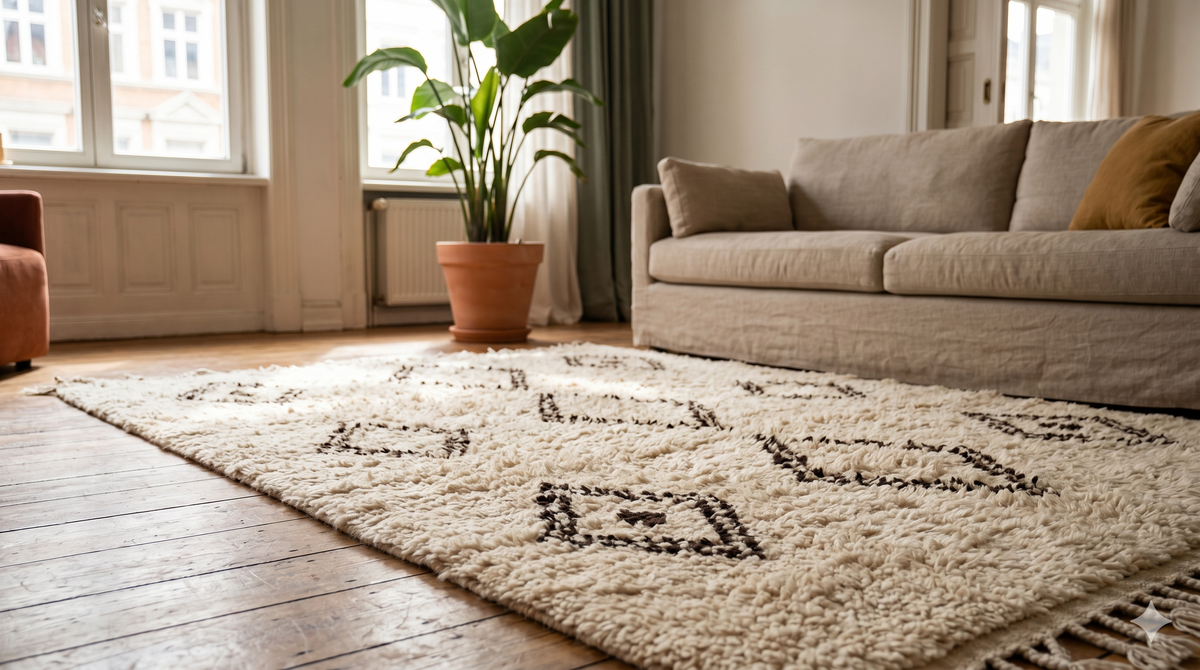
The most common Berber symbols carry universal meanings. The diamond often stands for protection and the female body, while zigzag lines symbolize water, life, and snakes. The X sign represents fertility and union, and the eye serves as a protective symbol against the evil eye. These elements form the vocabulary of the weavers.
Although the language of symbols is rich and complex, there are several fundamental motifs that appear again and again, forming a kind of shared vocabulary among the Amazigh tribes. When you understand these core symbols, you can begin to decode the stories in your own rug.
The diamond (lozenge): This is perhaps the most powerful and frequently used symbol. In its purest form, the diamond represents the feminine principle, the womb, and fertility. It is a symbol of life and creation. It is often also interpreted as a protective eye that shields the home and its inhabitants from negative energies and the "evil eye". A chain of diamonds can represent a family history or ancestral line.
The zigzag line: This dynamic pattern is a symbol of water, the source of all life, especially in the arid regions of North Africa. It can represent a river, a stream, or rain. At the same time, the zigzag shape symbolizes the snake, an animal that stands for healing, rebirth, and masculine strength in many ancient cultures.
The cross (X shape): Contrary to modern associations, the X symbol has a deep, pre-Christian meaning in Berber culture. It stands for the free human being, flourishing, and female fertility. The intersecting lines can symbolize the union of man and woman, and are often used in wedding rugs to wish the couple happiness and many children.
The comb: This symbol looks like a small rake and directly represents the weaver's most important tool. It stands for the craft itself, creativity, and solidarity among the women of the community. A rug with many comb symbols honors the art of weaving and the women who keep this tradition alive.
| Symbol | Main meaning | Additional interpretations |
|---|---|---|
| Diamond | Femininity, protection | Fertility, eye, the family tent |
| Zigzag | Water, life | Snake, masculine energy, lightning |
| Cross (X) | Fertility, union | The free person, balance |
| Eye | Protection against the evil eye | Wisdom, spiritual insight |
| Comb | Weaving, female solidarity | Creativity, diligence, community |
These symbols are the building blocks from which more complex narratives emerge. In our collection of hand-knotted unique pieces, you can see how diverse this language can be.
How to Read the Story of Your Berber Rug
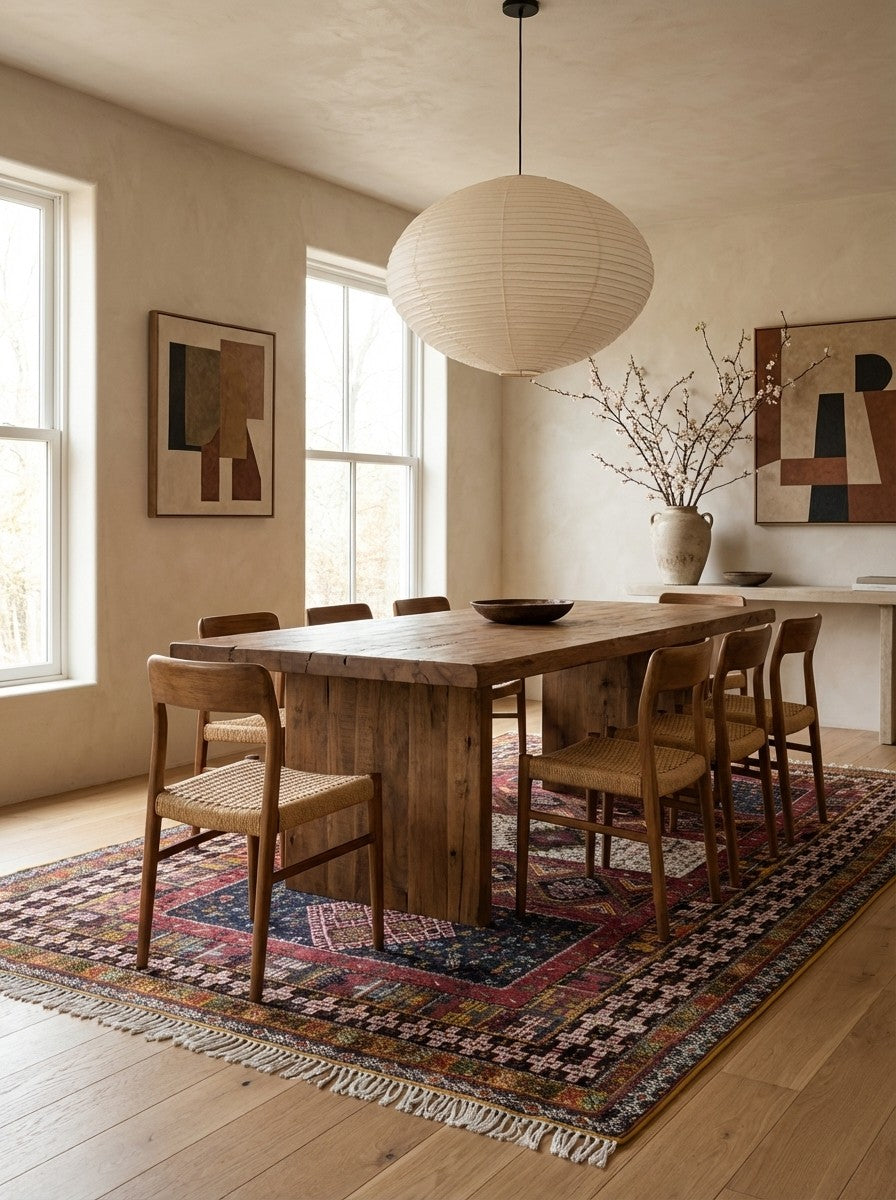
To "read" a Berber rug means considering the combination of symbols, their arrangement, and the coloring as a whole. A central medallion can have a protective function, while repeating patterns tell of generations. Color variations, known as Abrash, are also part of the story and bear witness to the authentic, artisan creation of the unique piece.
The true magic of a Berber rug unfolds when you do not view individual symbols in isolation, but in the context of the entire design. The arrangement, repetition, and combination of patterns tell a much deeper story. A single, large diamond medallion in the center can act like a powerful shield for the heart of the home. A row of smaller symbols along the border of the rug might protect the boundaries of one's living space or chronologically depict the events of the past year.
Colors also play a decisive role. Traditionally, they were extracted from local plants, minerals, and insects. * Red, often from madder root, stands for strength, protection, and vital energy. * Blue, obtained from indigo, symbolizes wisdom, the sky, and infinity. * Green stands for peace, fertility, and the oases of the desert. * Yellow, from saffron or pomegranate rinds, represents the sun and divine energy.
A particularly authentic feature that reveals a great deal about how a piece was made is the subtle color variation within a field of color. This phenomenon, known as Abrash, occurs when the weaver starts a new batch of hand-dyed wool. Because it is almost impossible to mix the exact same shade again, these beautiful, gentle transitions are created. They are not a flaw, but proof of manual craftsmanship and a visible sign that the rug grew over weeks or months.
Often the story woven into a design only reveals itself upon closer inspection: zigzag lines may symbolize a river and thus an ongoing journey, while a stylized bird serves as a messenger carrying hopes of a safe return.
Recognizing Authenticity: Genuine Symbols vs. Modern Designs
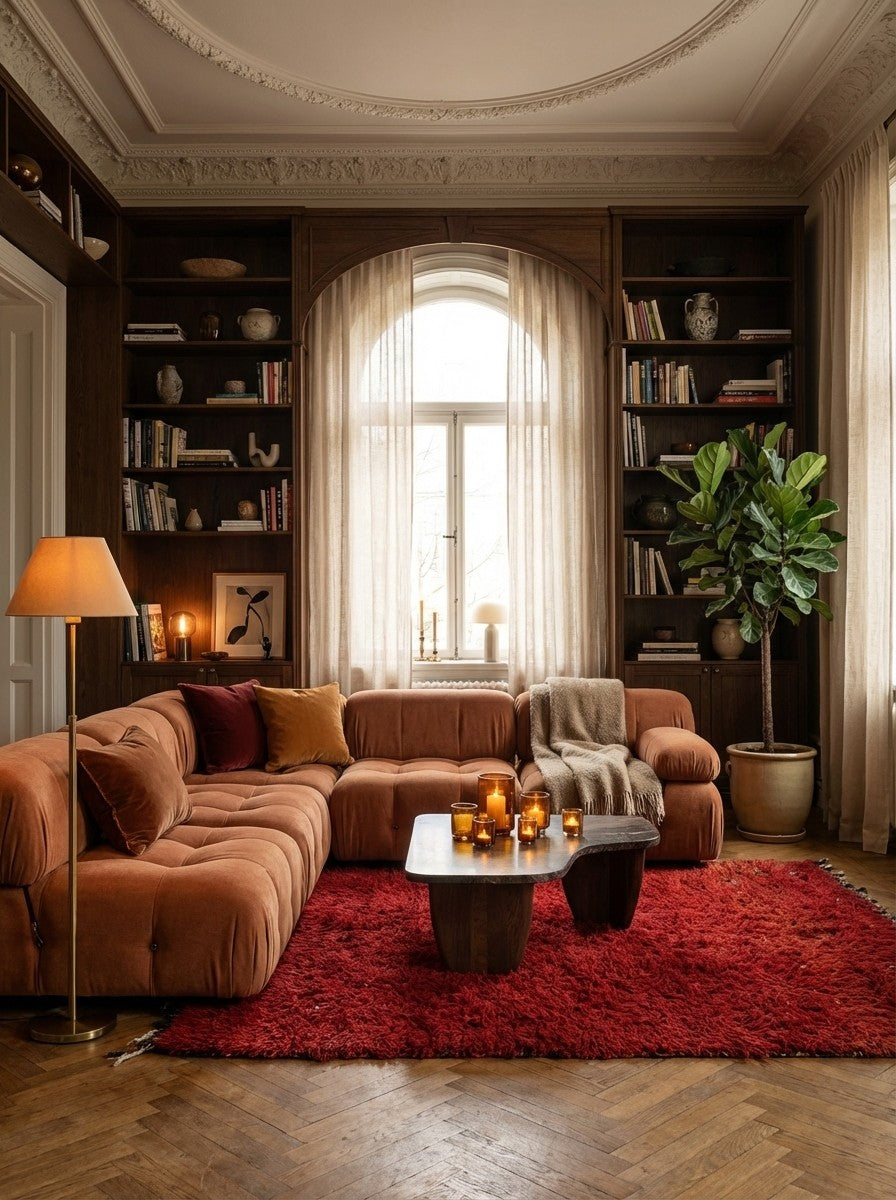
Genuine Berber symbols are often asymmetrical and irregular, a clear sign of handcraft and personal expression. In contrast, machine-made rugs are perfect and soulless.
In a world where the "Berber style" is often copied, it is important to distinguish genuine craftsmanship from mass-produced industrial goods. The most telling sign of authenticity is human imperfection. A weaver working on a simple loom does not create a flawless, computer-generated pattern. Her lines may be slightly uneven, the symbols perhaps not mirrored exactly. Precisely these small variations are her signature, proof of a creative process and the soul of the rug.
Machine-made rugs in a Berber look, on the other hand, exhibit sterile perfection. Patterns repeat exactly, edges are straight as an arrow, and colors are flat, without any Abrash whatsoever. They imitate the form, but they can never capture the story and the energy of a hand-knotted original. Our experience as a family business since 1952 allows us to separate the wheat from the chaff.
Therefore, pay attention not only to the quality of the wool and rug care, but also to the coherence of the symbolism and the knotting technique. Initiatives such as CARE & FAIR also work to ensure that weavers are treated fairly and that their communities can thrive from their craft. This way, you receive not just a beautiful home accessory, but a genuine piece of cultural history.
FAQ
What does the diamond symbol on a Berber rug mean? The diamond, also known as a lozenge, is one of the most powerful and multi-layered symbols. Primarily, it stands for femininity, the female womb, and fertility. At the same time, it acts as a protective eye that shields the tent or home and its inhabitants from negative influences and the evil eye.
Are all patterns on Berber rugs symbols? No, not every geometric element carries a profound symbolic meaning. Many patterns, especially in filler areas, serve aesthetic balance and composition. The central, recurring core motifs, however, almost always carry a traditional meaning passed down from generation to generation.
Why are the symbols on my rug not perfectly symmetrical? These charming irregularities are a clear sign of authenticity and genuine handcraft. Asymmetry is the weaver's personal signature and often a deliberate choice that gives the rug soul and character. Perfection is the mark of a machine, not a human being.
Are there differences in symbolism between different Berber tribes? Yes, absolutely. Although there is a universal vocabulary of symbols such as the diamond or the zigzag line, each tribe and region in the Atlas Mountains has its own dialects of this visual language. Specific patterns and combinations can reveal a rug's origin and reflect the unique history and environment of the respective community.
How can I be sure that the symbols on my Rugtales rug are genuine? We have been dealing in handmade rugs as a family business since 1952 and know this symbolic language from our family tradition. If you have questions about a specific piece, write to us at hello@rugtales.com; we will gladly share what we know about its origin.
Every Berber rug is an invitation to discover a story. Perhaps you will find symbols that reflect your own life journey, the desire for protection, family, or a new beginning. We invite you to browse our collection of nomadic rugs and find the piece whose language speaks to you. With our AR visualizer, you can view every rug directly in your room and experience how it feels in your space.