Women at the Loom: The True Artists Behind Tribal Rugs
TL;DR: In most traditional rug cultures, especially among nomadic peoples such as the Gashgai, it is the women who master the art of weaving and pass it down from generation to generation. They are not merely craftswomen, but artists and storytellers who weave their experiences, dreams, and traditions directly into the patterns and colors of the rugs.
More than Just Craft: Why Women Are the Keepers of the Weaving Tradition
Women are the keepers of the weaving tradition because knotting goes far beyond pure craft. It is a form of cultural expression and the transmission of knowledge. Mothers teach their daughters the intricate patterns and symbolism, which often represent the history and beliefs of their tribe, thereby securing the survival of this unique heritage.
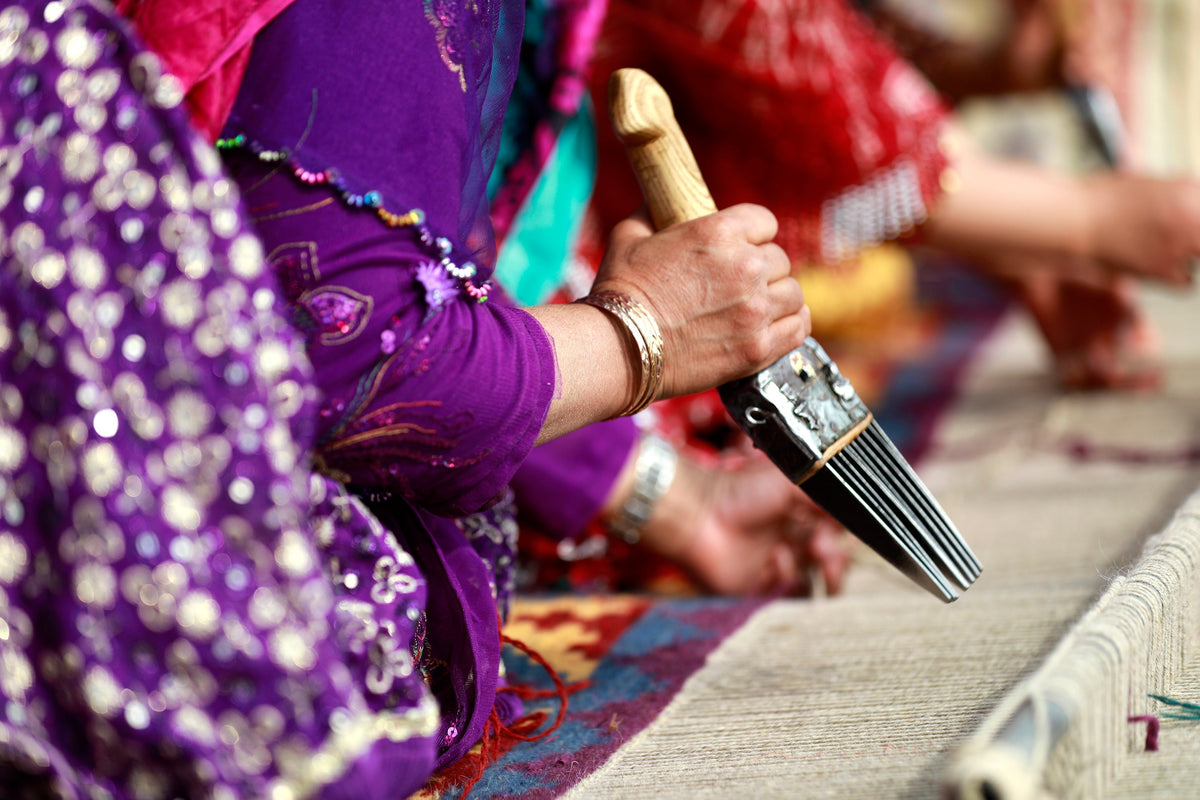
When we speak about handmade rugs, we often talk about origin, material, or knot density. Yet the soul of every nomadic rug, its true story, is woven by the hands and hearts of women. In many village and nomadic communities of the Persian highlands, rug knotting is an almost exclusively female domain. It is an art form passed down from mother to daughter; a silent language spoken across generations.
This passing down of knowledge is more than just technical instruction. It is the transmission of a cultural memory. The patterns are not mere ornaments; they are a visual archive recounting weddings, births, myths, and everyday life. A rug thus becomes a piece of family history lying on the floor. For the family, the weaver is often also the economic backbone. Selling a rug secures income and strengthens the woman's position within her community. In this way, every thread weaves together spirituality, daily life, and economic necessity.
Amin Ipektchi, Co-Founder: "In our family, the rug story has been passed down for six generations. When I travel to the regions of origin today, I see the exact same thing: mothers sitting beside their daughters at the loom. It is this unbroken chain of knowledge that touches me most deeply. You see the same concentration, the same dedication. It is a profound understanding of a craft that goes far beyond the technical."
Women are the true artists because they do not just master a technique, but are creators. They translate their world into wool and color, preserving a heritage that might otherwise be lost. When you own one of these rugs, you possess a fragment of this profound, female tradition.
From Sheep to Wool: The Female Cycle of Rug Making
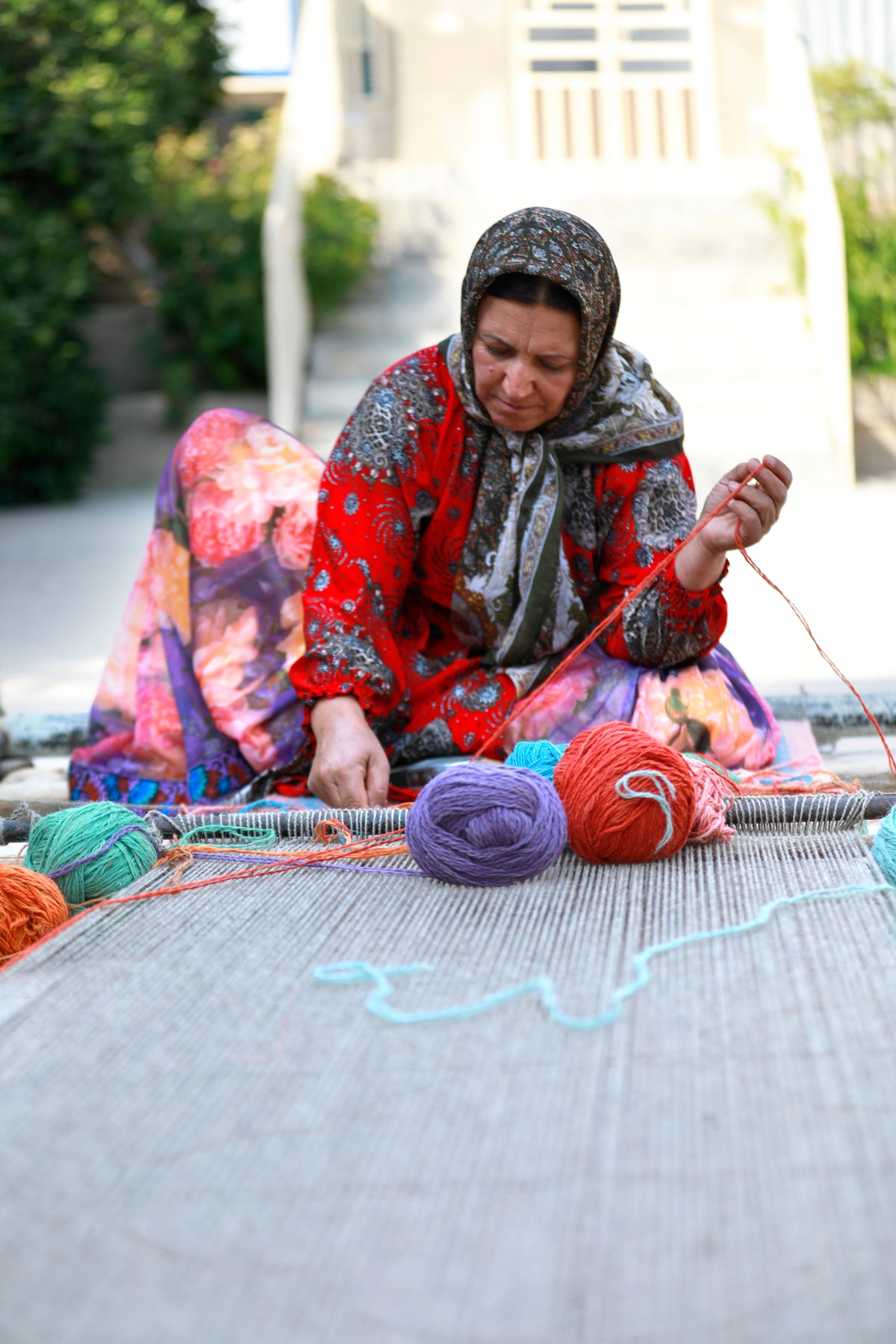
Women's contribution begins long before the first knot on the loom. They are often responsible for the entire process: from shearing the sheep, washing, and carding the wool, to the painstaking spinning of yarn by hand and the subsequent dyeing using traditional, plant-based recipes. Every step is pure manual work.
The process leading to a finished rug is a long and labor-intensive cycle, deeply rooted in nature, and this cycle rests firmly in female hands. It all begins with the wool of mountain sheep living in the Persian highlands. After shearing, it is the women who wash the raw wool, often in running streams, to remove dirt and excess lanolin. It is then combed and carded by hand to align the fibers and prepare them for spinning.
Spinning itself is meditative yet physically demanding work. Using a simple drop spindle, the women transform the combed wool into yarn of varying thickness. The irregularities that arise in this process are not a flaw, but a hallmark of authentic handcraft. They give the finished rug its vibrant texture. It is precisely this perfection within imperfection that never fails to fascinate us.
After spinning comes dyeing. The weavers use recipes passed down for centuries, based on plants and minerals from their immediate surroundings. Madder root for deep reds, indigo for blue, pomegranate rinds for yellow, and walnut husks for brown and black tones. Each batch of yarn dipped into the dye bath absorbs the color slightly differently. These variations result in the natural color shifts, also known as Abrash, which give a rug its incredible depth and vibrancy. It is the visible signature of a process carried out entirely by hand.
Symbols, Patterns, Stories: How Weavers Knot Their World into the Rug
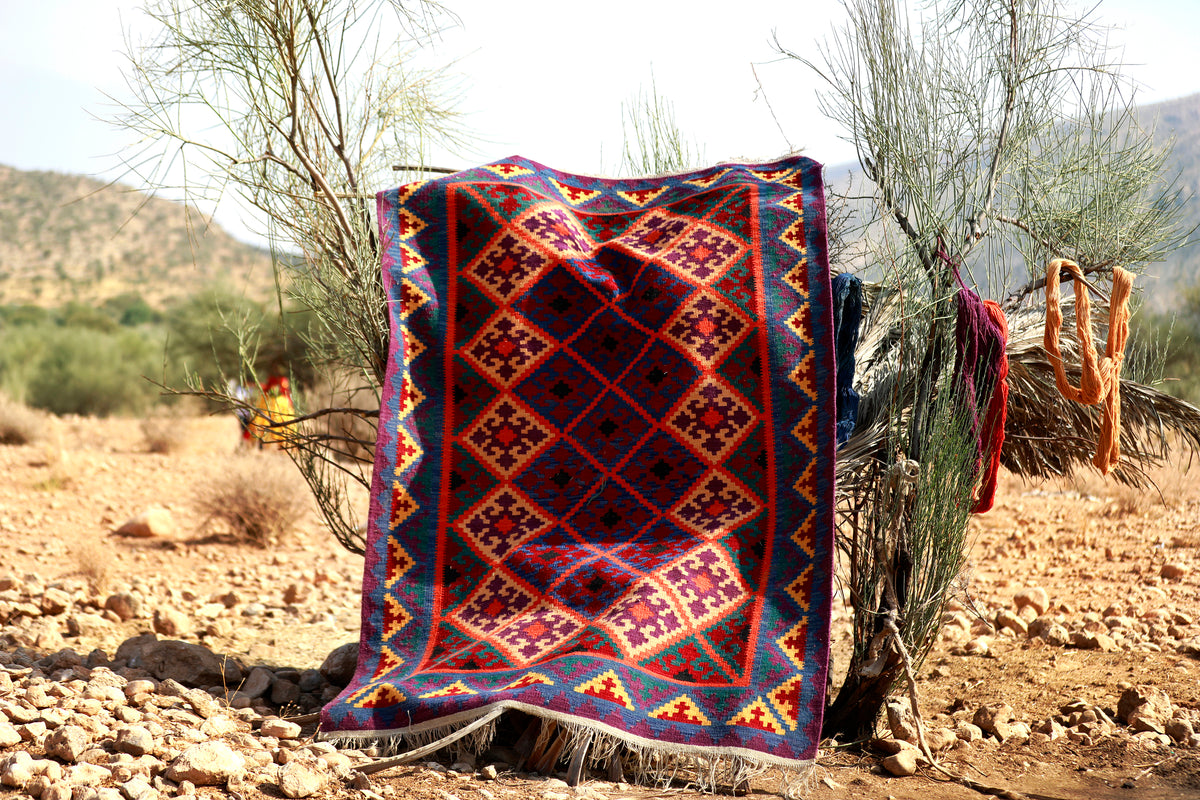
Every handmade rug is a woven diary. The weavers use a rich symbolic language to depict their personal stories, wishes for fertility and protection, or events from tribal life. Geometric patterns are not random decoration; they are a profound, non-verbal form of communication that can be read by connoisseurs.
A nomadic rug is never just a floor covering. It is a canvas on which the weaver immortalizes her thoughts, hopes, and worldview. The patterns are a universal language that needs no words. A small diamond-shaped symbol can represent an eye warding off the evil eye. A stylized tree of life symbolizes the wish for a long, fertile life. Flowing water is depicted by zigzag lines, and small animal or human figures tell of their immediate living environment.
Unlike workshop rugs knotted from exact templates, nomadic weavers usually work from memory. They draw on an extensive repertoire of traditional motifs from their tribe (be it Gashgai, Lori, or Afshar), which they freely interpret and recombine. In this way, the weaver's personal creativity and present mood always flow into the design. Perhaps she adds a symbol representing a special dream, or she varies a color simply because she feels like it that day.
This personal touch, whether a spontaneous colour shift or an added miniature motif, is what makes the authentic nomadic rugs in our collection so remarkable: here worked not merely an artisan, but an artist.
Nomadic vs. Workshop: Two Worlds of Weaving
The role of women differs fundamentally between nomadic and urban workshop production. While nomadic weavers control the entire creative process from the raw wool to the finished pattern, women in workshops often work from fixed design templates, known as cartoons. Their technical skill is immense, but their creative freedom is often more limited.
It is important to understand that there is no single world of rug knotting. The conditions and the role of women can vary greatly depending on whether a rug is made in a nomadic tent or an urban workshop. Both traditions produce wonderful works of art, yet the creative processes are fundamentally different.
Among nomadic tribes and village communities, the weaver, as described, is the creative director. She decides on design, colors, and composition. She often works on a horizontal loom that is simply assembled on the ground and can be packed up and taken along when moving. The results are rugs with a strong personal touch and charming irregularities that attest to their authentic origin.
In urban workshops, for instance in centers such as Nain or Tabriz, the process is more formalized. Here, female knotters, and sometimes men, work on large, vertical looms following an exact design template, the "cartoon". This is created by a master designer and precisely prescribes every knot and color. The technical perfection of these rugs is often breathtaking, with extremely high knot densities and intricate floral patterns. However, the individual creative freedom of the knotter recedes into the background in favor of a flawless execution of the template.
| Feature | Nomadic / Village Weaving | Urban Workshop |
|---|---|---|
| Design process | Free, from memory, improvised | Following an exact template (cartoon) |
| Creative control | Rests entirely with the weaver | Lies with the master designer |
| Loom | Horizontal, portable | Vertical, stationary |
| Patterns | Geometric, symbolic, personal | Often floral, complex, symmetrical |
| Character | Individual, authentic, "imperfect" | Technically perfect, precise, formal |
| Typical styles | Gabbeh, Gashgai, Kelim | Nain, Isfahan, Tabriz |
Neither method is "better" than the other; they merely represent different philosophies and traditions of craftsmanship. However, understanding these differences helps you appreciate the story behind a rug and the dedication of the woman who created it.
Fair Conditions as a Foundation: How You Support the Art of Female Weavers
A conscious purchase is the greatest appreciation for the craft of female weavers. Look for certifications like STEP or CARE & FAIR, which guarantee fair wages, good working conditions, and a ban on child labor. This ensures that your rug enriches not only your home, but also the life of its creator.
The immense work, knowledge, and artistry woven into every handmade rug deserve recognition and fair compensation. A rug made under exploitative conditions loses its soul. That is why for us, as retailers with a long tradition rooted in our own family history, maintaining transparent and fair supply chains is of paramount importance.
Certifications from independent organizations are a crucial tool here. The STEP label, for example, guarantees compliance with fair trade practices. These include fair wages, safe working conditions, and the strict prohibition of exploitative child labor. CARE & FAIR goes one step further by actively working to improve the living conditions of knotting families through building schools and providing basic healthcare.
When you choose a rug that carries such a seal, you make a direct contribution. You not only support the weaver herself, but also enable her children to attend school instead of having to work at the loom. You help strengthen the communities of weavers and ensure that this centuries-old art form carried by women has a future. In our guide to choosing a rug, you will find further information on what to look for when making a purchase.
FAQ
Do men weave rugs too? Yes, although the nomadic and village tradition is firmly in female hands, men often work at the loom in large urban workshops. There, knotting is more of a learned trade following fixed instructions, whereas among nomadic women, it is a holistic way of life passed down from generation to generation.
How long does a weaver need to make a rug? That depends heavily on the size, knot density, and complexity of the pattern. For a medium-sized nomadic rug (approx. 2x3 meters), a single weaver can easily take three to six months, and for very fine pieces, significantly longer. This immense investment of time highlights the true value of every single piece.
Do weavers memorize the patterns? Yes, in most nomadic and village cultures, traditional patterns are passed down orally and through imitation from mother to daughter. It is a repertoire of symbols and compositions that has grown over generations, which the weaver masters by heart and then interprets and recombines individually.
Does the price of a rug reflect the woman's labor? With fair-trade rugs, yes. The price directly reflects the working time invested, the quality of the materials processed by hand, and the unique craftsmanship of the weaver. Seals such as STEP and CARE & FAIR help ensure that a fair share of the proceeds truly reaches the artist and her family.
How does Rugtales ensure that female weavers are treated fairly? We rely on two pillars: first, independent initiatives; we are a Label STEP Partner and actively involved with CARE & FAIR. Second, the long-standing, personal relationships with weaving communities that our family has built over six generations. This trust forms the foundation for fair and respectful cooperation.
The stories women weave into their rugs are as diverse and profound as life itself. Every piece is a testament to their creativity, strength, and cultural heritage. If you would like to discover the story behind your rug, explore the handwoven Kelim pieces or the traditional Gabbeh rugs. With our AR visualizer, you can even see directly on your smartphone how such a work of art would look in your home.