Nain: Persian City Rugs with Silk Outlines
TL;DR: A Nain rug is a masterpiece of Persian knotting art from the city of the same name near Isfahan. It is characterized by its extremely fine knotting, a light color palette of ivory, blue, and beige, as well as luminous contours made of pure silk. These city rugs are renowned for their elegance, precision of detail, and high knot density, which make them valuable collector's pieces.
The History of the Nain Rug: From Textile Art to Knotting Masterpieces
The Nain rug has its roots in the city of Nain, near Isfahan, which was historically renowned for fine textiles. When the textile industry declined in the early 20th century, the experienced weavers shifted to rug production. They transferred their knowledge of intricate patterns and high-quality materials directly to the art of knotting, which explains the extraordinary quality.
The history of the Nain rug is inextricably linked with the artisanal tradition of its region of origin. The city of Nain, located on the arid plateau of central Persia, was for centuries a center for the production of the finest woolen fabrics and luxurious cloaks. The weavers possessed a deep understanding of materials, colors, and complex patterns that was passed down from generation to generation.
When demand for these traditional textiles fell in the early 20th century, the workshops faced a challenge. But instead of abandoning their craft, they underwent a remarkable transformation: they turned all their knowledge toward rug knotting. This transition came naturally, as the neighboring city of Isfahan was already a world-famous center of rug art and served as an inspiration. The masters from Nain adapted the techniques while preserving their own aesthetic signature. They transferred the precision and delicacy of their fabrics directly onto the rug pile. The result was a new type of rug that quickly made a name for itself through its exceptional elegance and technical perfection. This blend of ancient textile know-how and new knotting artistry remains the foundation of the Nain rug's reputation to this day. As a family business since 1952, we at Rugtales have witnessed the evolution of this art form up close.
Characteristics of a Genuine Nain: Color, Material, and Pattern
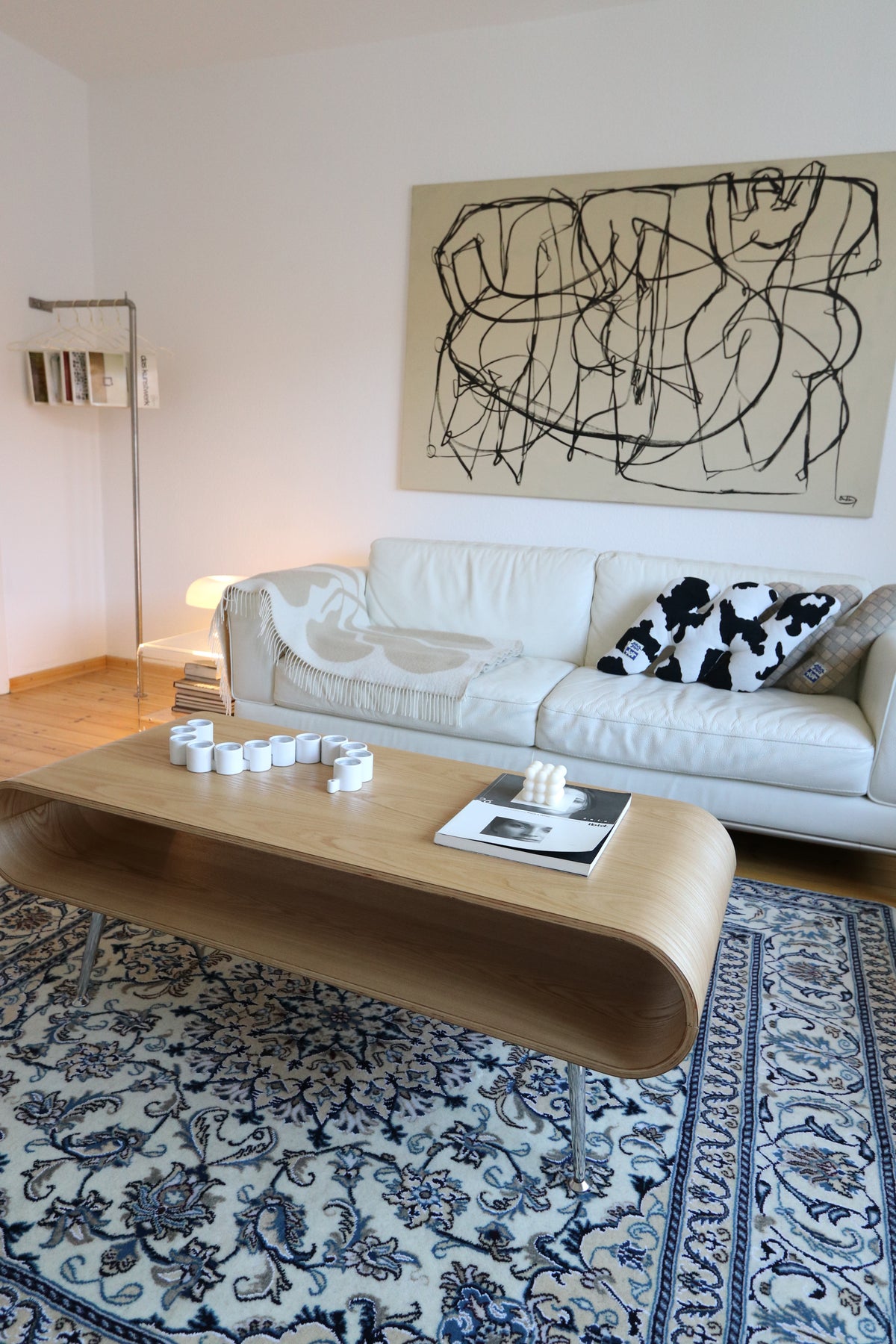
You can recognize a genuine Nain rug by its characteristic color palette of ivory, cream, light blue, and dark blue. The material used is the finest kork wool, often from the sheep's neck, combined with silk for the outlines of the patterns. Typical is a central medallion surrounded by floral arabesques and tendril motifs in the so-called Shah Abbas style.
A Nain is more than just a rug; it is a composition of carefully chosen elements working together in perfect harmony. The first thing that catches the eye is the coloring. Unlike many other Persian rugs, which are often kept in warm red tones, cool, elegant colors dominate in a Nain. The base tone is almost always a soft ivory or beige, creating a calm and bright canvas for the detailed patterns. Accents in various shades of blue unfold across it, ranging from delicate sky blue to deep navy blue.
The material is just as crucial. High-grade kork wool is usually used for the pile. This is the exceptionally soft and fine wool sheared from the neck and shoulders of sheep. It possesses a natural luster and allows for very fine knotting. The rug's structure, meaning warp and weft, is typically made of durable cotton. Yet the defining characteristic is the deliberate use of silk. It is not used across the entire pile, but only to accentuate the pattern outlines. This subtle touch makes the floral tendrils and arabesques virtually step out from the rug. The design itself is often inspired by classic Isfahan patterns: a central medallion from which delicate floral motifs, known as Islimi tendrils, spread across the entire surface.
| Feature | Nain Rug | Isfahan Rug | Gashgai Nomadic Rug |
|---|---|---|---|
| Color palette | Ivory, blue, beige | Red, dark blue, cream | Rich red, blue, and earth tones |
| Pattern | Fine floral arabesques, medallion | Symmetrical, floral, palmettes | Geometric, stylized animals |
| Material | Kork wool, silk highlights | Finest wool, often silk warp | Robust highland wool |
| Feel | Dense, velvety, cool | Very dense, fine, smooth | Soft, textured, rustic |
| Knotting | Extremely fine and precise | Extremely fine, often with signature | Medium to coarse, lively |
These differences make it clear why a Nain holds a special place among fine city rugs.
The Secret of Quality: What Does 'La' Mean in Nain Rugs?

The 'La' (Persian for 'layer') in Nain rugs is a crucial quality characteristic and refers to the number of strands twisted together to form a warp thread. The lower the La number, such as 6La or the extremely rare 4La, the finer the warp thread. This allows for a higher knot density and thus a more detailed pattern.
When exploring Nain rugs, you will inevitably encounter the designation 'La'. This term is the key to quality grading and a fascinating detail of the craft. 'La' means 'layer' or 'ply' in Persian and describes the fineness of the warp thread, meaning the vertical threads onto which the knots are tied. A warp thread is spun from several thinner cotton strands twisted together. The La number indicates how many of these individual strands are used.
The logic is simple: the fewer individual strands (meaning the lower the La number), the thinner and finer the resulting warp thread. A thinner warp thread allows the weaver to place the knots closer together. The result is a higher knot density and thus the ability to create incredibly detailed, precise patterns.
- 9La (Noh La): The most common and already a very high quality. Here, each warp thread consists of nine individual strands. The knot density typically ranges between 300,000 and 500,000 knots per square meter.
- 6La (Shish La): This is the category of very fine masterpieces. A warp thread consists of only six individual strands, which allows for knot densities of 600,000 to over 800,000.
- 4La (Char La): The absolute pinnacle of knotting artistry and extremely rare. With only four individual strands per warp, knot densities of over one million knots per square meter can be achieved. Such rugs are works of art of museum quality.
Amin Ipektchi, Co-Founder: "For me, the La system is the purest form of artisanal poetry. A lower La number not only means more knots, but an exponentially greater challenge for the weaver. With a 4La rug, every single knot must be tied with absolute precision, as the slightest mistake would be immediately visible in the highly detailed pattern. It is proof of the patience and masterful skill that defines this high level of craftsmanship."
The Luster of Silk: More Than Just Decoration
The silk in a Nain rug is not mere decoration, but a functional design element. It is used deliberately for pattern contours to catch the light and lend floral motifs three-dimensional depth. This subtle luster sets the design apart from the matte wool foundation and creates incomparable visual brilliance.
The use of silk is perhaps the most fascinating feature of a Nain rug. Unlike pure silk rugs, here the material is used purposefully and sparingly to achieve maximum effect. The silk outlines the contours of floral patterns, tendrils, and medallions. This has a twofold effect: on the one hand, it creates a crisp definition of the design elements, emphasizing the precision of detail. On the other hand, and this is the true secret, the silk plays with light.
While kork wool absorbs light rather gently, forming a matte, warm surface, the smooth silk fiber reflects light. Depending on the angle of light and viewpoint, the patterns seem to glow and stand out from the woolen ground. A subtle, three-dimensional effect is created, lending the rug incredible vitality and depth. This conscious contrast between the matte shimmer of the wool and the bright luster of the silk is a hallmark of supreme design artistry. It is comparable to the natural color variations known as Abrash that lend character to a rug, only here the effect is deliberately controlled.
You can even read a Nain with your feet: the fine silk outlines are subtly raised, feeling noticeably cooler and smoother than the wool. This tactile dimension, combined with luminous visual brilliance, makes a genuine Nain a delight for all the senses.
How to Integrate a Nain Rug into Your Home
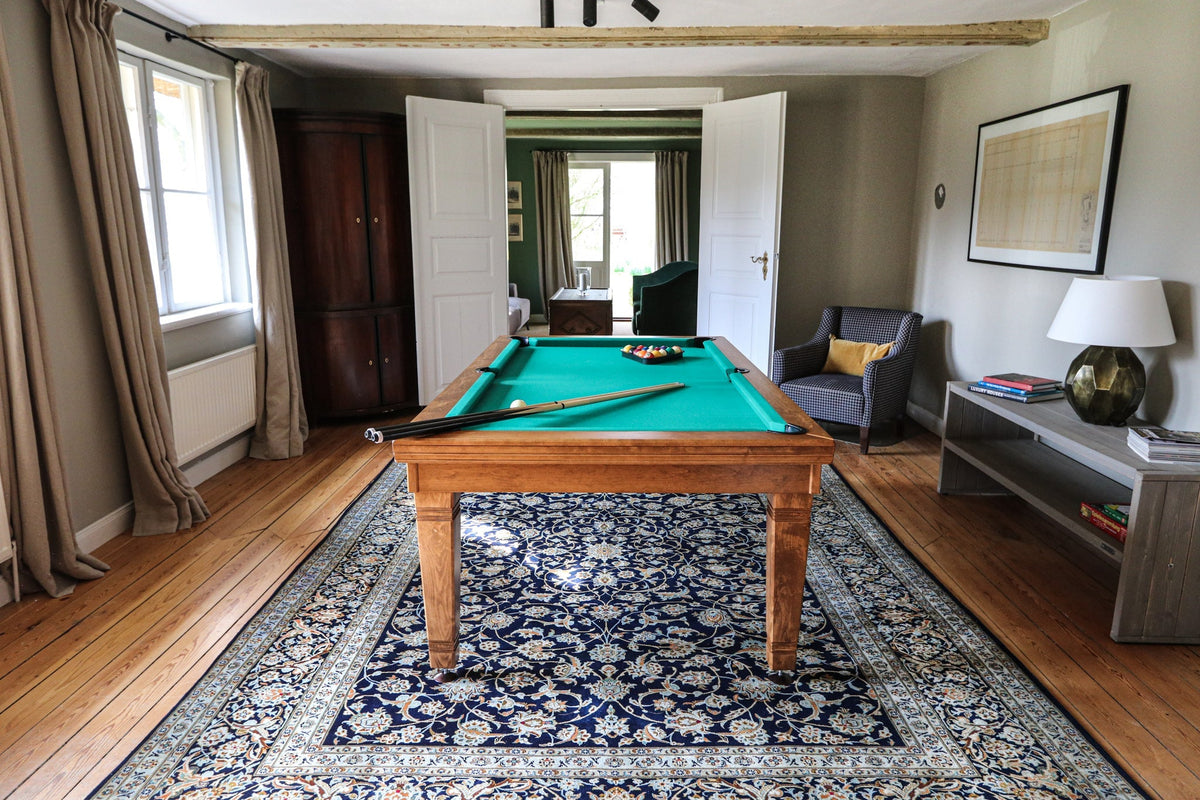
Despite its classic patterns, a Nain rug blends harmoniously into modern living spaces. It creates an elegant counterpoint to minimalist furniture or complements classic interiors perfectly. Use it as a central work of art in the living room or as an exquisite runner in the hallway. With our AR visualizer, you can test its effect directly in your room before buying.
The timeless elegance of a Nain rug makes it surprisingly versatile. When thinking of classic Persian patterns, many picture opulent, heavy furnishings, but a Nain often unfolds its true impact in a modern, understated environment. Picture a light Nain rug on dark floorboards, paired with a sleek modern sofa and minimalist furniture. The rug becomes a central work of art that lends warmth, soul, and a story to the room without overwhelming it.
In a classic interior surrounded by antiques or high-quality wooden furniture, a Nain integrates seamlessly and underlines the elegance of the ambiance. Its delicate patterns correspond wonderfully with crown molding or fine fabrics.
Choosing the right size is essential. A Nain that is too small can look lost, whereas a generous format defines the room and gives it a luxurious foundation. To make sure you find the right rug size for your living room, we at Rugtales have developed a handy tool. With our AR visualizer, you can virtually place any rug from our collection in your own room using your smartphone and test the effect live.
Checking Authenticity and Proper Care: Value for Generations
You can verify the authenticity of a Nain rug by the fine, uniform knotting on the back, the precise silk contours, and often a master weaver's signature. For care: vacuum gently on a regular basis, and in case of soiling, have a professional organic rug wash carried out to protect the delicate fibers.
A Nain rug is an investment for life. To preserve its beauty and value, proper inspection and care are essential. To assess authenticity, turn the rug over. The back is the most honest part of any rug. You should see a clear, mirror-image pattern and a very high density of tiny, uniform knots. Run your hand across it; it should feel firm and grainy. On the finest pieces, you will sometimes find a knotted-in signature of a famous master workshop, such as 'Habibian', who are regarded as pioneers of the Nain style.
If you are unsure, send us photos of the front and back to hello@rugtales.com; we will gladly take a look. Our experience, rooted in our family history since 1952, helps you recognize an authentic piece.
Care at home is uncomplicated. Regular vacuuming with a flat nozzle (without a rotating brush) removes dust and dirt. Avoid aggressive household remedies when treating stains. Blot liquids immediately with a cloth and consider a professional hand wash for deep cleaning. You can find more tips in our guide to professional rug care.
FAQ
What does the signature on a Nain rug mean? A signature, such as that of the famous workshop 'Habibian', is a mark of exceptional quality and provenance from a renowned atelier. It often enhances collector value. However, not all authentic, high-quality Nain rugs feature a signature, especially older pieces or those from smaller workshops.
Are Nain rugs suitable for underfloor heating? Yes, absolutely. Because Nain rugs are hand-knotted from natural materials such as wool, cotton, and silk, they are breathable. They conduct heat from underfloor heating well and evenly, without causing heat accumulation. The natural fibers ensure a pleasant indoor climate.
What is the knot density of a typical Nain rug? Knot density depends heavily on the 'La' grade. A 9La Nain has a density of around 300,000 to 500,000 knots per square meter. A finer 6La Nain reaches 600,000 to 800,000 knots/m², and the extremely rare 4La masterpieces can feature over 1 million knots/m².
Why are Nain rugs often light in color? The light color palette is a historical trademark and a deliberate aesthetic choice by the Nain workshops. The base tone of ivory or cream provides an elegant, serene foundation that showcases the fine blue patterns and luminous silk contours to brilliant effect.
Is a Nain rug a good investment? Yes, a high-quality Nain rug can be an excellent investment. Particularly fine pieces in 6La and 4La qualities, especially by well-known masters and in well-preserved condition, hold their value exceptionally well and can appreciate over time due to their rarity and timeless artistry.
What is the main difference between Nain and Isfahan rugs? Although both originate from neighboring cities and are renowned for their fineness, the biggest difference lies in the color palette. Nain rugs are typically kept in cool, light tones such as ivory and blue. Isfahan rugs, on the other hand, often feature a warmer and richer color palette dominated by red and deep blue tones.
The elegance of a Nain rug lies in its understated perfection. It is not a loud companion, but a quiet one that brings incomparable depth to a room through its devotion to detail and the subtle play of light on wool and silk. If you would like to experience the fascination of these artworks for yourself, I invite you to discover our hand-picked selection.
With our AR tool, you can even see in advance how such a masterpiece looks in your home. Discover our fine city rug collection and find the piece that continues your story.