Persian vs. Moroccan Rugs: The Key Differences
TL;DR: Choosing between a Persian and a Moroccan rug depends on your style. Persian rugs are often known for their fine floral patterns and high knot density, making them ideal for classic or eclectic interiors. Moroccan Berber rugs, on the other hand, captivate with geometric, minimalist designs and a high, soft pile, perfect for modern, Scandinavian, or Boho interior styles.
Design & Patterns: Symmetry Meets Abstraction
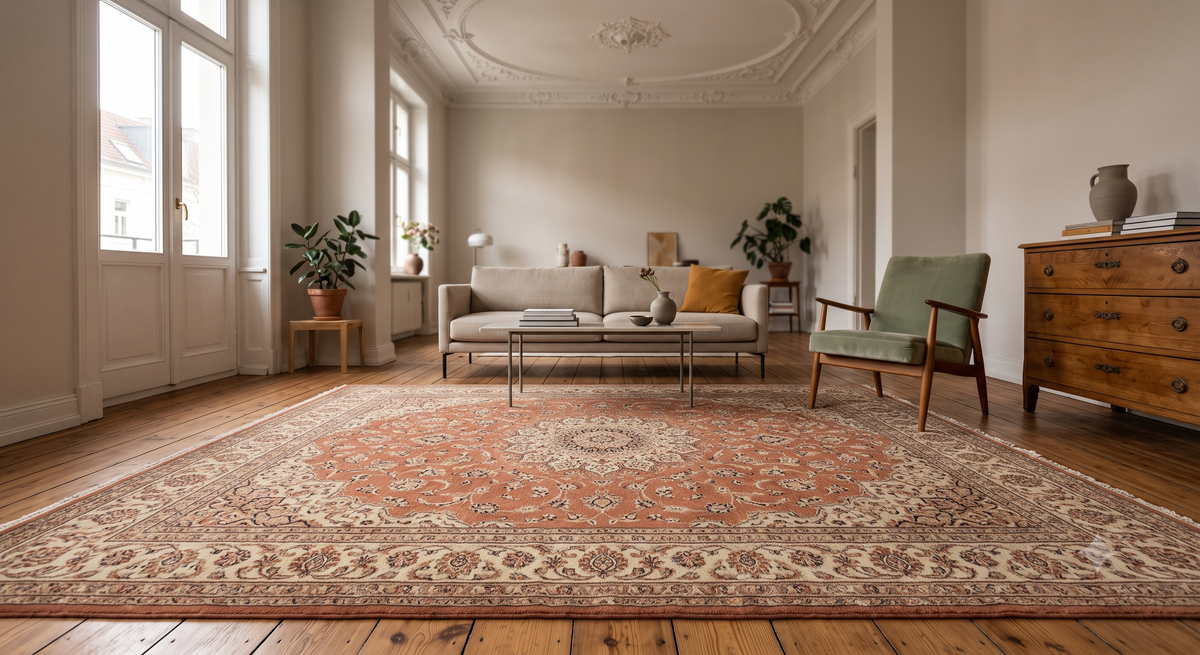
Design is the most obvious difference. Persian rugs are characterized by complex, symmetrical patterns, often featuring central medallions and floral motifs. Moroccan rugs, by contrast, use an abstract, geometric symbolic language with lines, diamonds, and dots, which are often arranged asymmetrically and tell the weaver's personal story.
When you look at a rug, you see more than just a home accessory; you are looking at a canvas filled with cultural narratives. With Persian and Moroccan pieces, these stories could not be more different. A classic Persian rug from a city like Nain or Isfahan is a masterpiece of precision. Its patterns often follow an exact design template, known as a "cartoon". Here, you will find ornate central medallions surrounded by detailed floral tendrils, arabesques, and palmettes. Every knot is planned; every line strives for perfect symmetry and harmony. It is an aesthetic inspired by courtly art and paradise gardens.
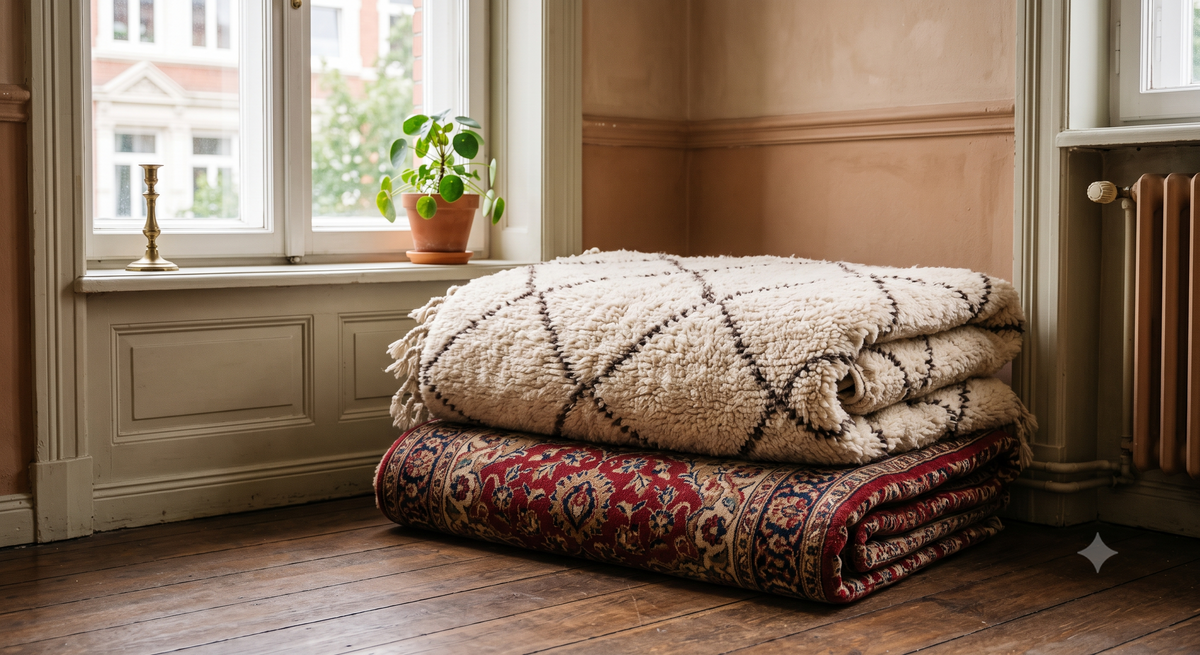
In contrast is the intuitive and deeply personal art of the Moroccan Berber tribes from the Atlas Mountains. Here, there is rarely a fixed plan. The weavers knot from memory and the inspiration of the moment. Their designs are shaped by an archaic, geometric symbolic language: diamonds as protective symbols, zigzag lines representing water and fertility, or simple crosses depicting the eye of the prophet. These patterns are often asymmetrical and might seem simple at first glance, yet they tell the most intimate stories of birth, marriage, nature, and daily life. It is an honest, unfiltered art that comes straight from the weaver's soul.
To make these worlds more tangible, here is a direct comparison:
| Feature | Persian rug (classic) | Moroccan rug (Berber) |
|---|---|---|
| Pattern | Floral, ornamental, medallions, arabesques | Geometric, abstract, symbolic (diamonds, lines) |
| Symmetry | Highly symmetrical and balanced | Often asymmetrical and intuitively designed |
| Level of detail | Very high, fine lines, complex details | Reduced, minimalist, focused on shape and texture |
| Inspiration | Paradise gardens, poetry, courtly art | Tribal life, nature, protective symbols, personal stories |
| Design process | Often knotted according to an exact template (cartoon) | Developed freely and intuitively on the loom |
While you admire a centuries-old, refined art form in the artistic Persian city rugs, with authentic Moroccan Berber rugs you feel the immediate, human connection to the creator.
Material & Feel: Dense Elegance vs. Plush Coziness
The texture and feel are fundamentally different. Persian rugs usually feature a dense, shorter pile made of high-quality virgin wool that feels firm and defined. Moroccan Berber rugs are known for their high, soft, and often shaggy pile, which conveys a sense of warmth and coziness and invites you to walk barefoot. The wool is often thicker and more rustic.
Imagine running your hand across the surface. A Persian rug often feels cool, dense, and velvety. Wool from mountain sheep in the Persian highlands is usually finely spun to allow for the high knot density needed for detailed patterns. The result is a short to medium-high pile that is extremely resilient and allows patterns to stand out clearly. The warp and weft, the foundational structure of the rug, are frequently made of cotton, giving the rug additional stability and allowing it to lie flat and smoothly.
A Moroccan Berber rug is the exact opposite. It is an invitation to take off your shoes and sink your feet into its deep, soft pile. The wool from sheep in the Atlas Mountains is often thicker, coarser, and rich in natural lanolin. This makes the rug not only incredibly soft and warm, but also naturally dirt- and water-repellent. The pile is long, shaggy, and has a lively, almost untamed texture. Traditionally, these rugs were crafted as sleeping mats and protection against the mountain cold; you can still feel this purpose in every single piece today. The foundation is also traditionally made of wool, giving the rug a softer, more flexible structure.
Origin & Knotting Technique: Ancient Traditions Compared
The knotting technique reveals the origin. Persian rugs originate from city workshops, villages, or nomads and often feature a very high knot density (up to over 500,000 knots/m²), woven on vertical looms. Moroccan rugs are the work of Berber tribes from the Atlas Mountains, traditionally knotted on horizontal looms with a lower knot density.
Persian knotting is one of the oldest and most sophisticated arts in the world. In major rug centers such as Tabriz or Kerman, weavers work on large vertical looms. These stationary frames allow tremendous tension on the warp threads, which in turn enables an extremely high knot density. A fine Nain rug can easily exceed 500,000 knots per square meter. This density is the prerequisite for the delicate patterns we admire so much. Yet traditional nomadic rugs from Persian regions, such as those of the Gashgai, also demonstrate supreme craftsmanship, even when created on simpler looms.
The Moroccan tradition is shaped by nomadism. Berber tribes traditionally used horizontal looms that could easily be assembled, dismantled, and transported with the herd. The weaver often sits directly on the already knotted section of the rug. This technique results in a looser weave and charming irregularities in shape and pattern, hallmarks of authentic handcraft. The knot density here is deliberately lower, as the focus is not on draughtsman-like precision, but on warmth and the expressive power of the symbols.
Amin Ipektchi, Co-Founder: "A Persian Nain follows a plan, a centuries-old poetry in knots. A Berber rug, on the other hand, is like a diary. Every 'irregularity' is not a flaw, but an event, a pause, a thought, a story from the weaver. That is what makes it so incredibly human and relatable."
Color Palette & Symbolism: Vibrant Diversity vs. Earthy Tones
Persian rugs are famous for their rich, diverse color palette, often based on natural dyes such as madder red and indigo. The symbolism is profound, telling stories of paradise gardens and poetry. Moroccan rugs mostly rely on a restrained palette of earthy tones like cream, brown, and black, with symbols speaking of protection, fertility, and nomadic life.
The color world of a Persian rug is often a feast for the eyes. Recipes perfected over centuries using natural dyes from plants and minerals create a virtually endless palette of vibrant colors: deep madder red, rich indigo blue, brilliant yellow from saffron or pomegranate rinds. These colors are combined harmoniously to create complex compositions. Each color also carries symbolic meaning deeply rooted in Persian culture and poetry. The natural color variations, also known as Abrash, created by hand-spun wool dyed in small batches, lend the rug added vibrancy and depth.
Moroccan Berber rugs are often more understated and earthy in their coloring. The best-known examples, such as the Beni Ourain, use the natural colors of sheep's wool, ranging from cream and ivory to shades of brown and gray. The patterns are usually knotted with undyed black or dark brown wool. This minimalist palette directs full attention to the rug's texture and the strength of the archaic symbols. Of course, there are exceptions: colorful Boucherouite or Azilal rugs show that Berber weavers also master a bold, vibrant aesthetic, often incorporating recycled fabric scraps.
Our experience as a family business since 1952 shows time and again: whether Persian or Moroccan, the truest beauty lies in the authenticity of the materials and colors.
Which Rug Fits Your Interior Style?
Your interior provides the answer. With its clean geometry and soft texture, a Moroccan Berber rug perfectly complements Scandi, Boho, or minimalist styles. A Persian rug, with its detailed patterns and deep colors, makes a strong statement in classic, eclectic, or maximalist interiors and can serve as the room's central piece of art.
Choosing the right rug is a deeply personal decision that adds the finishing touch to your space. A Moroccan rug is the ideal partner for modern living spaces. In a Scandinavian-style room, its soft, light texture enhances the feeling of hygge. In a Boho interior, it blends seamlessly among rattan furniture, macrame, and lush plants. And in a minimalist room, it becomes a warm, textured counterpoint to clean lines and smooth surfaces, without overwhelming the space with patterns.
A Persian rug, on the other hand, is often the jewel of the room. In a classic setting with antique furniture and rich fabrics, it feels naturally at home. In an eclectic mix of styles, it can serve as a common thread linking different eras and designs. And in a maximalist home, it can be boldly paired with other patterns and colors to create an opulent, sophisticated atmosphere. Even as a deliberate contrast in an otherwise very modern setting, a Persian rug can generate incredible tension and personality.
Put simply: an intricate Persian Tabriz appeals to the mind, while an archaic Berber speaks straight to the heart. If you find it hard to decide, our AR Rug Visualizer is here to help: open the product page on your smartphone, tap "View in your room", and see both options right in your living room. Discover the perfect size for your space and give it a try.
FAQ
Which rug is more durable, Persian or Moroccan? Both are extremely durable with proper care, often lasting for generations. The high knot density of a Persian rug makes it very resistant to wear. At the same time, the thick, naturally lanolin-rich wool of a Moroccan rug makes it incredibly robust and stain-resistant. Longevity ultimately depends on the quality of the craftsmanship and the wool, not on the origin.
Are Moroccan rugs always just black and white? No, although cream-colored rugs with black patterns are the most famous. Many tribes, such as the Azilal or Boucherouite, are renowned for their colorful pieces. These rugs often use vibrant colors and sometimes even recycled textiles, giving them a completely different, lively, and colorful aesthetic. The variety is greater than you might initially think.
Is a Persian rug a better investment? Historically, fine antique Persian city rugs have been considered a very stable investment, especially pieces from famous workshops. However, authentic vintage Moroccan rugs are also steadily gaining value among connoisseurs and collectors. For both, what counts in the end is the quality of craftsmanship, age, condition, and rarity of the design. A well-made piece is always an investment in beauty and durability.
Which rug is easier to care for? Caring for either rug type is very similar and straightforward. Regular vacuuming without a brush attachment and occasional rotation are the essentials. The robust virgin wool of both rug types is naturally dirt-resistant. For thorough cleaning, we always recommend professional hand washing. You can find more about this in our tips for proper rug care.
Can I combine a Persian and a Moroccan rug in the same room? Yes, absolutely! It can look very stylish and shows interior design confidence. The key to success is finding a unifying element. This could be a shared color present in both rugs, or a similar scale of patterns. This 'layering' look, where rugs are placed overlapping one another, creates an exciting, multi-layered, and sophisticated atmosphere in the room.
Whether your heart beats for the poetic artistry of Persia or the honest soul of Morocco, both worlds offer you the chance to enrich your home with a piece of authentic craftsmanship and history. Take a look at our entire collection of unique handmade rugs and find the piece that tells your story. With our AR visualizer, you can experience your favorite directly in your home before you make your decision.