The Qashqai Way of Life: From Summer Pastures to Winter Grounds
TL;DR: The Qashqai way of life is shaped by a semi-nomadic tradition in the Persian Zagros Mountains. Twice a year, they migrate with their herds between the cool summer pasture (Yeylaq) and the warmer winter pasture (Qishlaq). This migration, known as "Il-rah", influences every aspect of their life, especially their world-renowned rug-weaving art crafted on portable looms.
Who Are the Qashqai? A People on the Move
The Qashqai are a confederation of tribes in southwestern Persia, renowned for their nomadic lifestyle and their extraordinary rug-weaving art. Their identity is deeply rooted in the seasonal migration across the Zagros Mountains. This movement is not merely a change of location, but a cultural rhythm that shapes their social structure, their traditions, and their craft.
The Qashqai are not a monolithic people, but an alliance of different tribes with Turkic roots who have forged a shared identity over centuries. Their home is the vast and often rugged landscape of the Zagros Mountains. Here, life is dictated by the seasons, and the community, the extended family, is the foundation of everything they do. Within this structure, women play a central role: they are not only the heart of the family, but also the guardians of the weaving tradition. Knowledge of patterns, techniques, and the art of dyeing is passed down from mother to daughter.
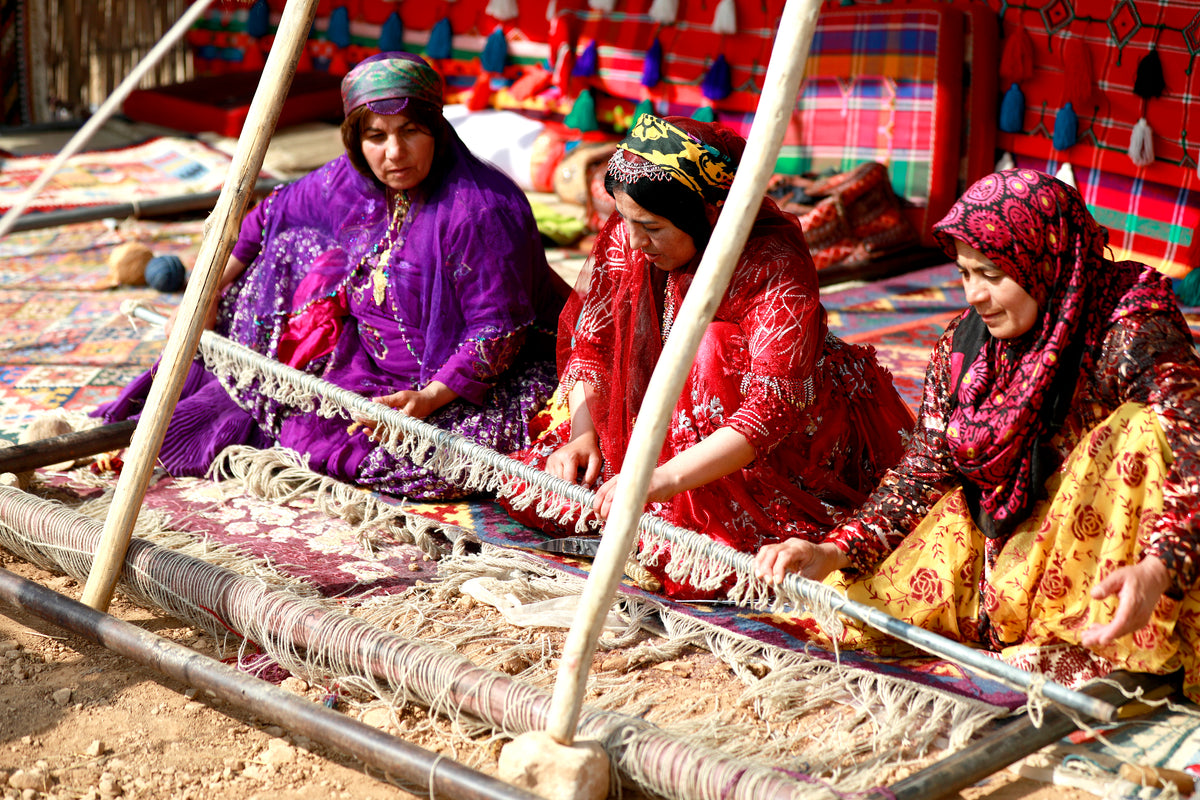
I remember a journey to the Fars region, where I had the privilege of visiting a family in their summer camp. It was fascinating to see how seamlessly daily life and rug making intertwined. While the men tended to the herds, the women sat at the looms outside their tents. A grandmother showed her granddaughter how to tie a specific knot, while the mother next to them spun the yarn for the next section. It was not work in an industrial sense, but an integral part of their everyday life, as natural as cooking or storytelling. In that moment, I understood that each of their rugs is a genuine family portrait. It is this deep connection to heritage that has driven our family history at Rugtales since 1952.
The Great Migration "Il-rah": The Heart of Qashqai Culture
The "Il-rah" is the biannual migration of the Qashqai, spanning hundreds of kilometers. It leads from the warm winter pastures (Qishlaq) near the Persian Gulf to the cool summer pastures (Yeylaq) at higher altitudes in the Zagros Mountains and back again. This demanding journey ensures the survival of their herds and sets the central rhythm of their life.
The "Il-rah", the tribal road, is more than just a path. It is a living tradition and a logistical masterpiece that structures the entire life of the Qashqai. Imagine packing up your entire household, tents, cooking utensils, and looms, and setting out with your family and hundreds of sheep and goats over hundreds of kilometers across rugged terrain. This trek, which often lasts for weeks, follows ancient routes passed down through generations.
The migration is an enormous challenge. The weather can be unpredictable, mountain passes must be crossed, and rivers navigated. Every family member has their role. The journey is a constant balancing act between the welfare of the livestock, which forms the livelihood, and the needs of the family. With many nomadic and village rugs, you can truly feel the energy of this journey. The small irregularities in the pattern or shape are not flaws, but echoes of movement, witnesses to a life that never stays in one place.
Yeylaq vs. Qishlaq: Life in the Summer and Winter Lands
Yeylaq, the summer land, is located in the cool, fertile highlands and is a time of intensive social activity and weaving. Qishlaq, the winter land, is located in the warmer, lower-lying valleys and serves for rest and preparation. The contrast between these two places shapes the materials, the inspiration, and the rhythm of rug making.
The life of the Qashqai is a life of contrasts, perfectly symbolized by the summer land (Yeylaq) and the winter land (Qishlaq). In Yeylaq, upon lush mountain pastures, social life flourishes. Here, there is time for weddings, festivities, and visits between families. The days are long and nature is lush, an inexhaustible source of inspiration for the weavers. The wool sheared here is of the highest quality.
The Qishlaq in the sheltered valleys is quieter. It is a time of regeneration for people and animals alike. Here, tools are repaired, wool is prepared for the upcoming season, and the experiences of the summer are processed. This duality is reflected directly in the rugs. The vibrant colors recall the flower-filled meadows of summer, while the geometric patterns capture the barren, majestic landscape of the mountains. The natural color variations in the yarn, known as Abrash, also arise from this cycle, as the wool is often dyed in smaller batches throughout the season.
| Feature | Yeylaq (Summer Land) | Qishlaq (Winter Land) |
|---|---|---|
| Location | Cool plateaus of the Zagros | Warmer, lower valleys |
| Climate | Mild, fertile, green | Dry, sheltered, mild winter |
| Main activities | Pastoral farming, intensive weaving, celebrations | Rest, repairs, wool processing |
| Social life | Very active, exchange between tribes | Quieter, focus on the immediate family |
| Inspiration | Blooming flora, rich wildlife | Clean lines of the landscape, starry skies |
The Horizontal Loom: Rug Art on the Move
The Qashqai loom is traditionally a horizontal loom that can be easily assembled, disassembled, and transported. In contrast to the heavy, rigid vertical looms of the cities, it is perfectly adapted to nomadic life. This design leads to the characteristic, slightly irregular, and incredibly charming geometries of Qashqai rugs that define their authenticity.
A rug from an urban workshop is knotted on a massive, vertical loom that allows for absolute precision. The Qashqai could never afford this luxury. Their loom had to be as mobile as they were. Therefore, they developed a horizontal loom, essentially two beams anchored to the ground between which the warp threads are stretched. The weaver sits directly on the already knotted section of the rug.
This simple yet ingenious construction has several consequences. First, the loom can be disassembled in a short time, packed onto a pack animal, and reassembled at the next campsite. Second, the tension of the warp threads is harder to keep constant than on a rigid frame. This leads to the charming, minor irregularities in width and shape that distinguish a genuine nomadic rug. They are not flaws, but a certificate of authenticity. Much like with a flat-woven Kelim, the story of the making process becomes part of the final product.
Symbols and Patterns: A Map of the Soul

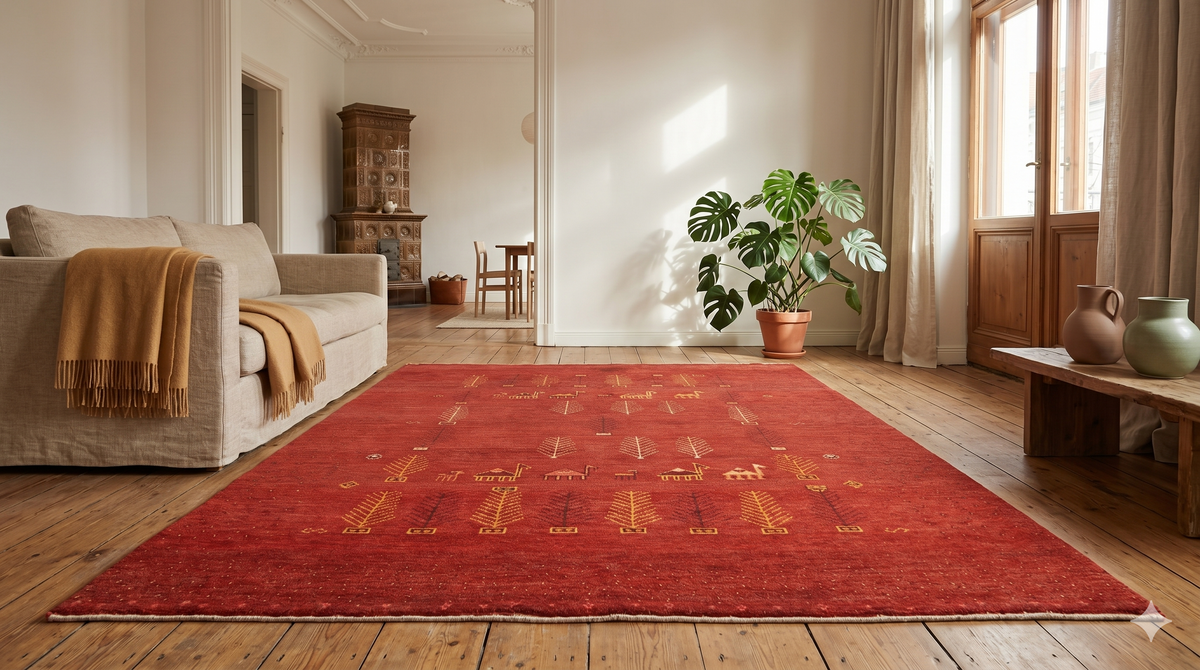
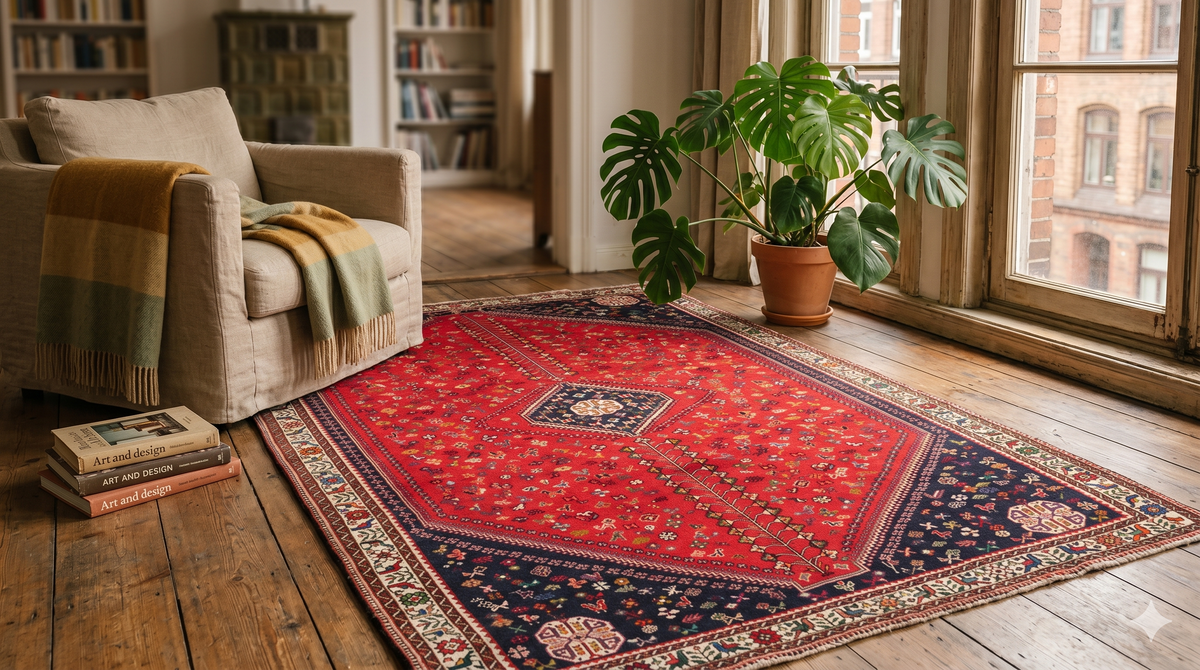
The patterns of a Qashqai rug are not mere ornamentation, but a visual language that tells stories of migration, nature, and tribal life. Animals, plants, and geometric figures symbolize protection, fertility, and events from the weaver's daily life. Every rug is thus a personal diary passed down from generation to generation.
Unlike the often floral and symmetrical patterns of Persian city rugs, the design language of the Qashqai is abstract, geometric, and deeply personal. The weaver usually works without a fixed cartoon or template and draws from a rich repository of traditional symbols that she interprets freely. A stylized animal might represent a predator against which the herd must be protected. A diamond motif can represent an eye warding off evil. The Tree of Life symbolizes the connection between heaven and earth.
The landscape of the migration is the canvas. The rich colors of the summer meadows appear just as vividly as the jagged ridges of the mountain ranges. Every weaver weaves in her own story, her hopes, and her experiences. In this way, every rug becomes a unique piece, a woven map of the soul, and a chronicle of nomadic life. When you browse our collection of Gashgai rugs, try not only to see patterns, but to read the stories behind them.
The Legacy of the Qashqai in the Modern World
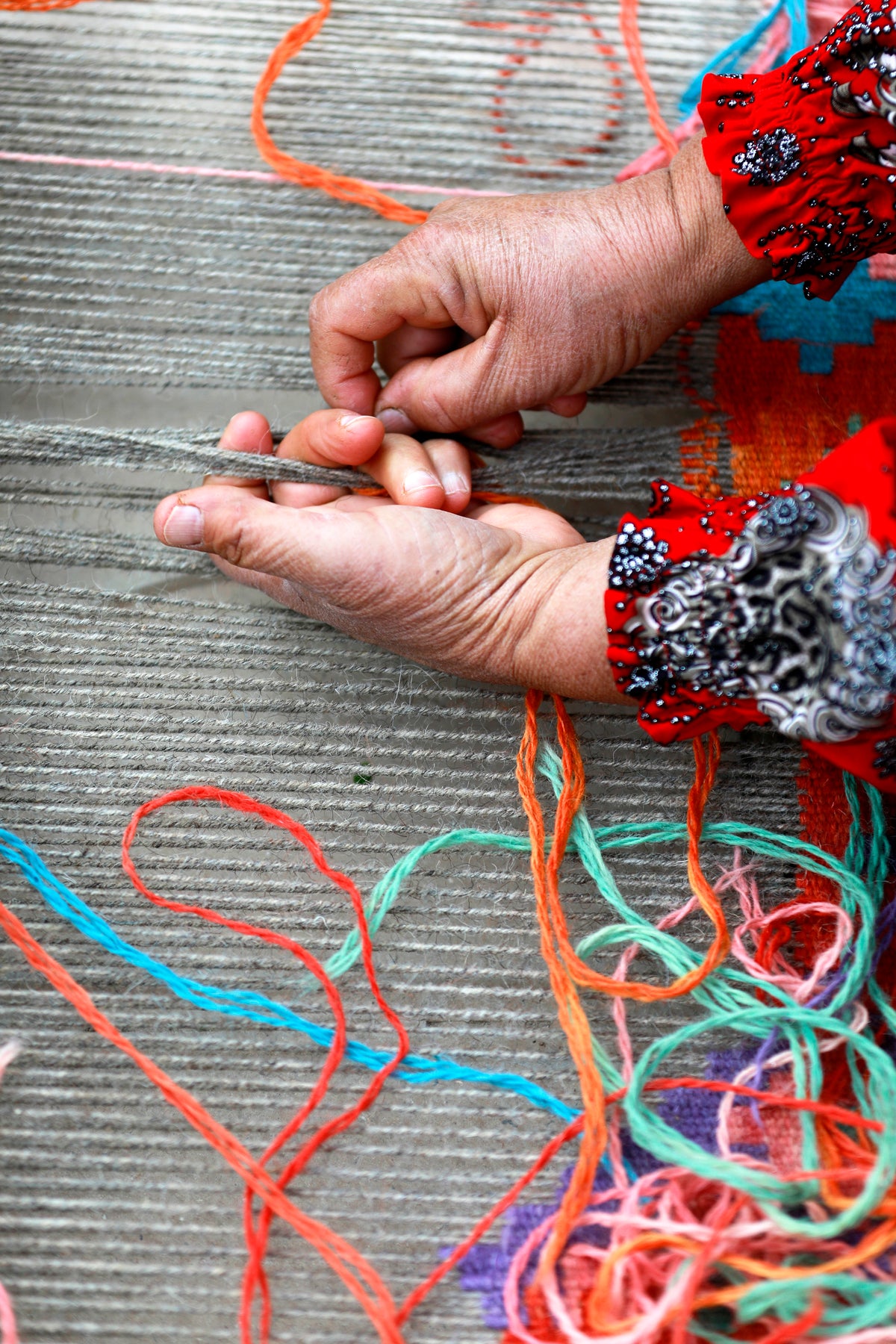
Although the traditional way of life of the Qashqai is changing due to modernization, their cultural heritage lives on in their rugs. Initiatives like CARE & FAIR, to which we are committed, help preserve this unique craftsmanship and secure a fair livelihood for weaving families. Today, a Qashqai rug is more than just a floor covering; it is a piece of living history.
The nomadic way of life of the Qashqai faces major challenges today. Sedentarization, modern borders, and economic pressures are altering their culture. Yet the art of rug weaving remains a strong bond that holds the community together and preserves its identity. For many families, selling their rugs is the primary source of income, allowing them to pass their traditions on to the next generation.
That is why it is so important for us at Rugtales to be partners, not just traders. As a Label STEP Partner and through our commitment to CARE & FAIR, we advocate for fair wages for weavers and for investments in the education and healthcare of their communities. A Qashqai rug in your home is therefore not only an expression of your personal style, but also a contribution to preserving a valuable cultural heritage and a statement for fair trade. It is a piece of living history that brings warmth, character, and incredible depth to any room.
FAQ
What does the name Qashqai mean? Its origin is not conclusively determined, but it is believed that the name derives from a Turkic language. One popular theory suggests it comes from "qasqa at", meaning "a horse with a white blaze", pointing to the importance of horse breeding. Another interpretation is "those who flee", which may reference their storied history of migration.
Do all Qashqai still live as nomads today? No, a significant portion of the Qashqai is now settled or semi-settled in villages and towns along their traditional migration routes. The full nomadic migration is now practiced by only a minority. However, the art of rug weaving is still actively cultivated in the villages and remains an important cultural and economic pillar.
Why are the colors in Qashqai rugs often so vibrant? The luminous colors stem from the traditional use of natural dyes extracted from the flora and fauna of the Zagros Mountains. Madder root yields rich reds, indigo provides deep blues, while yellow is obtained from pomegranate rinds or saffron. These colors reflect the bountiful nature surrounding the weavers on their journey.
How do I recognize an authentic Qashqai rug? Authentic pieces are crafted almost entirely from wool (sometimes with a cotton warp). Look for geometric, stylized motifs rather than photorealistic depictions. Slight irregularities in shape and symmetry stemming from the portable horizontal loom are a strong hallmark of authenticity, as are natural color variations (Abrash) within a field of color.
Are Qashqai and Gabbeh the same thing? Not quite. "Qashqai" refers to the tribal confederation that weaves a variety of rug styles. "Gabbeh" is one of those styles, which is also woven by other tribes such as the Lori. Gabbeh rugs are typically characterized by a thicker, higher pile, more minimalist patterns, and expansive color fields, whereas the term "Qashqai rug" can also encompass finer and more intricate designs.
Every Qashqai rug tells a story of the vast Zagros Mountains, of long migrations, and of life lived in rhythm with nature. When you are ready to bring one of these stories into your home, discover our handpicked selection. With our AR visualizer, you can even see directly on your smartphone how a piece of living history looks within your own four walls.