Should Your Rug Be Smaller or Larger Than Your Sofa?
TL;DR: A rug should always be wider than the sofa, ideally extending 15 to 30 cm on each side. This rule visually anchors the seating area, creates a harmonious island, and makes the room feel larger. A rug that is too small quickly looks lost and disproportionate, noticeably disrupting the room's overall aesthetic.
Why the Rule Is: Always Choose a Rug Wider Than the Sofa
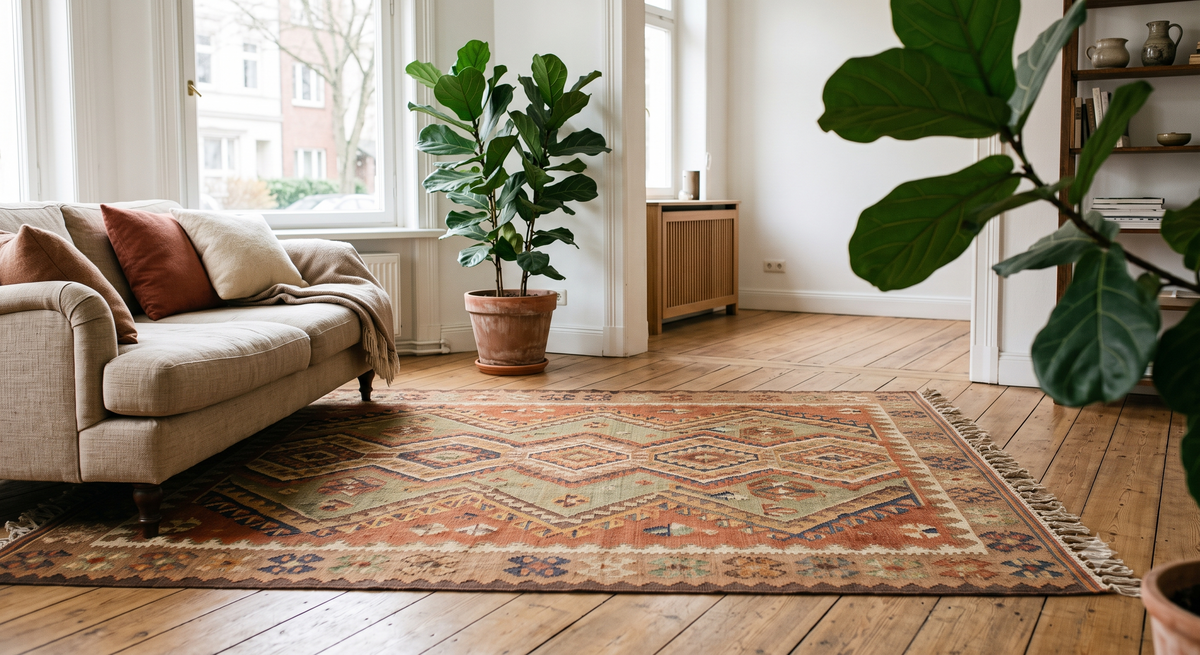
The rule of choosing a rug wider than the sofa serves as a visual anchor. It ties the seating furniture together into a cohesive "island" and creates clear zones within the room. A sufficiently large rug makes the entire arrangement look more generous and well thought out, while a small rug visually pulls the furniture apart.
A living room without a rug often feels incomplete. The furniture seems to float aimlessly in the space. A rug is the foundation that holds everything together. Yet the wrong size can undo this effect. The most important rule of proportion in interior design is therefore: your rug must be wider than your sofa.
Picture your seating group (sofa, armchairs, coffee table) as a single unit. The rug is the stage for this unit. If the stage is too small, the performance feels lost and insignificant. A generous stage, on the other hand, highlights the furniture, gives it a clear place, and creates a defined zone of comfort. This visual anchor brings calm and order to the viewer's eye. It signals: "This is the space to relax, this is where life happens." A rug that is too small, however, fragments the room, making it look restless and smaller than it actually is. For this reason, investing in the right size is one of the most impactful decisions you can make for your home.
Choosing the right size is therefore not merely a matter of taste, but a fundamental design decision. It influences how you perceive the space and how you feel inside it. When you are looking for the right rug for your living room, always start with the width of your sofa as your reference point.
Three Proven Placement Options for Sofa and Rug
There are three common approaches: 1. All furniture sits completely on the rug, ideal for large rooms. 2. Only the front legs of the sofa and armchairs rest on the rug, the most flexible and popular solution. 3. Only the coffee table sits on the rug, usually a compromise suitable only for small rooms.
Once you have internalized the basic rule (rug wider than the sofa), it is all about fine-tuning. How exactly do you place the furniture on the rug? The answer depends on your room size and the desired ambiance. Each option has its own unique effect.
Option 1: All furniture on the rug ("all legs on") This luxurious option requires a very large rug. All furniture pieces in the seating area, including sofa, armchairs, and coffee table, stand entirely on the rug surface. This method is ideal for large, open-concept living spaces, as it clearly defines the living island and creates an opulent, hotel-like aesthetic. The room feels exceptionally tidy and spacious as a result.
Option 2: Front legs on the rug ("front legs on") This is the golden mean and the most popular method for most living rooms. The rug is large enough for the front legs of the sofa and armchairs to rest comfortably on it. This visually connects the furniture to the rug without requiring a huge surface area. This layout creates a harmonious connection, keeps the room feeling airy, and gives you more flexibility whenever you want to rearrange the furniture.
Option 3: No furniture on the rug ("no legs on") Here, only the coffee table sits on the rug, while the sofa and armchairs are placed at a distance around it. This option is risky and works only in very small rooms where a larger rug would feel overwhelming. Most of the time, however, this arrangement leads to the dreaded "postage stamp effect," where the rug looks disconnected and lost.
Here is an overview to help you decide:
| Placement Option | Ideal for... | Effect | Rug Size |
|---|---|---|---|
| All legs on | Large, open-concept living spaces | Luxurious, defining, opulent | Very large |
| Front legs on | Most living rooms | Harmonious, connecting, flexible | Large |
| No legs on | Very small rooms (use caution!) | Minimalist, can feel disconnected | Small to medium |
For a more detailed look at various room layouts, we recommend our comprehensive rug size guide. There you will find even more examples and tips.
The Most Common Mistake: A Rug That Is Too Small and the "Postage Stamp Effect"
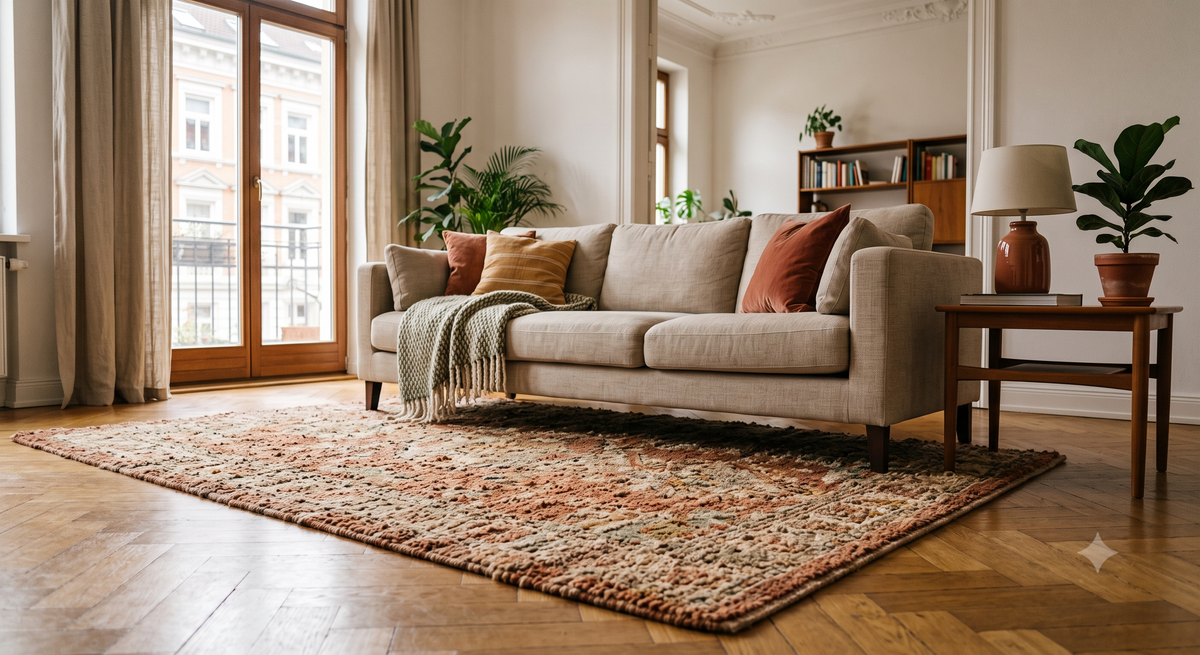
A rug that is too small, sitting lost in front of the sofa, is often referred to as a "postage stamp rug." It fails to connect the furniture and makes the space look unfinished and smaller. This mistake disrupts proportions and diminishes the cozy atmosphere instead of enhancing it. Investing in the right size is always worth it.
The "postage stamp effect" is the classic decorating mistake that can make even the most beautiful room feel discordant. It happens when a rug is so small that it sits like an isolated island among the furniture. It touches neither the sofa nor the armchairs, failing to create any visual connection. The result is a fragmented overall look where every piece of furniture stands on its own. Instead of fostering warmth and coziness, such a rug generates a subtle sense of restlessness.
A familiar sight: a living room feels unfinished despite lovely furniture, simply because a petite Kelim sits in front of a generous sofa. A larger rug wide enough to slip beneath the front feet of the sofa brings the whole setting together. That is the transformative power of the right size: it completes the room.
A rug that is too small makes the room look not only unfinished, but also smaller. The eye perceives the edges of the rug as boundaries. When this boundary is far from the walls and disconnected from the furniture, the perceived living area shrinks. A generous rug, on the other hand, which unifies the furniture, visually expands the space. So don't hesitate to go bold. When in doubt, the larger option is almost always the better choice. Explore our selection of large rugs to avoid this mistake right from the start.
Guide: How to Measure the Perfect Rug Size for Your Sofa
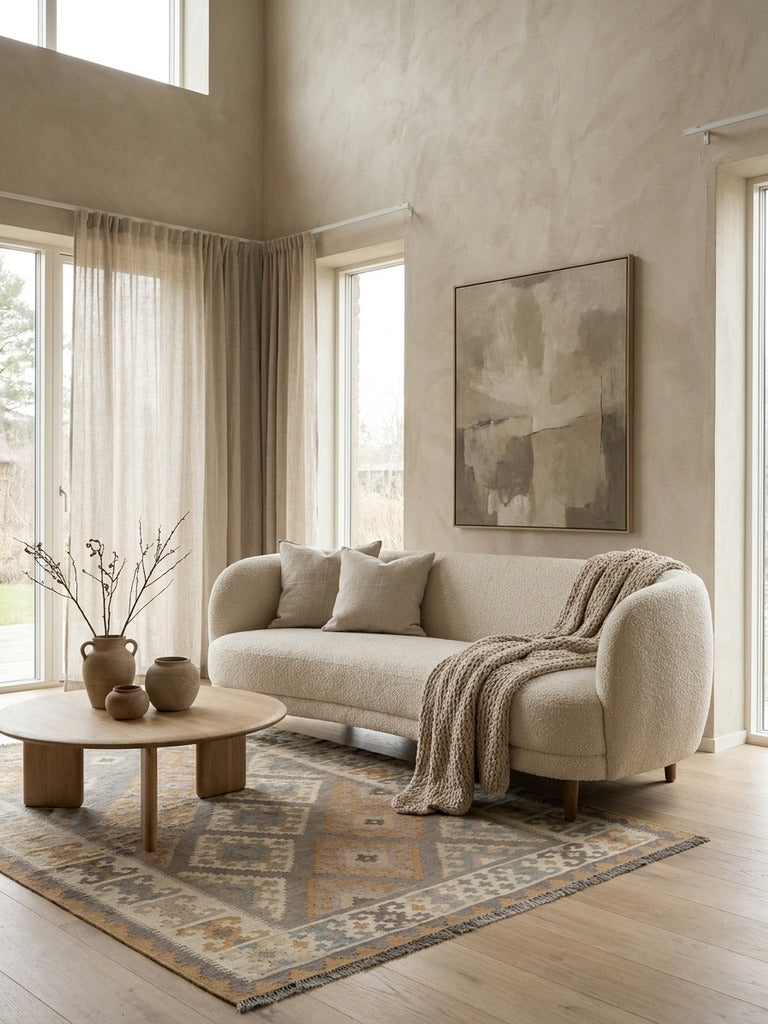
First, measure the exact width of your sofa. Then add 15 to 30 centimeters on each side to determine the ideal rug width. Mark out this area on the floor with painter's tape to get a feel for the surface. In addition, use our AR visualizer to place different rugs virtually in your room.
The theory is clear, but how do you find the exact dimensions for your home? With these four simple steps, you can determine the perfect rug size that will transform your living room.
Step 1: Measure the sofa Take a tape measure and measure the full width of your sofa, from the outer edge of one armrest to the outer edge of the other. Note down this measurement. This is your absolute minimum width for the rug.
Step 2: Calculate the overhang Now add the crucial overhang. For a balanced look, there should be at least 15 cm on each side, ideally 25 to 30 cm. Formula: sofa width + 30 cm (minimum) = ideal rug width Example: your sofa is 200 cm wide. Your minimum rug width is 230 cm. An even better choice would be a rug around 250 cm wide.
Step 3: Visualize the area Numbers are abstract. To get a true feel for the size, simulate the rug on your floor. Use painter's tape or lay out newspaper sheets to mark the calculated dimensions on your parquet or tile floor. Live with it for a day and notice how the area feels. Does it work with your walkways? Does it feel right?
Step 4: Test digitally with the AR visualizer The final step gives you total confidence. With our AR visualizer on the Rugtales website, you can place our rugs virtually in your own living room. Simply open the product page of your favorite rug on your smartphone, click the "View in your room" button, and point your camera at the floor. You will immediately see how the size, colors, and pattern look in your actual space. Especially for XXL rugs for large living rooms, this step is worth its weight in gold.
Special Cases: The Right Rug Size for Sectionals and Open-Concept Living Spaces
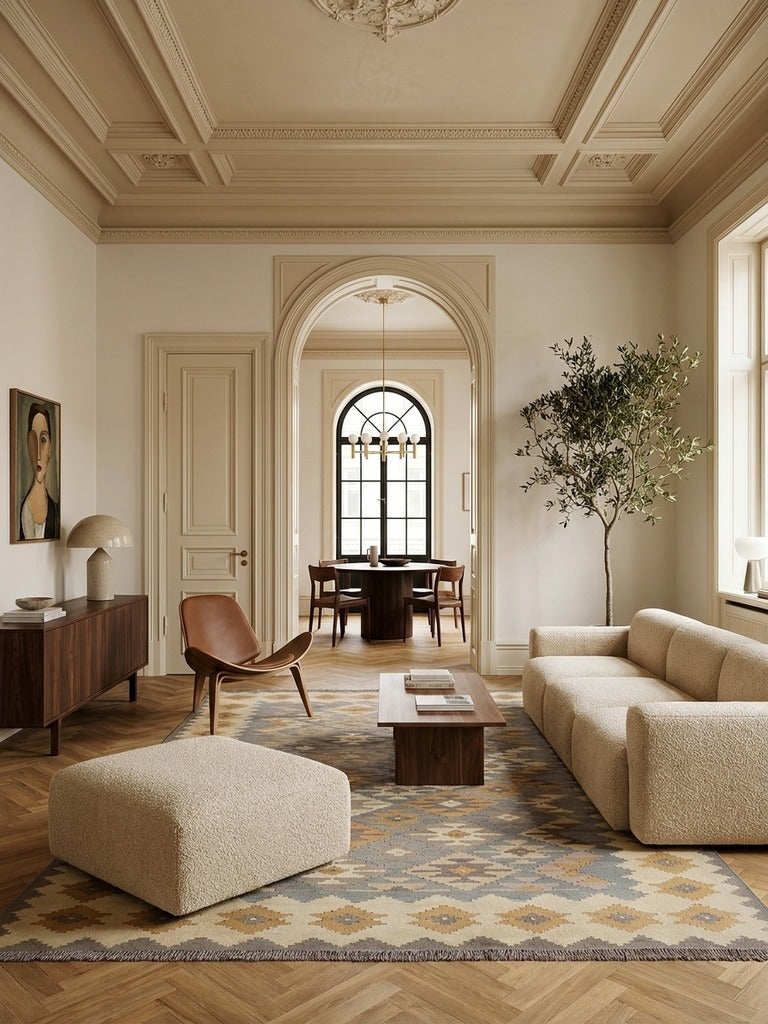
For a sectional sofa, the rug should be large enough to fit under the front legs of both sections and echo the L-shape. In open-concept spaces, a large rug is essential to clearly set the living area apart from other zones like the dining area or kitchen, creating a cozy, defined island.
Not every living room features a classic two- or three-seater sofa. Sectionals, modular sofas, and open floor plans place special demands on rug sizing. Yet the same principles of visual anchoring apply here as well.
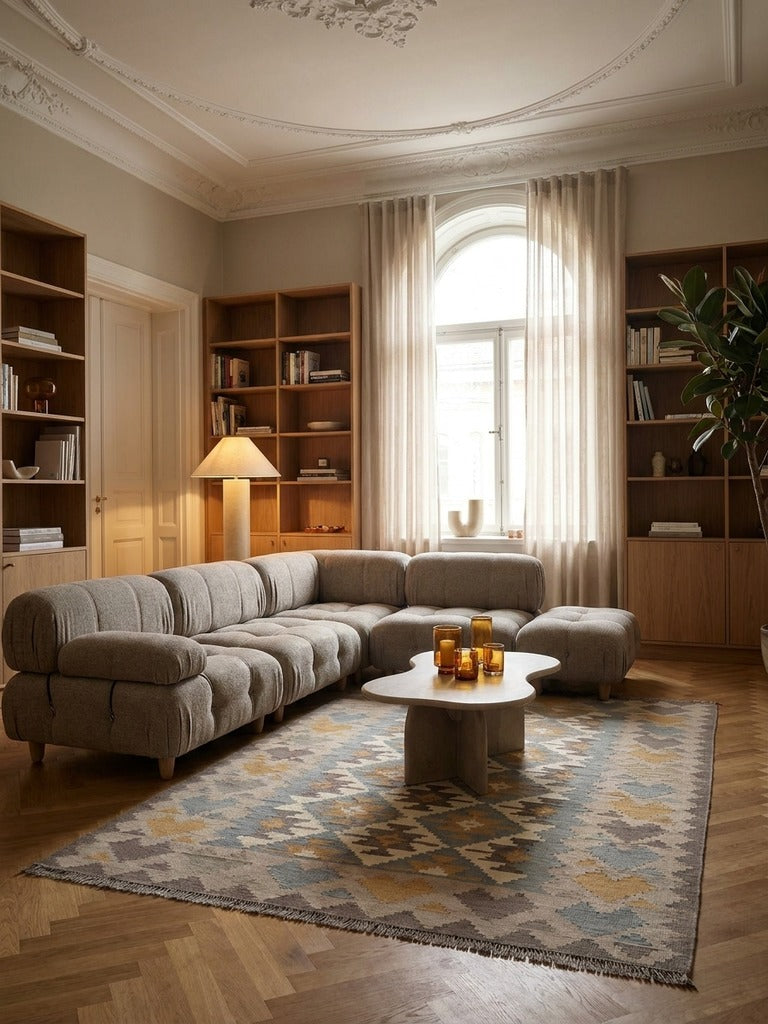
Rugs for sectionals and modular sofas With an L-shaped sofa, it is crucial that the rug is large enough to underpin the entire shape. It should reach under the front legs of both sections of the sofa. Ideally, the rug complements the L-shape and extends 15 to 30 cm beyond the outer edges. A rug that is too small, sitting only in front of part of the sofa, would disrupt the unity of the seating arrangement. Therefore, choose a generous rectangular format that brings the entire seating area together as a unified whole.
Rugs in open-concept spaces In modern lofts or open living-dining areas, rugs are not merely decorative, but essential architectural tools. Here, a large rug serves to clearly define zones. It visually separates the cozy living space from the dining area or kitchen without the need for walls. In this case, following the "all legs on" or at least the "front legs on" rule is all the more important. The rug creates an island of comfort and gives structure to the room. A small rug would get lost in the expansiveness of the space and fail in its organizing role. Exploring different rug types can help you find the right style for your defined zone and discover more about our family story and the tradition behind each piece.
Where the rug sits exactly, whether only the front legs or all furniture pieces rest on it, is explained in our guide Placing a Rug in Front of the Sofa.
FAQ
What is the minimum size for a rug under the sofa? The absolute minimum is a width that allows the front legs of the sofa to rest comfortably on it, while still leaving about 15 cm of the rug extending on both sides. Anything smaller risks looking disproportionate and lost, failing to connect the furniture properly.
Can a rug also be too large? Yes, that is possible. A rug is too large if it covers almost the entire floor from wall to wall. A border of the original flooring of at least 30 to 45 cm should always remain visible. This "frame" prevents the room from feeling cramped and looking like it has wall-to-wall carpeting.
Should the rug go under the entire sofa or just in front of it? It does not necessarily have to go under the entire sofa. The most important rule is that it reaches at least under the front legs to create a visual connection. Sliding it completely under the sofa is an aesthetic choice that works especially well in very large rooms, but it is not a must.
What shape should the rug in front of a sofa have? In the vast majority of cases, a rectangular rug is the best choice, as it complements the linear shape of the sofa and provides calm geometry. Round rugs can create an intriguing contrast, but they work best in specific situations, such as with a curved seating arrangement or in an architecturally distinct area like a bay window.
Does the 'wider than the sofa' rule also apply to a two-seater? Absolutely. The principle of visual proportions applies universally, regardless of sofa size. Even a small two-seater benefits enormously from a rug that is slightly wider. It anchors the smaller piece of furniture in the room and makes it look more intentional and present, rather than lost.
As you can see, choosing the right rug size is the key to a harmonious and inviting living room. Now you are ready to put theory into practice. Measure your sofa, play with the placement options, and find the piece that completes your space. Browse through our living room rug collection and use our AR visualizer to test your favorite directly in your home.