What Does Hand-Knotted Mean? And How Does It Differ From Machine-Woven?
TL;DR: A hand-knotted rug is a unique work of art in which every single knot is tied by hand, a process that can take months. In contrast, machine-woven rugs are produced quickly and uniformly on power looms, often from synthetic fibers. The true difference lies in the soul, durability, and perfect imperfections of authentic craftsmanship.
The Art of Hand-Knotting: One Knot at a Time
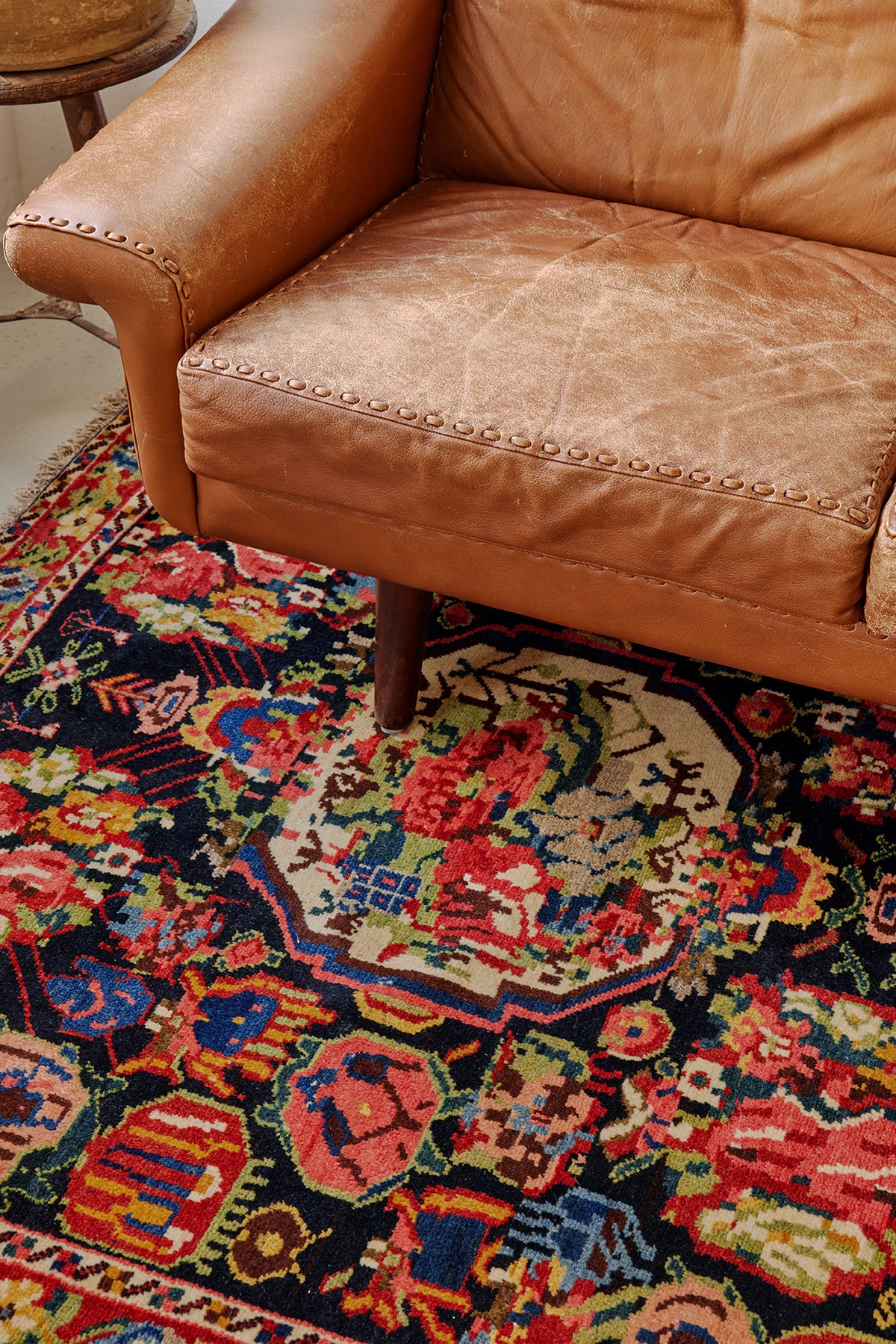
Hand-knotting is a traditional art form in which weavers loop yarn, strand by strand, around the warp threads of a loom to create a dense pile. This manual process, which uses Persian or Turkish knots, takes weeks to months and gives each rug a distinctive character reflected in subtle irregularities and the depth of the material.
The creation of a hand-knotted rug is an act of patience and devotion. Everything begins on a loom where vertical threads, the warp, are strung under tension. Most often, this warp is made of robust cotton that gives the rug its structural stability. Then the true magic begins: the weaver takes a short strand of yarn, often hand-spun virgin wool from the Persian highlands, and loops it around two warp threads to tie a knot. After each row of knots, a horizontal weft thread is inserted and beaten down firmly to secure the row.
Two main types of knots shape the rug world: the asymmetrical Persian knot (Senneh) and the symmetrical Turkish knot (Ghiordes). The Persian knot is more open, allowing for finer, more curvilinear patterns, while the Turkish knot is firmer and more block-like, ideal for geometric designs often found in nomadic and village pieces.
The materials are as honest as the craft itself. We rely on highland virgin wool, whose high lanolin content makes it naturally stain-resistant and exceptionally resilient. Cotton for the warp ensures shape stability, and in particularly fine city rugs, silk is sometimes used to highlight details and create an incomparable luster.
Amin Ipektchi, Co-Founder: "When you run your hand across the surface of a hand-knotted rug, you do not just feel wool. You feel thousands of hours of concentration and the history of a family that has passed down its knowledge across generations. Every small irregularity is the weaver's signature; to me, that is where the true value lies."
The time required is immense. A skilled weaver ties perhaps 8,000 to 10,000 knots per day. For a medium-sized rug with 500,000 knots, that means months of demanding work. Each of these art pieces tells its own origin story.
Machine-Woven Rugs: Precision Without Personality
Machine-woven rugs are manufactured at high speed on computer-controlled power looms. This process guarantees a flawless, identical pattern, but frequently uses synthetic materials such as polypropylene or polyester. They lack the structural integrity and unique texture of their hand-knotted counterparts, which is reflected in their shorter lifespan.
The manufacture of a machine-woven rug is an industrial process designed for efficiency and speed. Large, computer-controlled weaving machines, known as power looms, produce these rugs in just a few hours. Instead of tying knots individually around the warp threads, yarns are shot through the warp by machine and often secured with a layer of latex or adhesive on the back.
The result is absolute perfection. Every line is straight, every pattern is precisely symmetrical, and every rug in a production run is an identical copy. What appears to be an advantage at first glance turns out to be the greatest disadvantage on closer inspection: it lacks the human touch, the soul.
The choice of materials is also fundamentally different. While natural fibers dominate in hand-knotted rugs, machine-woven alternatives are frequently made from synthetic fibers like polypropylene, viscose, acrylic, or polyester. Although these materials are inexpensive to manufacture, they feel different, do not age gracefully, and are far less durable. They tend to mat down, and thorough cleaning is often difficult.
| Feature | Hand-Knotted Rug | Machine-Woven Rug |
|---|---|---|
| Manufacturing | By hand, knot by knot | By machine, on power looms |
| Time Required | Months to years | A few hours |
| Materials | Wool, cotton, silk (natural) | Polypropylene, polyester (synthetic) |
| Backside | Mirror image of the pattern, individual knots visible | Rigid grid, often coated with latex |
| Fringes | Part of the warp, integral component | Usually sewn on afterwards |
| Pattern | Subtle, human irregularities | Perfectly symmetrical, identical copies |
| Durability | Generations | A few years |
How to Spot the Difference: The Rugtales Check

Turn the rug over: a hand-knotted rug displays a mirror-image, slightly irregular pattern of knots on the back. With a machine-made piece, you see a rigid grid. The fringes on a hand-knotted rug are the actual ends of the warp threads, whereas on a machine-made rug, they are almost always sewn on after production.
With a few practiced steps, you can quickly tell whether you are looking at an authentic artisanal piece or a mass-produced item. Simply follow our checklist.
1. Look at the back: This is the most crucial test. On a hand-knotted rug, the back is essentially the negative of the front. You can see the individual rows of knots, and they will show subtle irregularities, sometimes slightly denser, sometimes slightly looser. That is the signature of the weaver. On a machine-woven rug, you see a very uniform, almost computer-generated grid of weft threads holding the pile fibers in place.
2. Inspect the fringes: On an authentic hand-knotted rug, the fringes are not decoration, but a fundamental part of its structure. They are the ends of the warp threads that run through the entire rug. Pull gently on a fringe; you will see that it is firmly anchored in the weave. On machine-made rugs, the fringes are almost always sewn on as a separate strip to mimic this look. You can often spot a seam where they are attached.
3. The edges (Schirasi): The long sides of a rug are called Schirasi. On a hand-knotted piece, these edges are bound by hand with yarn to protect the outer warp threads. This wrapping is sturdy, yet often slightly uneven. Machine rugs have a machine-sewn, very uniform, and often thin edge.
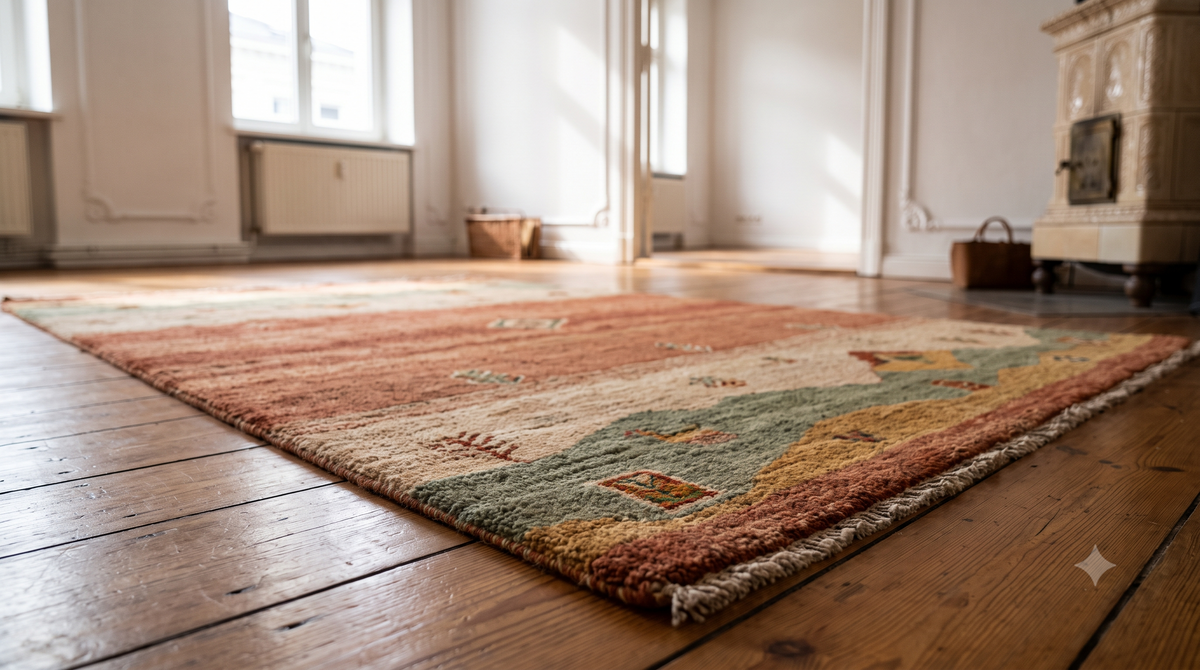
4. The perfection of imperfection: Lay the rug out flat and inspect the pattern and colors closely. A hand-knotted piece thrives on its small variations. The lines may not be 100% straight, and the colors may display subtle tonal shifts. These characteristic color gradients, known as Abrash, occur due to different dye batches of yarn and serve as a hallmark of authenticity.
If you are unsure about an inherited rug, turn it over and run your fingers across the back: on a hand-knotted piece, you will feel tiny, distinct knots. Hand-wrapped selvedges along the sides are another unmistakable sign.
If you are unsure about your selection, it also helps to determine the right rug size for your room to showcase the full impact of an authentic piece.
Value, Longevity, and Sustainability: Why Handcraft Wins
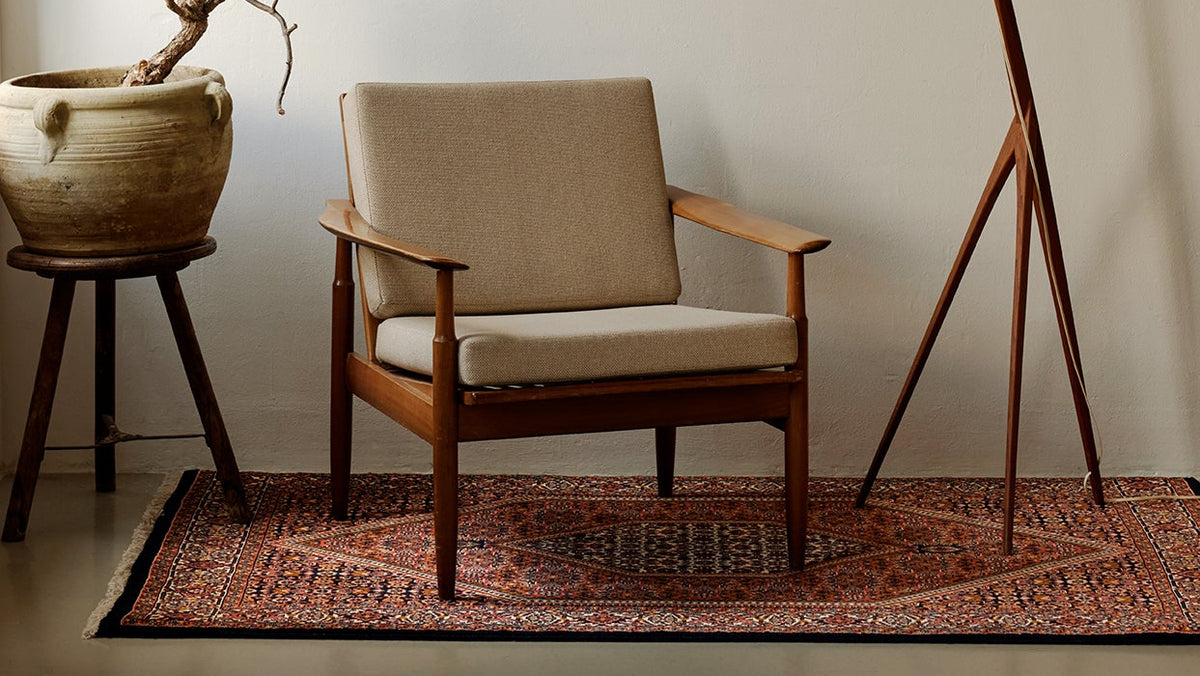
A hand-knotted rug is an investment that can endure for generations. Its value often appreciates over time. It is crafted from natural, renewable raw materials and directly supports weaving communities through fair trade practices such as STEP and CARE & FAIR. Machine rugs, by contrast, are often disposable items with a short lifespan.
A machine-woven rug might seem more affordable initially, but true economy reveals itself over the years. A hand-knotted rug made from premium virgin wool is virtually indestructible when properly maintained. It does not merely survive relocations, playing children, and everyday life; it actually develops a lovely patina over time. Many of the pieces in our collection of unique rugs are already several decades old and more beautiful than ever.
This longevity also makes them a sustainable choice. Rather than replacing a synthetic rug every few years that ends up in a landfill, you invest in a piece that accompanies you for a lifetime. The materials used, wool, cotton, are renewable resources. The dyes often originate from natural sources such as plants and minerals.
In addition, behind every hand-knotted rug lies a human story and an ethical value chain. As a Label STEP Partner and through our dedication to CARE & FAIR, we are committed to ensuring weavers receive fair pay, work under good conditions, and their children have access to education. Your purchase directly supports the preservation of a centuries-old craft and the communities that keep it alive. Learn more about this on our About Us page.
A hand-knotted rug is far more than an interior furnishing. It is a piece of culture, a testament to human creativity, and an investment in lasting value.
FAQ
Is a hand-knotted rug always more expensive? Yes, the initial purchase price is generally higher due to the immense manual labor involved and the premium natural materials. However, considering a lifespan that often exceeds 50 years compared to only a few years for a machine-made rug, it is frequently the more economical and sustainable investment over the long term.
How long does a genuine hand-knotted rug last? With proper care, a high-quality hand-knotted wool rug can easily endure for 50 to 100 years or longer. Many pieces are passed down through generations as family heirlooms. Their robust structure, based on genuine knots, makes them exceptionally resistant to wear.
Are the fringes on a hand-knotted rug always authentic? Yes, on an authentic hand-knotted rug, the fringes are always the extended warp threads of the foundation. They are an integral structural element rather than a decorative trim sewn on after weaving. This is one of the most reliable features to distinguish genuine handcraft from machine imitations.
Why are patterns on hand-knotted rugs sometimes uneven? These "imperfections" are the charming marks of genuine handcraft. They arise from the individual hand of the weaver, slight variations in yarn tension, or the use of hand-spun yarn that varies in shade (Abrash). It is precisely these details that make each rug an unmistakable one-of-a-kind treasure.
Can you wash a hand-knotted rug? Yes, but never in a household washing machine. Professional, traditional hand washing is the proper method. Through our cleaning and repair service, together with long-standing partner workshops, we offer an organic wash specifically tailored to natural fibers to gently remove dirt, revitalize colors, and ensure the rug's longevity.
Are you ready to explore the world of genuine handcraft? Every piece in our collection tells its own story. Find the rug that tells yours. With our AR visualizer ("View in your room"), you can even see directly on your smartphone how each unique piece looks in your space. Discover the variety in our collection of hand-knotted rugs.